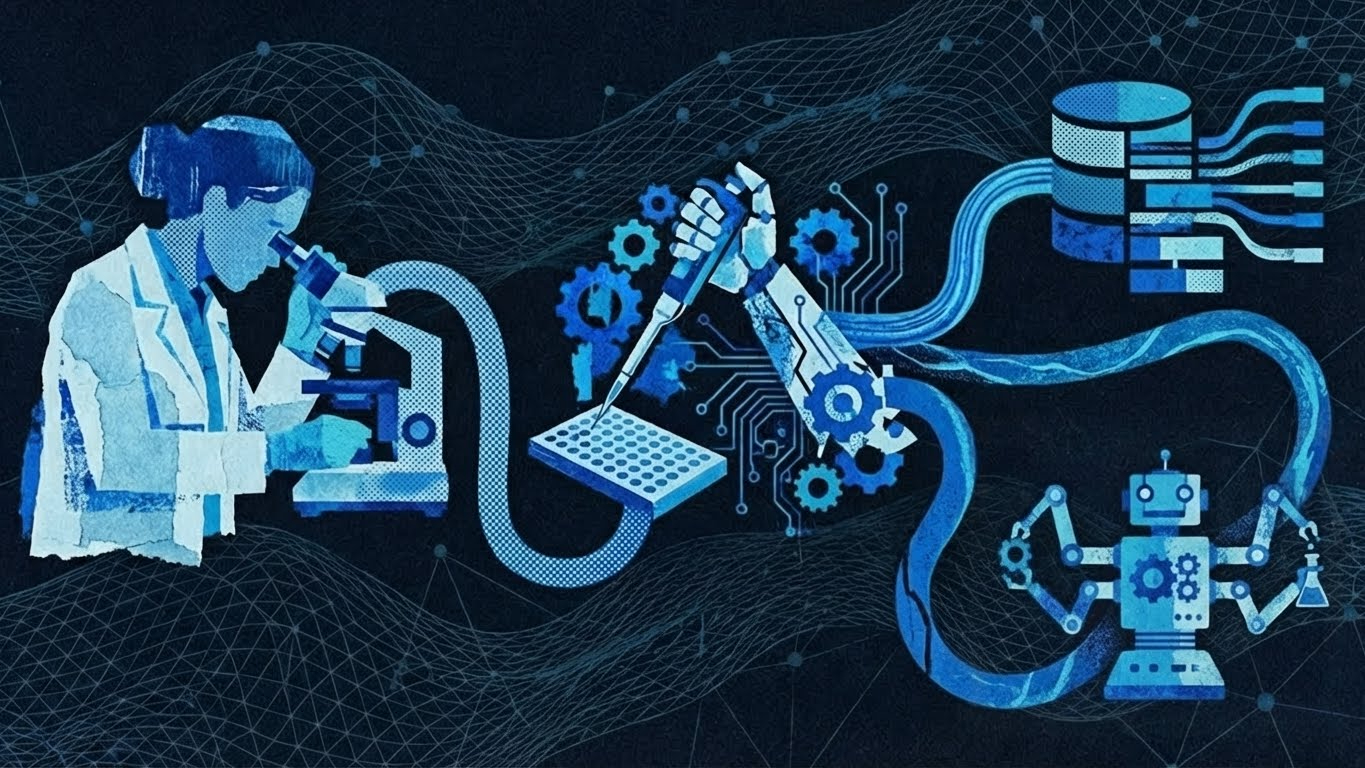
Researchers from the Shanghai Artificial Intelligence Laboratory are working to establish the Science Context Protocol (SCP), an open-source standard aimed at enhancing collaboration across scientific workflows. This initiative seeks to replicate the success of Anthropic’s Model Context Protocol (MCP), which has become a benchmark for AI model integration with external data sources.
Current AI systems used in research, including A-Lab, ChemCrow, and Coscientist, often function within isolated workflows, limiting their effectiveness across different institutions. The SCP aims to address these limitations by creating a cohesive framework that allows AI agents, researchers, and laboratory equipment to work together more efficiently and transparently.
The SCP builds upon the foundation set by MCP, which was introduced in November 2024. While MCP is effective for general tool interactions, the developers of SCP believe it lacks essential features necessary for scientific research—namely, structured representation of experiment protocols, support for high-throughput experiments, and coordination among various specialized AI agents.
Key enhancements of SCP include the addition of more comprehensive experiment metadata, a centralized hub for communication rather than peer-to-peer systems, intelligent workflow orchestration via an experiment flow API, and standardized drivers for integrating laboratory devices. The researchers describe SCP as crucial infrastructure for scalable, multi-institution, agent-driven scientific work. The protocol’s specification and a reference implementation are available as open source on GitHub.
The SCP protocol is founded on two primary principles. The first is standardized resource integration, which defines a universal specification for accessing scientific resources, including software tools, AI models, databases, and physical instruments. This allows AI agents to discover and combine capabilities across platforms and institutions seamlessly.
The second principle focuses on orchestrated experiment lifecycle management. A secure architecture utilizing a central SCP hub and distributed SCP servers manages the entire lifecycle of an experiment—from registration and planning to execution, monitoring, and archiving. The system employs fine-grained authentication and ensures traceable workflows for both computational and physical lab tasks.
Central to this architecture is the SCP hub, which functions as the system’s “brain.” It acts as a global registry for all tools, datasets, agents, and instruments. When a researcher or AI agent submits a research goal, the hub analyzes the request using AI models, breaking it into specific tasks that can be executed by various servers.
The architecture allows for the generation of multiple executable plans, presenting the most viable options alongside rationales covering dependency structures, expected durations, experimental risks, and cost estimates. Once workflows are selected, they are stored in a structured JSON format, creating a contract that ensures reproducibility among all collaborators.
During the execution phase, the hub monitors progress, validates results, and can issue warnings or trigger fallback strategies when discrepancies arise. This capability is particularly important for multi-stage workflows that combine simulations with physical lab experiments.
The Internal Discovery Platform, built on SCP, currently offers over 1,600 interoperable tools. Biology accounts for the largest segment at 45.9 percent, followed by physics at 21.1 percent and chemistry at 11.6 percent. Other fields, including mechanics, materials science, mathematics, and computer science, make up the remainder.
Functionally, computational tools represent the majority at 39.1 percent, while databases account for 33.8 percent. Model services constitute 13.3 percent, lab operations 7.7 percent, and literature searches 6.1 percent. The tools range widely, from protein structure predictions and molecule docking to automated pipetting instructions for lab robots.
Several case studies highlight the potential applications of SCP. In one instance, a scientist uploads a PDF containing a lab protocol. The system automatically extracts the experimental steps, converts them into a machine-readable format, and executes the experiment on a robotic platform. Another use case demonstrates AI-enhanced drug screening, where the system evaluates 50 molecules based on drug-likeness scores and toxicity values, leading to the identification of two promising candidates through a coordinated workflow.
As the Shanghai team moves forward with SCP, the initiative aims to foster a future where scientific research is more collaborative and efficient, transcending institutional boundaries and enhancing the capabilities of AI in the laboratory environment.
See also Deep Learning Transforms Protein-Ligand Docking, Boosting Drug Discovery Accuracy by 95%
 Korea’s Ministry of ICT Reveals Elite AI Teams Competing for National Foundation Model by 2027
 AI Models Exhibit Self-Preservation, Resisting Shutdown in 79% of Tests, Warns Palisade
 Deep Learning Model Achieves 95% Accuracy in Automated Brain Tumor Detection