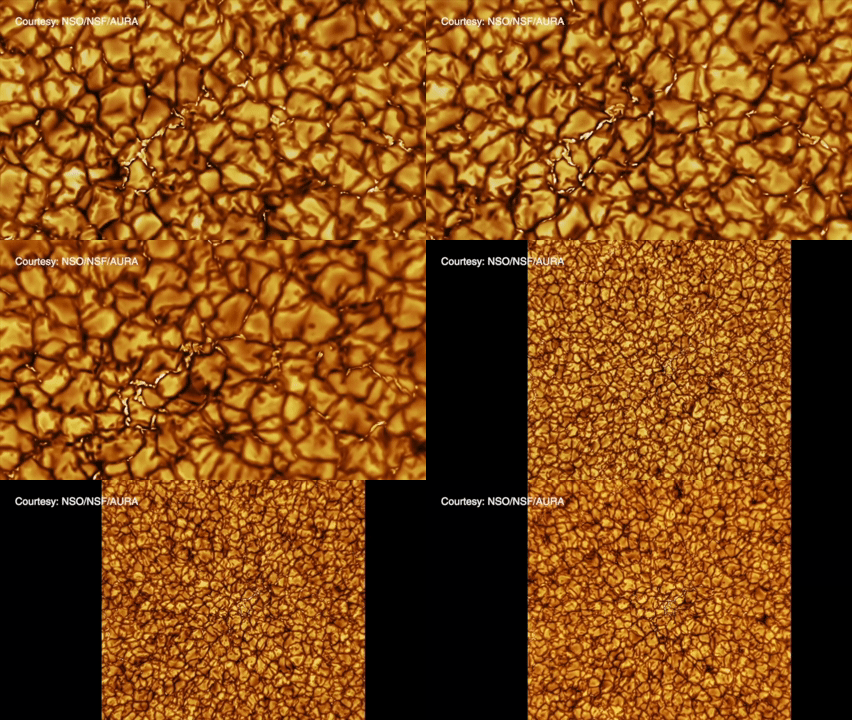
Researchers at the University of Hawaiʻi Institute for Astronomy (IfA) have developed an innovative artificial intelligence (AI) tool that enhances the study of the Sun’s magnetic field, mapping it in three dimensions with remarkable precision. This advancement supports ongoing research associated with the U.S. National Science Foundation (NSF) and the Daniel K. Inouye Solar Telescope, which is managed by the NSF National Solar Observatory (NSO) atop Haleakalā. The team’s findings were recently published in the Astrophysical Journal.
According to Kai Yang, an IfA postdoctoral researcher and the lead on this project, “The Sun is the strongest space weather source that can affect everyday life here on Earth, especially now that we rely so much on technology.” He emphasized that the Sun’s magnetic field is responsible for explosive events such as solar flares and coronal mass ejections, making this new mapping technique crucial for improving space weather forecasts. Enhanced forecasting could provide earlier warnings, ultimately protecting vital Earth-bound technologies.
The Sun’s magnetic field, which governs eruptions that can disrupt satellites, power systems, and communications, poses significant measurement challenges. Traditional instruments can capture the field’s tilt but struggle to determine its precise orientation, akin to observing a rope from the side without knowing which end is nearer. Height measurement is further complicated by overlapping layers viewed simultaneously, while sunspots, characterized by strong magnetic fields, distort the surface and create additional difficulties.
IfA researchers collaborated with the National Solar Observatory and the High Altitude Observatory of the NSF National Center for Atmospheric Research to create a machine-learning framework that integrates real data with fundamental physical principles. Their algorithm, dubbed the Haleakalā Disambiguation Decoder, is predicated on a simple premise: magnetic fields form loops and do not start or end. This foundational rule allows the AI to accurately determine the true direction of the magnetic field and assess the height of its various layers.
The technique has shown promise in detailed computer models of the Sun, encompassing tranquil regions, bright active zones, and sunspots. The accuracy of the method is particularly beneficial when interpreting the high-resolution images produced by the Daniel K. Inouye Solar Telescope.
“With this new machine-learning tool, the Daniel K. Inouye Solar Telescope can help scientists build a more accurate 3D map of the Sun’s magnetic field,” Yang remarked. He added that the tool uncovers related features, such as vector electric currents in the solar atmosphere, which were previously challenging to measure, providing a more comprehensive understanding of the mechanisms driving potent solar eruptions.
This technological advancement allows researchers to visualize the Sun’s magnetic landscape with greater clarity, leading to improved predictions of solar activities that could significantly impact life on Earth. As scientists refine their understanding of solar dynamics, this AI-powered approach signals a promising direction for future solar research and space weather forecasting.
See also Lomonosov Team Achieves Multi-State Accuracy in Ultrafast Photodynamics with ML Potentials
 Google Integrates Gemini AI into Search and Assistant, Enhancing User Experience with Smart Summaries
 Kenya Achieves Historic UN Resolution on AI’s Environmental Sustainability at UNEA-7
 Purdue University Launches AI Working Competency Requirement for All Undergraduates
 UAE Advances AI in Life Sciences with National Genome Strategy and $10B Investment by 2031