






















































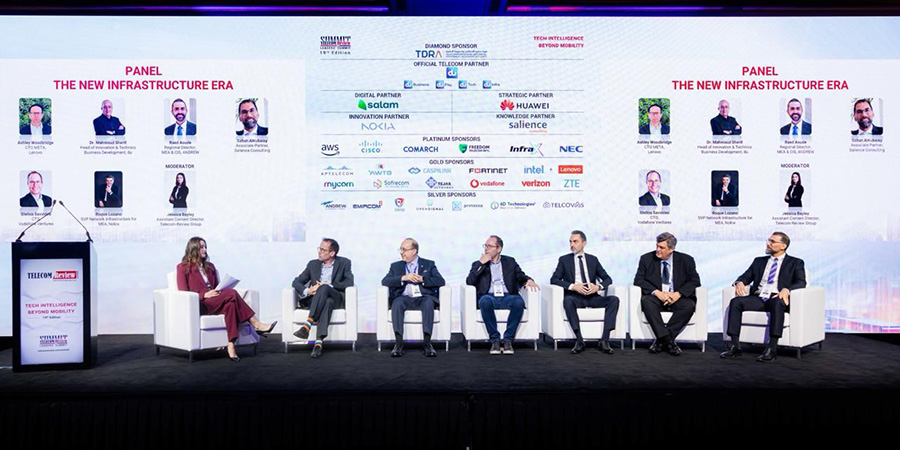
During the second day of the 19th edition of the Telecom Review Leaders’ Summit, held on December 10–11, 2025, in Dubai, UAE, a panel titled ‘New Infrastructure Era’ convened to explore the impact of artificial intelligence on telecommunications and network infrastructure. The summit’s theme, ‘Tech Intelligence Beyond Mobility,’ attracted senior executives from the telecom and technology sectors to discuss the ongoing transformation driven by AI.
The panel included Ashley Woodbridge, CTO META at Lenovo; Dr. Mahmoud Sherif, Head of Innovation & Technico Business Development at du; Raed Aoude, Regional Director for MEA & CIS at ANDREW; Sabah AlKubaisy, Associate Partner at Salience Consulting; Stelios Savvides, CTO at Vodafone Ventures; and Roque Lozano, SVP Network Infrastructure for MEA at Nokia. Jessica Bayley, Assistant Content Director of the Telecom Review Group, moderated the discussion, which highlighted the dual challenges of opportunity and disruption facing the industry.
Panelists noted that as the AI era increasingly pressures legacy networks, a new infrastructure paradigm is emerging characterized by flexibility, modularity, and proximity to computing resources. Traditional networks, which were initially designed for predictable voice and data traffic, are struggling to meet the demands of AI’s dynamic workloads. These workloads necessitate new requirements for logging, latency, and extensive, distributed computing capabilities. Consequently, GPUs and accelerated processing are shifting from centralized data centers to edge locations, fostering a convergence between physical and digital infrastructure.
Rather than being disruptive, this transition is expected to enhance operators’ ability to scale coverage and capacity dynamically based on real-time use cases. This shift will also accelerate automation across various applications, from core network operations to customer service centers. Ultimately, AI is prompting demand for new components, processes, and skill sets aimed at delivering ultra-low latency, edge-proximate computing, improved efficiency, and enhanced customer experiences.
Sabah AlKubaisy pointed out that the push toward this new infrastructure era is largely fueled by evolving AI use cases, particularly the rise of generative and agentic AI that operates within the network framework itself. This evolution allows for capabilities such as “self-healing” and “self-optimized” networks, moving beyond applications targeted at consumers or employees. He emphasized the need for telecom operators to partner with technology vendors, governments, and regulators to align innovation with broader policy and investment goals.
Dr. Sherif identified operations as the area undergoing the most immediate transformation due to AI. He noted, “Operations is the highest priority,” as it aligns well with AI models. Following operations, panelists emphasized service and customer-facing functions, where AI virtual assistants in call centers are already showing effectiveness. Planning and capacity design, though more challenging due to their artistic nature, are also increasingly benefiting from AI, particularly in capacity forecasting.
Stelios Savvides echoed Dr. Sherif’s sentiments, envisioning a future where networks autonomously respond to faults and performance issues, eliminating the need for operations teams to manually detect problems. “You won’t need your operations team to notice a fault,” he stated, highlighting that even marginal improvements in energy consumption could yield substantial operational savings while supporting sustainability initiatives.
AI’s Role in Future Network Infrastructure
AI is set to revolutionize infrastructure planning, construction, and maintenance by automating design processes and decentralizing intelligence. According to Ashley Woodbridge, “The networks of the future are going to be completely designed by, or assisted by, AI agents,” aided by emerging “world models.” He pointed out that computer vision technology, harnessed through cameras in mobile devices, is becoming a key resource, making the shift toward edge GPUs and localized data processing imperative.
Raed Aoude emphasized the necessity of hybrid infrastructure, as no single access technology can optimally serve both indoor and outdoor environments. He articulated that the future of networks will focus on orchestrating these layers intelligently and invisibly, enabling greater autonomy across various settings.
Panelists discussed the importance of public-private collaborations in network development, citing Vodafone’s partnership with Iraq’s Ministry of Communications to establish a new 5G network. Savvides noted that while the public sector provides vision, successful execution relies on collaboration with experienced organizations capable of actualizing that vision. Lozano added that meaningful digitalization across sectors is essential for a sustainable future, with private companies providing the agility and innovation needed to drive transformation.
As the discussion turned toward the implications of agentic AI in the upcoming 6G era, Dr. Sherif highlighted a shift in focus within the 3GPP contributions, moving beyond technical specifications to include monetization strategies. This pivot underscores the significance of edge computing in 6G architecture, where each user might have a personal AI agent optimizing performance interactively.
Sustainability emerged as both a challenge and a responsibility for the telecom industry. Aoude advocated for material efficiency and longevity in network infrastructure design, while Woodbridge pointed out that AI-driven workloads significantly increase energy demands. To address these challenges, innovation in hardware and cooling systems is essential, with strategies such as liquid cooling potentially reducing costs significantly.
As the panel concluded, participants recognized the fundamental shift in the role of networks: they must now support intelligence and innovation at scale, rather than merely facilitating traffic flow. This transition signifies a broader transformation within the telecom industry, shaped by the convergence of AI and network operations.
See also LinkedIn India Enhances Hiring Process with AI-Powered Features and Tools
 Google’s AI Recipe Summaries Threaten Livelihoods of Food Bloggers, Sparking Industry Fears
 Ciena’s 160% Surge: Is AI Infrastructure Growth Already Priced In?
 Rebellions Aims to Build a Non-Nvidia AI Ecosystem with New Semiconductor Focus
 Saras AI Institute Launches $6,000 Online Master’s in AI Engineering for Professionals