



























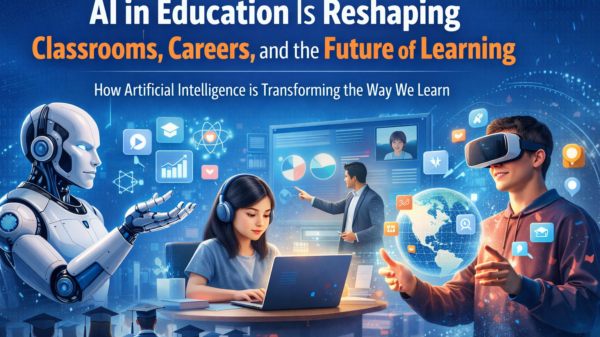

















As universities increasingly integrate artificial intelligence (AI) into their operations, a broader transformation in higher education is underway that extends beyond concerns about academic dishonesty. While public discourse has focused largely on whether students might use chatbots to complete assignments or whether instructors can detect such use, the reality is that AI is reshaping multiple aspects of institutional life.
From invisible systems that allocate resources to visible tools that assist students and faculty, AI is being adopted for tasks such as optimizing course schedules, flagging “at-risk” students, and automating routine administrative decisions. In this evolving landscape, questions arise about the fundamental purpose of universities as machines become more adept at performing tasks traditionally associated with research and learning.
A recent white paper from a joint research project between the Applied Ethics Center at UMass Boston and the Institute for Ethics and Emerging Technologies examines the ethical implications of AI in higher education. It articulates concerns over the pervasive use of AI, particularly as systems become more autonomous, raising both ethical stakes and potential consequences for educational institutions.
Three categories of AI systems illustrate the varied impacts on university life. First, “nonautonomous” AI systems, which are already prevalent in admissions, academic advising, and institutional risk assessment, automate tasks while keeping human oversight intact. These systems, while efficient, pose risks to student privacy and data security, and often exhibit biases that can perpetuate inequities. Transparency surrounding these tools is crucial but frequently lacking, leading to questions about student data access and the generation of risk scores.
Hybrid AI systems blend human oversight with advanced technologies, including AI-assisted tutoring chatbots and personalized feedback tools. In academic settings, students employ them for writing and studying, while faculty utilize them for creating assignments and lectures. This shift raises important ethical questions about the authenticity of interaction between students and educators. For instance, if students increasingly rely on AI-generated feedback, who is ultimately responsible for the educational outcomes? Are students truly engaging with the material, or merely coasting on the assistance of machines?
As hybrid AI systems become more integrated into academic life, a significant ethical concern is the cognitive offloading they encourage. While these technologies can alleviate mundane tasks, they risk diminishing essential learning experiences that foster deep intellectual engagement, such as grappling with confusion and revising drafts. The increasing reliance on AI may ultimately undermine students’ ability to develop critical thinking skills.
Looking ahead, the most transformative changes may arise from the development of “autonomous” AI agents capable of executing research independently. Although fully autonomous systems remain aspirational, advancements toward automated laboratories and research cycles are already reshaping responsibilities in both teaching and research. While this promises increased efficiency, it also raises questions about the erosion of traditional mentorship opportunities and the cultivation of expertise.
In this context, universities face a pivotal question: What purpose do they serve in an era of automated knowledge work? One perspective views universities primarily as engines for producing credentials and knowledge, focusing on outputs such as graduation rates and published research. However, another viewpoint emphasizes the intrinsic value of the educational ecosystem itself, wherein the processes of mentorship and the development of critical judgment are paramount.
As AI continues to permeate higher education, institutions must carefully consider what they owe to students, early-career scholars, and society at large. The adoption of AI will not only shape the operational dynamics of universities but also determine the nature of the educational experience and the cultivation of skilled professionals in the future.
See also India’s Ashwini Vaishnaw Launches AI-MET White Paper to Drive Manufacturing Transformation
 US Tech Giants, Including Google and Nvidia, Announce Major AI Investments in India
 State Dept. Launches AI Concierge Service to Boost Exports for Pax Silica Partners
 Entanglement Launches Maritech Systems with Quantum Logic for Real-Time Maritime Intelligence
 Taalas Raises $169M to Develop Custom AI Chips, Aiming to Compete with Nvidia