










































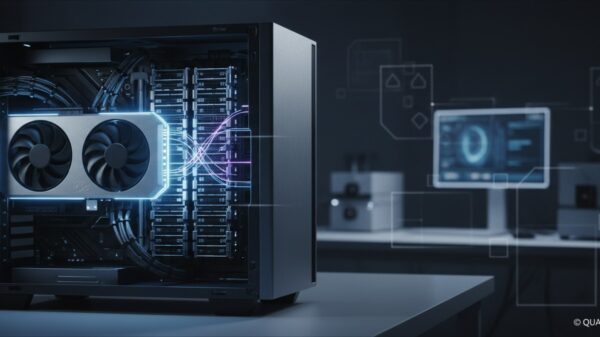





Amazon.com (NasdaqGS:AMZN) has revealed a significant focus on its proprietary artificial intelligence (AI) chips in its latest annual shareholder letter, disclosing that its in-house Graviton and Trainium chips have achieved a revenue run rate exceeding $20 billion. This announcement comes as Amazon reported a remarkable triple-digit year-over-year growth in its AI chip segment, and the company is contemplating the possibility of selling these chips to external customers.
The strategic pivot towards AI chip production underscores Amazon’s intent to deepen its involvement in the AI infrastructure sector, alongside its established e-commerce and cloud computing operations. This potential move into external chip sales could position Amazon in direct competition with leading semiconductor manufacturers such as Nvidia and AMD, while still supporting its own Amazon Web Services (AWS) data centers.
In tandem with its focus on AI chips, Amazon detailed plans for approximately $200 billion in capital expenditures by 2026, a figure that is underpinned by substantial customer commitments within AWS. This alignment of heavy infrastructure investment with confirmed demand signals a methodical approach to scaling its cloud capabilities to support growing AI workloads.
Investors are keenly observing how Amazon’s initiatives in AI chip manufacturing may reshape relationships with current chip suppliers, particularly as the company seeks to expand its market presence. The introduction of external chip sales could complicate existing partnerships, as Amazon might find itself negotiating more intensely with traditional chip vendors while relying on their products for high-demand workloads.
Amazon’s efforts to integrate custom AI chips into its AWS offerings align with a broader narrative of vertical integration, where the company aims to control more of its hardware stack to enhance performance and reduce costs for its cloud clients. However, the significant capital expenditures required for chip development raise concerns about the potential impact on profit margins, particularly if demand or pricing for AI services does not meet expectations.
While the prospect of expanding into external chip sales introduces new revenue opportunities, it also invites challenges. Analysts have noted the high level of non-cash earnings associated with this business, which could complicate the translation of these projects into cash flow. Competing directly with established semiconductor giants could lead to pricing pressures and execution risks, especially if Amazon’s chips fail to deliver competitive performance or developer support.
The internal chip business, if successful, could lower unit compute costs for AWS, potentially bolstering operating margins as workloads become increasingly AI-intensive. If Amazon’s external chip sales gain traction, the company could establish itself as a significant player in AI hardware, diversifying its revenue streams beyond cloud services and enabling participation across various sectors and industries.
Moving forward, it will be critical to monitor how Amazon reports metrics related to its AI chip initiatives, including customer adoption rates and usage within key AWS services. Investors should pay attention to any indications of external sales progress, as well as how capital expenditures are articulated in relation to confirmed customer commitments. Additionally, insights from competitors like Nvidia and AMD regarding their dealings with AWS may provide further clarity on the evolving dynamics in the semiconductor market.
As Amazon continues to innovate within the AI space, stakeholders will be closely watching the interplay between its custom silicon efforts and overall operating margins in AWS. Such developments could serve as indicators of whether Amazon’s investments in AI infrastructure are fostering long-term profitability or creating new challenges.
This article by Simply Wall St is general in nature. We provide commentary based on historical data and analyst forecasts only using an unbiased methodology and our articles are not intended to be financial advice. It does not constitute a recommendation to buy or sell any stock and does not take account of your objectives or financial situation. Simply Wall St has no position in any stocks mentioned.
Companies discussed in this article include AMZN.
Have feedback on this article? Concerned about the content? Get in touch with us directly. Alternatively, email [email protected]
See also Tesseract Launches Site Manager and PRISM Vision Badge for Job Site Clarity
 Affordable Android Smartwatches That Offer Great Value and Features
 Russia”s AIDOL Robot Stumbles During Debut in Moscow
 AI Technology Revolutionizes Meat Processing at Cargill Slaughterhouse
 Seagate Unveils Exos 4U100: 3.2PB AI-Ready Storage with Advanced HAMR Tech