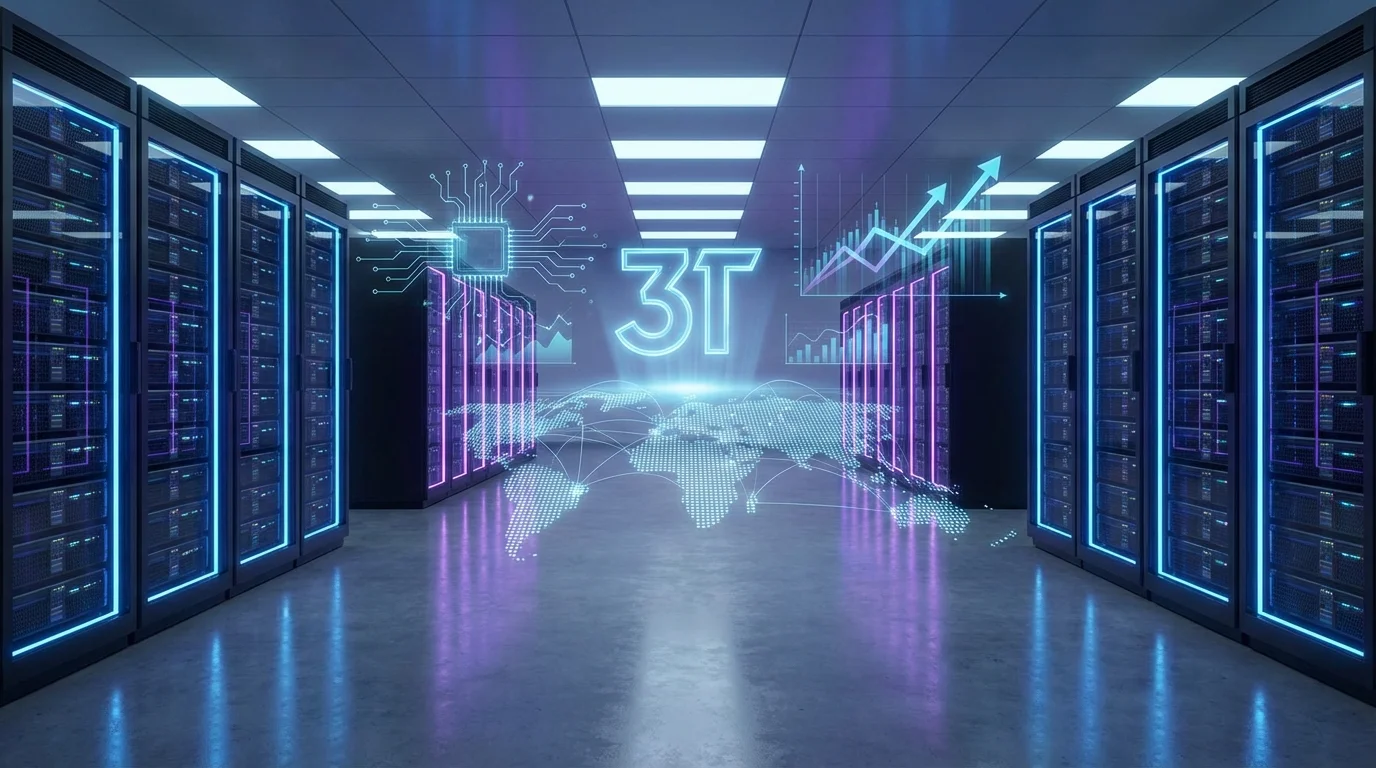
The artificial intelligence revolution is driving an infrastructure investment boom that could total $3 trillion, marking one of the most significant capital deployment cycles in recent market history. This undertaking goes beyond merely expanding server capabilities; it signifies a fundamental reorganization of global compute infrastructure that will shape which companies lead technological advancements over the next decade.
Major technology firms are committing unprecedented financial resources to secure their place in the AI landscape. For instance, Meta Platforms has raised its capital expenditure guidance to approximately $48 billion for the fiscal years 2025-2026, a move that underscores a deep commitment to AI infrastructure. This investment significantly eclipses previous technology cycles. Microsoft is also making aggressive expansions, with plans for a 1.5 gigawatt data center in Wisconsin and an additional 2 gigawatts of capacity projected for global deployment in 2025. The company has reportedly turned away customers due to power shortages, emphasizing the supply constraints that are driving this extensive build-out.
For investors, this booming infrastructure presents multiple avenues for opportunity. Companies like NVIDIA are at the forefront, benefiting from soaring demand for specialized AI hardware. Data center real estate investment trusts (REITs) are witnessing unprecedented leasing demand, while power and utility companies have found themselves essential players in this evolving landscape. Understanding which segments provide the most attractive risk-adjusted returns requires a close examination of capital flows, competitive dynamics, and structural constraints influencing this transformation.
This investment cycle’s scale is unmatched, surpassing that of the dot-com bubble and cloud computing expansion. Analysts at JPMorgan project that AI’s data center boom will necessitate tapping into “every debt market,” as financing needs outstrip the balance sheet capacity of even the largest tech firms. Such capital intensity brings both opportunities and risks that will determine future winners and losers.
The $3 Trillion Infrastructure Imperative
The $3 trillion figure encapsulates the total investment needed across the AI infrastructure spectrum through the decade’s end, covering not only technology hardware—such as GPUs, networking equipment, and storage systems—but also the physical real estate, power generation, cooling systems, and transmission infrastructure vital for supporting hyperscale AI operations. Hyperscalers currently control nearly half of global data center capacity, a concentration that is likely to accelerate as the AI arms race intensifies. Unlike past technology cycles, AI workloads require specialized infrastructure that existing facilities cannot readily accommodate.
Power demands illustrate the magnitude of this transformation. Industry analysts estimate that the AI data center build-out requires 125 gigawatts of dedicated power capacity—comparable to the total electricity consumption of entire nations. Microsoft’s anticipated Stargate supercomputer project with OpenAI, estimated to exceed $100 billion, could require several gigawatts of dedicated power alone.
Traditional capital deployment models struggle to meet these extensive infrastructure needs. Technology companies are innovating new financing structures that combine project finance, strategic partnerships, and novel debt instruments. A notable example is the $40 billion acquisition of Aligned Data Centers, a deal facilitated by a consortium including NVIDIA, Microsoft, BlackRock, and Elon Musk’s xAI, representing a shift towards direct stakes in infrastructure assets rather than purely leasing arrangements.
CoreWeave, a specialized AI cloud computing provider, has invested almost $3 billion in technology and infrastructure over the past year, equating to 57% of its revenue. This reinvestment rate surpasses that of traditional cloud providers and highlights the capital intensity required to remain competitive in AI infrastructure.
As the AI capital expenditure arms race unfolds, Meta has emerged as a leading investor, with its $48 billion commitment reflecting a strategic pivot placing AI infrastructure at the forefront of its competitive strategy. Already, this investment is yielding measurable returns, with a reported 5% increase in time spent on Facebook and 10% growth on Threads in the third quarter of 2025, largely attributed to AI-driven content recommendations.
Meta’s Hyperion project in Louisiana exemplifies the scale of these investments, featuring a $3.2 billion facility that includes a 2 gigawatt combined-cycle gas plant, with local residents contributing $550 million towards infrastructure costs. Such initiatives are transforming rural economies while establishing concentrated compute capacity.
Microsoft’s AI infrastructure strategy focuses on bolstering capacity for its Azure cloud platform and its partnership with OpenAI, with plans to invest $600 billion in U.S. infrastructure through 2028, primarily targeting AI data centers. The power constraints the company faces—evidenced by reports of turning away customers due to inadequate power—validate the urgency behind its aggressive expansion efforts.
The rapid evolution of AI technology presents both opportunities and challenges across multiple layers of the infrastructure stack. As demand for essential compute hardware escalates, semiconductor companies are well-positioned to capitalize on this trend. Data center operators benefit from unprecedented leasing demand, while power and utility firms are increasingly vital in this new frontier of technology.
The extensive capital requirements of this build-out favor established players with robust balance sheets, creating competitive moats that hinder new entrants. As the industry moves forward, understanding the complexities of capital flows, regional disparities in power availability, and the risk of technological obsolescence will be essential for investors aiming to navigate this transformative landscape successfully.
See also Meta AI and KAUST Reveal Roadmap for Completely Neural Computers with New Paper
 Nvidia, TSMC, and Broadcom Report Strong Earnings Amid AI Growth Concerns
 Community Resistance Grows as Data Center Proposals Surge in Archbald, PA
 Amazon Reveals $20B Revenue Potential from In-House AI Chips Amid Rapid Growth
 Amazon and Alphabet Stocks Poised for 30% and 50% Gains Amid AI Spending Fears