
















































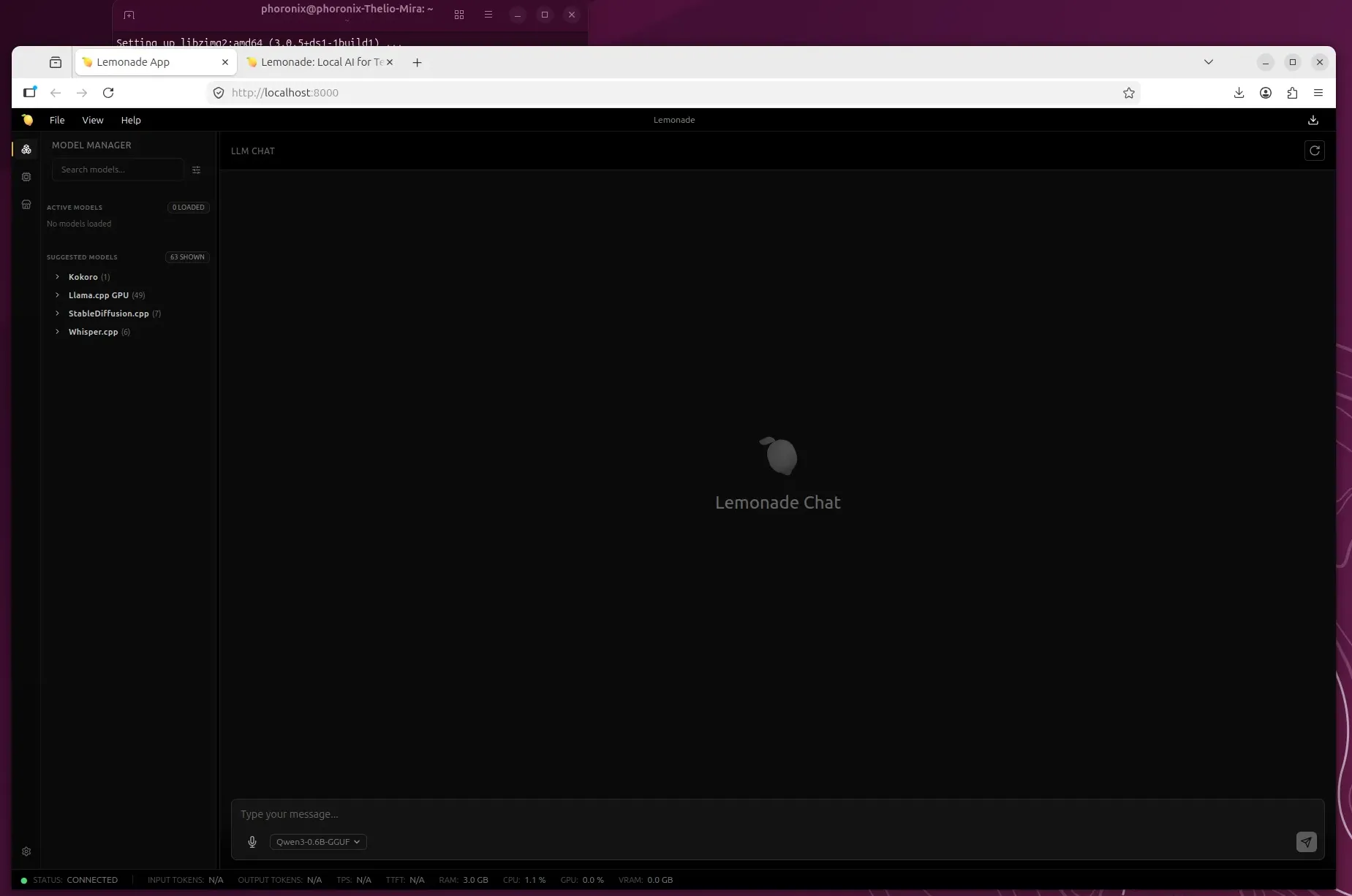
The open-source **Lemonade** local AI server has made significant strides in its capabilities, particularly for users utilizing **AMD** technology. The recent release of **Lemonade 10.2**, introduced shortly after version 10.1, focuses on making the software more suitable for integration into other applications, thereby enhancing its utility in AI tasks. With this update, the platform is now better equipped to leverage **Ryzen AI NPUs** on **Linux** for **large language model** (LLM) applications, in addition to supporting **AMD Radeon GPUs** and common **x86_64 CPUs**.
The new version emphasizes ease of embedding, publishing embeddable release artifacts for both Linux and Windows. These builds include only the core components—such as the **Lemonade daemon**, the **Lemonade CLI**, and necessary resource files—excluding any web app or extraneous code not needed for user-defined applications. This streamlined approach aims to facilitate developers who wish to incorporate local AI capabilities without unnecessary complexity.
“Embeddable Lemonade is a binary version of Lemonade that you can bundle into your own app to give it a portable, auto-optimizing, multi-modal local AI stack. This lets users focus on your app, with zero Lemonade installers, branding, or telemetry,” explained **Jeremy Fowers**, an engineer at AMD involved in the project. This development positions Lemonade as a versatile tool for applications requiring robust AI functionalities.
Despite the focus on embedding, Lemonade 10.2 retains support for LLMs across various hardware configurations, including GPUs, NPUs, and CPUs. The updated release also introduces enhanced integration features for automatically downloading **GGUF** and **RAI models**, as well as support for **Qwen image models** and **OpenCode integration**. These improvements reflect the ongoing commitment to making Lemonade a competitive option in the expanding field of local AI solutions.
As the demand for local AI capabilities continues to grow, especially in sectors where data privacy and computational efficiency are paramount, Lemonade’s advancements present an attractive proposition for developers. The open-source nature of the project, governed under the **Apache 2.0 license**, encourages collaboration and innovation within the community, further bolstering its relevance in today’s technology landscape.
In summary, the enhancements in Lemonade 10.2 not only simplify integration for developers but also strengthen its position as a robust local AI server. As organizations increasingly prioritize AI for various applications, platforms like Lemonade may play a critical role in democratizing access to advanced technologies. Developers interested in utilizing these new features can find downloads and detailed documentation on **GitHub**, paving the way for more innovative use cases in the future.
See also Tesseract Launches Site Manager and PRISM Vision Badge for Job Site Clarity
 Affordable Android Smartwatches That Offer Great Value and Features
 Russia”s AIDOL Robot Stumbles During Debut in Moscow
 AI Technology Revolutionizes Meat Processing at Cargill Slaughterhouse
 Seagate Unveils Exos 4U100: 3.2PB AI-Ready Storage with Advanced HAMR Tech