

















































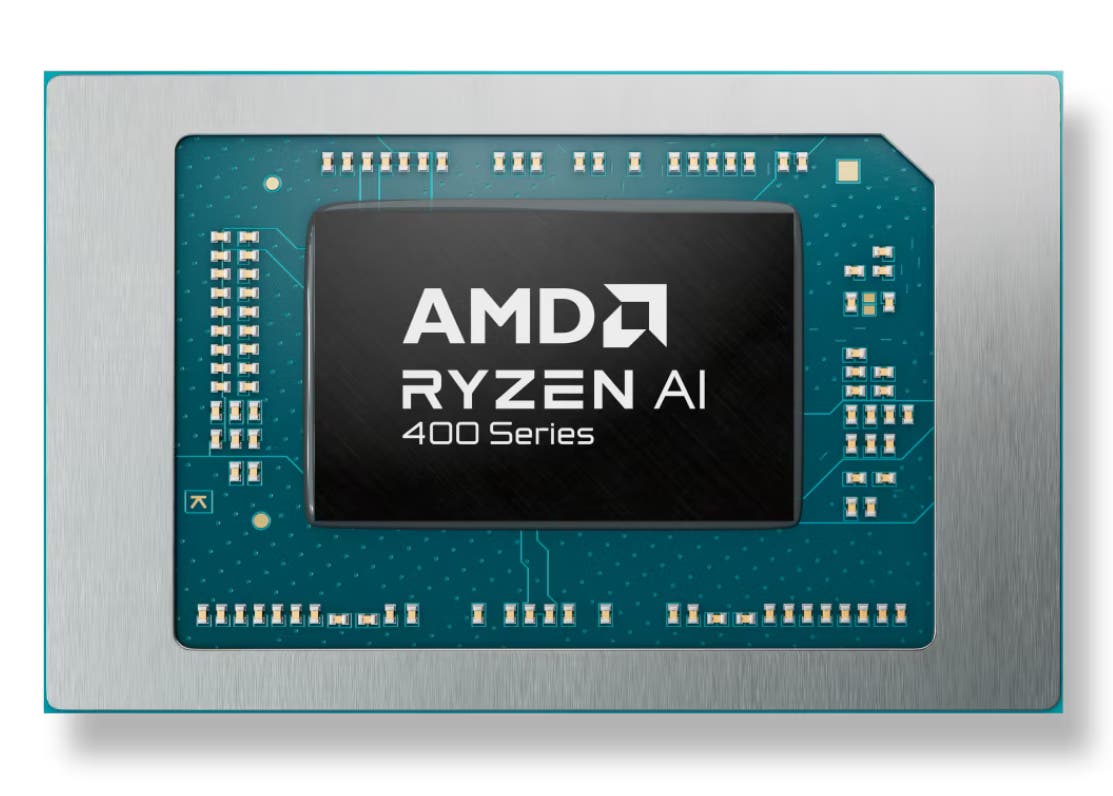
AMD unveiled its latest Ryzen AI 400 processors at CES 2026, asserting that these chips surpass Intel’s offerings for laptops and compact PCs. The company claims its performance-oriented Ryzen AI Max processors can outperform Nvidia’s DGX Spark mini workstation in terms of performance per dollar. This move positions AMD to compete with both Intel and Nvidia in an increasingly crowded market.
The Santa Clara, California-based semiconductor manufacturer announced that the Ryzen AI 400 series will achieve a maximum CPU frequency of 5.2 GHz and 60 trillion operations per second (TOPS) for neural processing units (NPUs). These enhancements represent a notable improvement over the previous Ryzen AI 300 chips, which maxed out at 5.1 GHz and 55 TOPS. Designed to support Microsoft’s Copilot+ PC program, the new chips aim to offer significant advancements in both general computing and AI tasks.
AMD also hinted at plans to introduce socketed versions of the Ryzen AI 400 for desktop PCs, marking a significant expansion for its AI chip lineup. The processors are expected to appear in laptops and small form factor devices from major original equipment manufacturers (OEMs) such as Dell Technologies, HP Inc., and Lenovo by March of this year.
With an emphasis on multi-day battery life and high performance, AMD is marketing the Ryzen AI 400 processors as ideal for users requiring exceptional CPU, GPU, and NPU capabilities. The new chips will feature boosted graphics frequencies of up to 3.1 GHz and memory speeds reaching 8,533 megatransfers per second (MT/s), a step up from the previous generation’s 2.9 GHz and 8,000 MT/s.
While the maximum cores and threading capabilities remain unchanged at 16 cores and 32 threads, based on AMD’s Zen 5 architecture, the company asserts that its Ryzen AI 9 HX 470, operating at 28 watts, is 30% faster for multitasking and 70% faster in content creation compared to Intel’s 30-watt, 8-core Ultra 9 288V. These claims also include a 10% advantage in gaming performance and a significant 70% boost in the Cinebench 2024 nT benchmark while running on battery in balanced mode.
AMD Expands Ryzen AI Max Lineup, Makes New Claims Against Nvidia
In addition to the Ryzen AI 400 series, AMD has expanded its lineup of Ryzen AI Max processors, increasing the competitive pressure on Nvidia’s offerings. These more robust chips feature up to 40 GPU cores, enabling performance levels of up to 60 teraflops. Similar to the Ryzen AI 400, they support a maximum of 16 Zen 5 cores and a boost frequency of up to 5.1 GHz, while all models maintain an NPU performance of 50 TOPS.
A distinctive attribute of the Ryzen AI Max series is the ability to allocate up to 128 GB of system memory for the integrated GPU, making them suitable for running large AI models and demanding workloads. “When we designed the Ryzen AI Max processors, this was the ultimate processor that we could design for content creators and gamers,” said Rahul Tikoo, senior vice president and general manager of AMD’s client business unit. He highlighted the processors’ potential for AI developers looking for high performance.
The new series now includes 8- and 12-core models, pushing the performance even further beyond the previous generation’s specifications. AMD’s comparative analysis against Nvidia’s DGX Spark workstation, which is equipped with the GB10 system-on-chip, claims that the HP Z2 Mini G1a mini workstation with Ryzen AI Max+ 395 Pro offers 50% more tokens per second per dollar for OpenAI’s 20-billion-parameter GPT-OSS model and 70% more for the 120-billion-parameter version.
“If you compare the Ryzen AI Max platform to the latest Nvidia DGX Spark, you’ll notice you’ll get fantastic AI performance at a much better price point,” Tikoo stated. Notably, Ryzen AI Max systems are compatible with both Windows and Linux, allowing access to a broader range of applications compared to Nvidia’s product, which operates on a customized version of Ubuntu.
Moreover, AMD claims that its Asus ROG Flow Z13 laptop, powered by the Ryzen AI Max+ 395 Pro, can outperform Apple’s latest M5-based MacBook Pro by 40% in AI inference, 80% in multitasking, and 60% in gaming according to their internal benchmarks. However, Tikoo tempered expectations by noting that while there is strong interest in Ryzen AI Max chips among content creators and AI developers, they are not aimed at everyday users.
As AMD continues to carve out its position in the competitive landscape of AI and high-performance computing, the new Ryzen AI processors reflect its commitment to delivering advanced technology tailored to various market segments. This strategic expansion could reshape expectations for performance in both consumer and professional devices.
See also Nvidia Launches Rubin AI Architecture; AMD Pushes Generative AI for Consumer PCs at CES 2026
 Razer Reveals AI-Powered Project AVA Companion and Next-Gen Gaming Innovations at CES 2026
 Siemens, NVIDIA Announce AI Industrial Revolution; Razer Unveils Game-Changing Tech at CES 2026
 Quantum AI: Researchers Highlight Hybrid Systems to Tackle AI’s Computational LimitsQuantum Computing and AI Collaborate to Enhance Computational Efficiency in Hybrid Systems