












































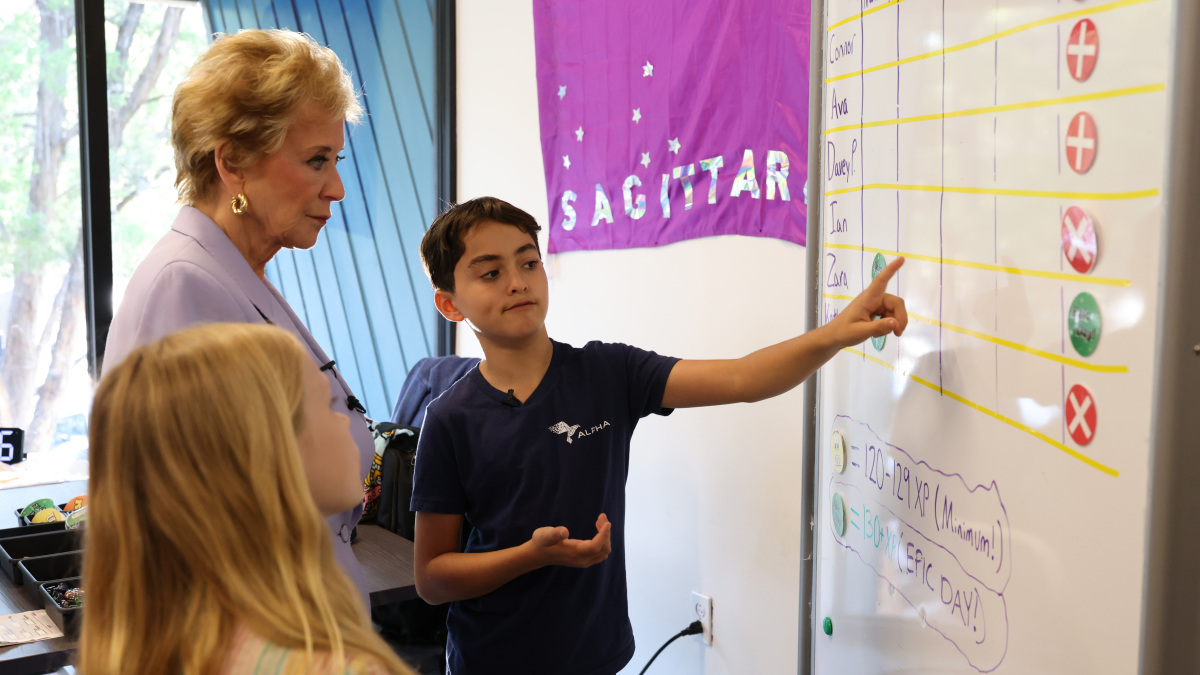
Could a child master reading, science, and math in just two hours, guided solely by an AI teacher? This concept is being tested by a small group of students at Alpha School, an “AI-powered private school” that has garnered attention as a potential blueprint for the future of education. In September, Department of Education Secretary Linda McMahon visited an Alpha School campus in Austin, Texas, praising its potential and labeling it an “exemplary” model for leveraging technology in American education. Co-founders MacKenzie Price, an educational podcaster, and billionaire Joe Liemandt assert that their unique approach is attracting support from advocates of alternative learning and expanded school choice.
Founded in 2014, Alpha School operates within a landscape crowded with tech-focused alternative educational programs, targeting families disillusioned with traditional public school curricula. Major AI developers such as OpenAI, Google, and Anthropic have entered the educational space with products designed to enhance classroom instruction and student learning. In contrast, Alpha School posits a more radical approach: AI serves as the sole instructor, grader, and academic administrator for students.
The school claims its K-12 curriculum is developed in consultation with “world-renowned learning scientists and advanced degreed academic experts.” Students spend only two hours each day on core subjects—reading and math—utilizing AI-driven software. The remainder of their time is dedicated to AI-supported practical skills such as entrepreneurship, public speaking, and financial literacy, all tracked on a platform that generates highly individualized lesson plans. Alpha School employs “guides” instead of traditional teachers; these guides provide specialized instruction but do not manage grades or curricula and are not required to hold advanced degrees.
Alpha School’s marketing challenges traditional notions of schooling, suggesting, “What if your child could crush academics in just 2 hours and spend the rest of their day unlocking limitless potential?” The school, which reported serving 200 K-8th grade students and an additional 50 at the high school level as of last year, anticipates expanding to multiple locations by the end of 2025. Tuition ranges from $10,000 to $75,000 annually.
Alpha School has established in-person classes in several states, including Los Angeles, New York City, Chicago, and Brownsville, Texas—location ties that often align with major tech hubs. Additionally, the school offers an at-home learning program, Alpha Anywhere, featuring personalized courses and academic support.
While the innovative model has generated interest, parents’ experiences have been mixed. Some families have withdrawn their children from the program, expressing concerns about the reliance on AI with minimal human oversight. Reports indicate that AI instructors assigned challenging goals, leading to an overwhelming workload without the flexibility and support typically offered by human teachers. This lack of human involvement has raised alarms among educational experts.
Hamsa Bastani, an associate professor at the University of Pennsylvania’s Wharton School and an AI researcher, emphasizes the importance of the human connection in education, stating, “How can humans play the role of ‘motivators’ if they are not even involved in instruction?” Randi Weingarten, president of the American Federation of Teachers, echoed these concerns, arguing that a strictly AI-driven school undermines fundamental educational principles.
Although research suggests that motivated students can benefit from AI-assisted learning, results related to actual academic performance remain inconclusive. A recent study found that while AI could yield modest positive effects in certain contexts, it may also hinder students’ learning perceptions. The lack of scientific consensus on the efficacy of universally designed AI tools, like chatbots, raises further questions about their educational value.
Experts also criticize Alpha School for its insufficient evaluation processes. Bastani notes that a lack of internal or independent assessments can lead to poor AI design, compromising the educational experience. The U.S. government and major technology firms view AI as a solution to systemic issues in an underfunded educational landscape, yet the implications of increased screen time and reliance on generative AI tools for young learners remain uncertain.
The ambition for new educational models persists amid these challenges, with Alpha School at the forefront of a debate about the future of learning in a technology-driven age. While the allure of AI in education is strong, experts caution that the technology is not yet ready to replace the critical human elements of teaching and learning.
See also UC Berkeley Researchers Reveal CATTS Technique, Boosts AI Performance by 9.1% with 2.3x Less Compute
 Meta Expands Nvidia Partnership, Commits to Millions of AI Chips Over Coming Years
 AMD Denies MI455X Delay Amid N2 Integration Challenges, Targets H2 2026 Deployment
 Meta Partners with NVIDIA to Deploy Millions of AI Chips and Build Hyperscale Data Centers
 Meta Partners with NVIDIA to Deploy Millions of AI-Optimized CPUs and GPUs in Data Centers