







































Entanglement, Inc., an AI quantum computing company founded in 2017, is reshaping the maritime technology landscape under the leadership of Chairman and CEO Jason Turner. Recognizing that the quantum computing hardware ecosystem is still maturing, Turner pivoted the company’s focus toward quantum logic and quantum-inspired algorithms that can be applied to existing computational technologies.
By leveraging quantum logic, Turner and his team have developed solvers capable of addressing significant challenges across various domains, including oceanography and maritime security. “We reframed the math into our own solvers that can solve massive problems on non-classical computer technology,” Turner explained. This approach allows for real-time detection of previously undetectable phenomena, utilizing both quantum and traditional sensors.
The term “non-classical computer technology” refers to advanced computational systems such as graphics processing units, quantum annealers, simulated annealers, photonic computers, and acoustic computers. Entanglement’s systems are described as “quantum ready,” meaning they can operate on quantum computers equipped with quantum-level encryption. However, Turner acknowledged the challenges posed by the current limitations of quantum computing, particularly the lack of sufficiently powerful qubits to provide scalable solutions in real-time applications.
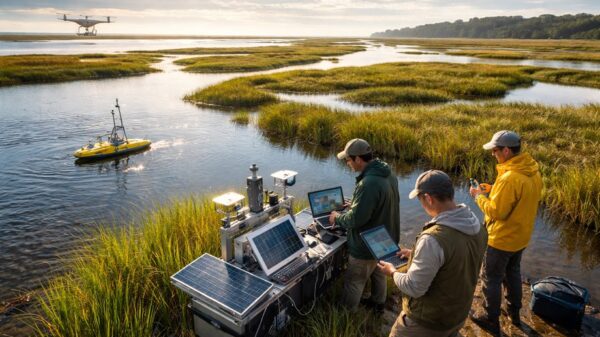
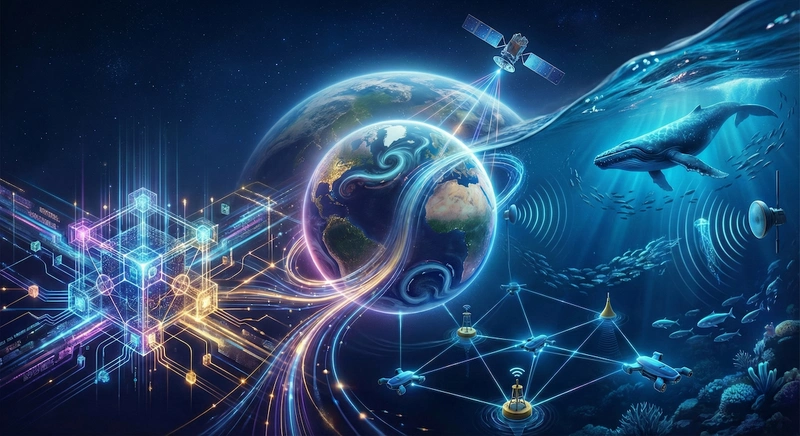
In January, Entanglement completed its acquisition of Applied Ocean Sciences (AOS), a company specializing in ocean science and acoustics. This merger led to the creation of Maritech Intelligence Systems, which has launched two foundational products: MIST™ and MADEN™. MIST, or Maritime Information Synthesis Terminal, is a digital twin of the world’s oceans, integrating remote and in-situ sensors with quantum-logic-enabled AI to deliver unmatched maritime awareness and prediction capabilities. Meanwhile, MADEN, or Maritime Autonomous Distributed Edge Network, is a robust, distributed intelligence network that enhances sensing, communication, and navigation across extensive maritime environments.
These innovative platforms are positioned to address a range of high-value applications. They include ocean sustainability and conservation, detection of pollution events impacting marine life, identification of illegal fishing practices, and enhancement of maritime safety and security. The technology is also applicable for defense missions that require accurate real-time sensing and targeting capabilities, as well as for search and rescue operations.
Operable on Oracle Cloud Infrastructure, Maritech’s systems provide secure, scalable, and compliant global operability, allowing customers—including sovereign governments—to maintain control over data security and regulatory compliance while deploying their solutions worldwide.
Maritech represents the culmination of extensive expertise in ocean acoustics, environmental science, and maritime security, augmented by Entanglement’s Quantum Logic Core™. Dr. Christopher Verlinden, the Chief Technologist at Entanglement and former Chief Technology Officer at AOS, emphasized the power of quantum logic in tackling complex problems. “When combined with quantum-logic-powered AI, we’re able to extract meaning from the ocean faster, more accurately, and at a scale that was previously impossible,” he stated.
Verlinden highlighted two notable mathematical approaches that exemplify the advantages of quantum logic: the resolution of mathematically intractable inverse problems, such as acoustic tomography for marine measurements, and the optimization of sensor placement in massive oceanic environments. These technologies are also being applied to urgent climatological challenges, including weather forecasting.
Dr. Verlinden envisions a future where their technology could improve predictions of El Niño events—phenomena with substantial socioeconomic implications. “El Niño causes famine, drought, floods, economies collapse, and socioeconomic instability. There are trillions of dollars on the line,” he remarked. The team is currently developing a system for predicting visibility at sea, enhancing safety for seafarers by assimilating data from a sparse set of observations.
Furthermore, the quantum-AI technology is expected to enhance user interfaces, enabling more intuitive interactions with systems like MIST. “You don’t need a PhD in computer science to use it,” said Turner, indicating a commitment to accessibility. This development underscores Maritech’s mission to deliver maritime intelligence capabilities that were once thought computationally unreachable, blending scientific rigor with cutting-edge computing technology.
As Entanglement continues to innovate, its work could redefine maritime operations, from safeguarding marine ecosystems to ensuring the security of global trade routes. By marrying science, sustainability, and advanced computing, Maritech is set to deliver trusted intelligence for critical decisions made under pressing time constraints.
See also Taalas Raises $169M to Develop Custom AI Chips, Aiming to Compete with Nvidia
 IoTeX Launches Infrastructure for AI with Real-World Data Layer and Device Identity System
 Daily AI Quiz: Test Your Knowledge on Key Developments in AI Technology
 Amazon’s AWS Faces Two AI-Related Outages, Sparking Concerns Over Automation Risks
 Meta Invests $115B-$135B in AI Infrastructure, Competing for Nvidia Chip Supply