














































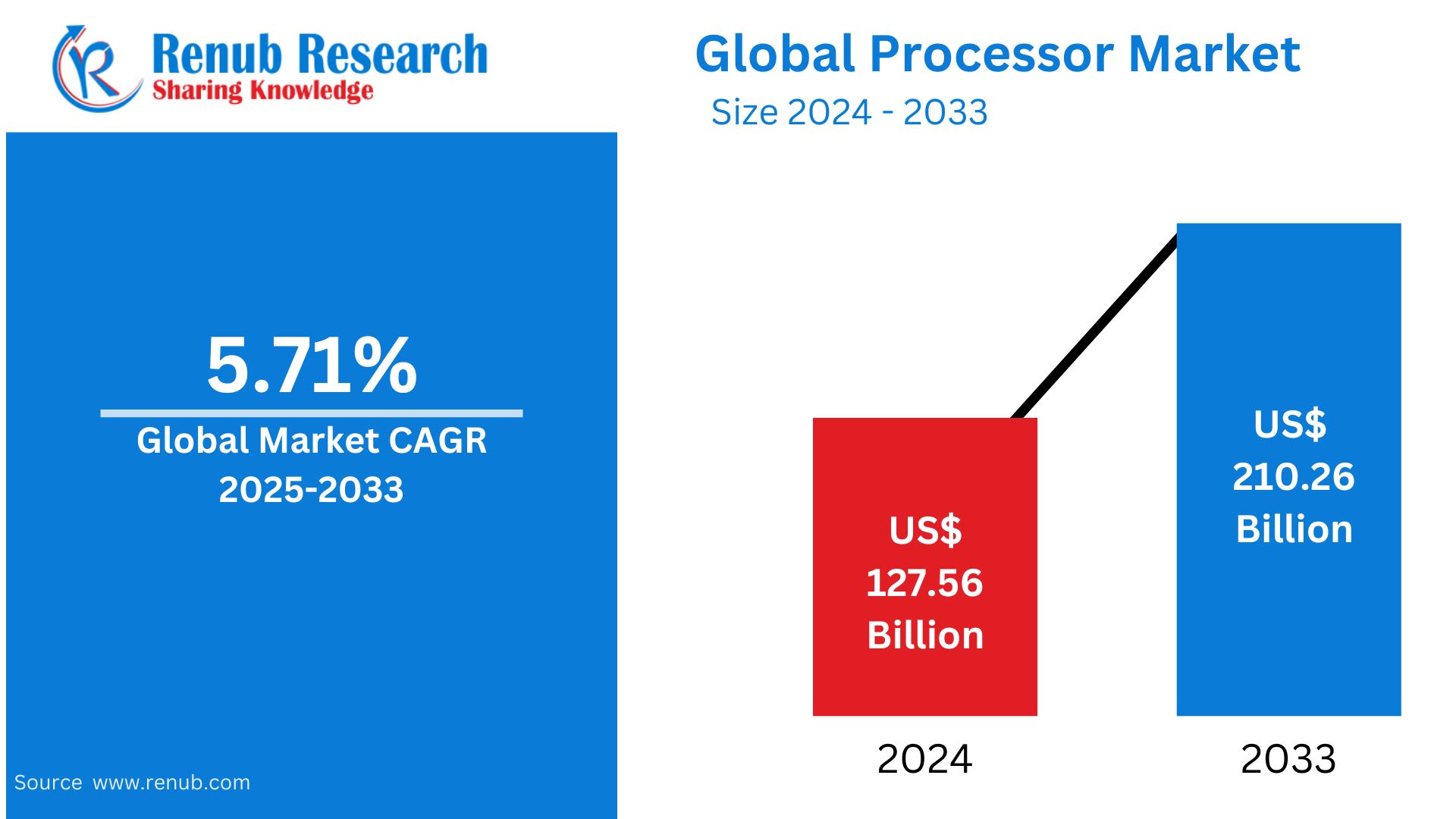
The global processor market is poised for significant growth, projected to reach US$ 210.26 billion by 2033, up from US$ 127.56 billion in 2024. This expansion, reflecting a compound annual growth rate (CAGR) of 5.71% from 2025 to 2033, is driven by a surge in demand across high-performance computing, cloud ecosystems, artificial intelligence, and connected devices, highlighting the critical role processors play in modern technology.
Processors, commonly referred to as Central Processing Units (CPUs), serve as the “brain” of various digital devices, from smartphones to supercomputers. They execute software instructions, perform arithmetic operations, manage input/output interactions, and facilitate multitasking. As industries accelerate their digitization efforts, the demand for advanced processors is intensifying, reshaping computing paradigms at all levels.
Today’s processors are characterized by several innovations, including multiple cores for parallel processing, energy-efficient designs for mobile applications, integrated graphics for enhanced multimedia experiences, and artificial intelligence accelerators tailored for machine learning tasks. The proliferation of smart devices, autonomous systems, and AI-enabled platforms is expanding the applications of processors beyond consumer electronics, with notable growth in sectors such as data centers, automotive systems, industrial IoT, and defense technologies.
Key factors driving this growth include the rising need for high-performance computing (HPC), which has transitioned from niche applications to mainstream requirements across various industries. From financial modeling and engineering simulations to drug discovery and gaming, HPC demands processors capable of extraordinary speeds. Applications such as real-time rendering, virtual and augmented reality platforms, and high-definition content creation further accentuate the need for multi-core, efficient processors.
The expansion of cloud computing and data centers also significantly contributes to processor demand. Major cloud service providers like Amazon Web Services, Microsoft Azure, and Google Cloud depend on server-grade processors that balance performance with energy efficiency. These modern data centers require CPUs adept at handling virtualization, managing distributed workloads, and executing intensive analytics. Moreover, the shift toward edge computing—processing data closer to its source—necessitates specialized processors optimized for speed and low power consumption.
Artificial intelligence is another pivotal driver reshaping the processor landscape. AI workloads, which encompass neural network training, natural language processing, deep learning, and computer vision, require processors with substantial parallel processing capabilities. This demand has led manufacturers to integrate AI-specific technologies into mainstream processors, including dedicated neural engines and tensor acceleration cores. Industries employing AI processors span healthcare, autonomous vehicles, finance, retail analytics, industrial robotics, and smart IoT environments.
Despite the promising growth of the processor market, challenges persist. High manufacturing and research and development costs present significant barriers, as creating advanced processors involves complex and costly processes. Semiconductor fabrication demands substantial investment in cleanroom facilities, precision tools, and ongoing R&D, particularly as designs shrink to 5nm or smaller. Low yield rates at cutting-edge nodes can further impact profitability, especially for smaller companies.
Intense competition in the processor market adds another layer of complexity, with major players such as Intel, AMD, Apple, Qualcomm, and NVIDIA vying for dominance. These companies are locked in a race to excel in performance, power efficiency, AI capabilities, and cost optimization. The rapid pace of product refresh cycles and the need for competitive pricing challenge profit margins, while emerging segments such as AI accelerators and automotive chips intensify the competitive landscape.
The United States leads in processor R&D and semiconductor innovation, supported by significant cloud and data center expansion and robust AI deployment. However, challenges such as high manufacturing costs and supply chain dependencies persist. In contrast, Germany’s processor market benefits from its strong industrial base, particularly in automotive engineering and smart manufacturing, while India’s market is rapidly growing due to increasing smartphone penetration and digital initiatives. Saudi Arabia’s Vision 2030 strategy is further propelling processor adoption across various sectors.
Recent developments spotlight the industry’s trajectory, including Qualcomm’s acquisition of Alphawave Semi for US$ 2.4 billion in September 2025, aimed at bolstering its cloud AI processor portfolio. In August 2025, TSMC announced a capex of US$ 38–42 billion for new fabs and advanced packaging facilities, while Tesla secured a US$ 16.5 billion chip supply agreement with Samsung for AI6 processors.
As computing demands escalate and advanced digital systems become integral to everyday life, the processor market is on the cusp of transformative growth. With an expected market valuation of US$ 210.26 billion by 2033, the next decade will redefine processor design, manufacturing, and deployment, paving the way for innovations in AI acceleration and edge computing.
See also One Stop Systems Launches PCIe 6.0 Products, Valuation Estimate at $8 Amid 156% Shareholder Return
 Google’s Gemini 3 Launch Transforms AI Landscape, Challenging Nvidia’s Dominance
 Google CEO Pichai: Quantum Computing Approaching Major Breakthroughs in 5 Years
 Q.ANT Launches NPU 2.0, Promising 30x Lower Energy Use and 50x Higher Performance
 Pusan National University Study Reveals New Framework for AI Accountability Distribution