































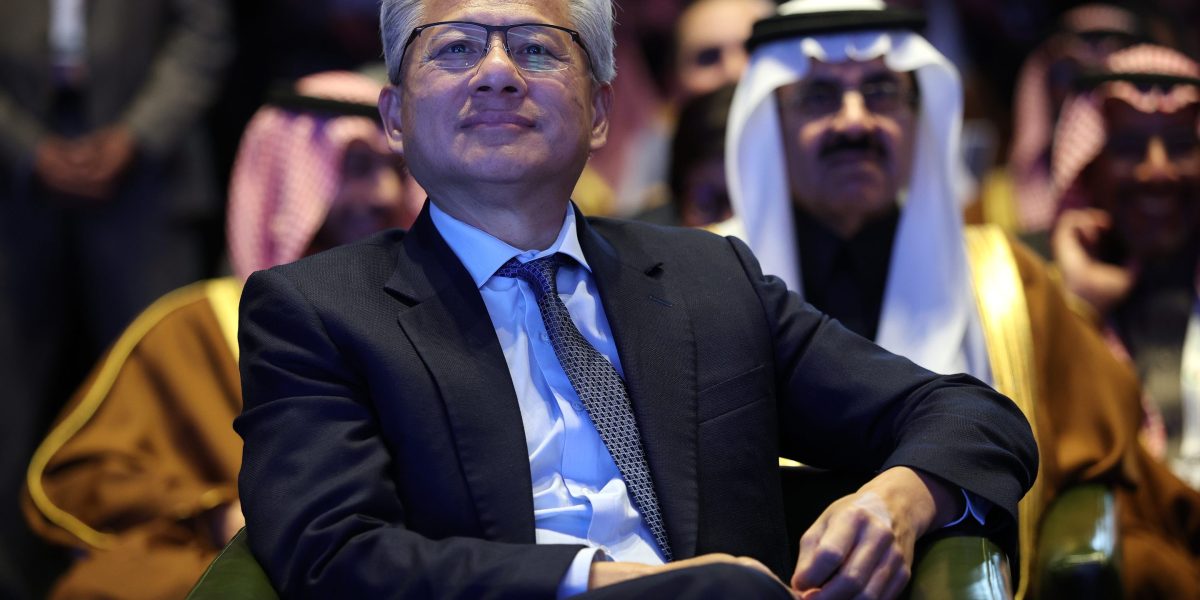
Nvidia’s recent earnings call highlighted a burgeoning player in the artificial intelligence (AI) landscape: Humain, a Saudi Arabian startup founded just six months ago. During the call, Nvidia CEO Jensen Huang emphasized Humain’s rapid ascent in the AI infrastructure sector, mentioning the company three separate times—placing it alongside major clients such as Amazon, Microsoft, Google, OpenAI, Anthropic, and Elon Musk’s xAI.
Founded by Saudi Arabia’s Crown Prince Mohammed bin Salman and backed by the nation’s $1 trillion Public Investment Fund, Humain aims to supply an ambitious 6% of the world’s AI computing power by 2034. If achieved, this would make it the world’s third-largest AI data center provider, trailing only the United States and China.
Huang’s remarks coincided with the Crown Prince’s state visit to the U.S., his first since 2018, during which Humain announced a major collaboration with Nvidia and Amazon. The deal includes deploying 150,000 Nvidia chips, including the powerful Grace Blackwell 300 models, in a new “AI Zone” data center being constructed in Riyadh.
Humain has also partnered with xAI to build a 500-megawatt data center in Saudi Arabia, with Nvidia once again providing the necessary chips. Huang explained, “Because of our deep partnership with Elon and xAI, we were able to bring that opportunity to Saudi Arabia, to the KSA, so that Humain could also be hosting opportunity for xAI.”
Led by former Aramco executive Tareq Amin, Humain is positioning itself as a full-stack AI company. This includes not only managing data centers for AI workloads but also developing models themselves. Among its recent achievements is ALAM, a large language model designed specifically for Arabic language tasks while avoiding culturally or politically sensitive areas. Humain has also launched an AI-native laptop and an operating system called Humain One.
The company’s largest potential impact lies in its AI infrastructure ambitions. Humain plans to build large-scale data centers that it can lease to cloud hyperscalers and AI companies. Saudi Arabia’s abundant energy resources—solar, oil, and gas—combined with fast-track permitting processes allow Humain to offer AI compute at roughly 30% lower cost than comparable processing in the United States. The country’s strong fiber-optic connectivity also enhances its value as an emerging AI hub.
Competing for AI Supremacy in the Middle East
Saudi Arabia is not the only regional player aiming to become an AI powerhouse. The United Arab Emirates (UAE) is aggressively expanding its own AI ecosystem. Its sovereign funds have heavily backed G42, a company building large-scale data centers for generative AI since 2018.
However, G42 has faced scrutiny from U.S. national security officials over potential ties to Chinese firms, delaying its access to Nvidia’s advanced chips. Even after a $1.5 billion investment from Microsoft in April 2024, the company struggled to secure necessary export approvals from the U.S. Commerce Department.
Similar concerns have been raised about Humain due to Saudi Arabia’s defense technology collaborations with China. Major firms like Aramco have publicly acknowledged using Chinese-developed models such as DeepSeek. Nevertheless, the Commerce Department recently approved the export of tens of thousands of Nvidia GPUs to both Saudi Arabia and the UAE.
Humain is also diversifying its partnerships beyond Nvidia. It secured a massive $10 billion deal with AMD to deploy 500 megawatts of AI computing power over the next five years. Additional partnerships with Qualcomm and AI chip startup Groq aim to further strengthen its computing ecosystem.
As Humain continues to expand at an unprecedented pace, its strategic alliances, infrastructure investments, and technological ambitions may position it as one of the Middle East’s most influential AI companies—potentially reshaping global competition in the AI infrastructure market.
See also Nvidia Boosts AI Chip Outlook, Revives Asian Tech and Chip Stocks by 3%+
 Baidu’s Robin Li Claims AI as Key to China’s New Productive Forces, Boosts Investments
 AI’s Energy Demand Threatens Global Agriculture, Warn Experts at Fortune Forum
 SingleStore CEO Raj Verma Warns AI Could Transform Civilization in 500 Years
 Students Use AI to Boost Learning: Do’s and Don’ts for Academic Success