





































Nvidia has halted production of its second-most advanced AI processors, the H200 chips intended for Chinese customers, as reported by the Financial Times. The chipmaker has redirected its manufacturing capacity at Taiwan Semiconductor Manufacturing Company (TSMC) from H200 production to its next-generation Vera Rubin hardware.
This decision follows Nvidia’s recent receipt of licenses from the U.S. government permitting the shipment of small quantities of H200 chips to China. However, the shift indicates that Nvidia’s executives do not anticipate significant sales of H200 chips in the Chinese market in the near future, even with regulatory approval.
Further complicating matters, U.S. officials are considering implementing caps that would limit Chinese companies to purchasing 75,000 H200 chips each. This restriction is reported to have been discussed among members of the Trump administration. Shipments of Advanced Micro Devices’ MI325 chips, which possess similar capabilities, would also count towards a customer’s cap under these proposed regulations.
Despite the potential for total shipments to China to reach as high as one million units based on earlier regulatory estimates, the cap would pose significant constraints on major Chinese tech companies like Alibaba Group Holding and ByteDance. Sources indicate that these firms privately communicated to Nvidia their desire for more than double the proposed 75,000-chip purchasing limit.
In a recent statement, Nvidia noted that it is not currently generating any data center revenue from China and is uncertain whether Beijing will permit imports even if Washington grants permission. Following the news of potential export caps, Nvidia’s stock fell nearly 1% to $181, while AMD’s shares dipped to $197.07.
The H200 represents Nvidia’s most powerful chip from its previous generation, serving as a de facto standard for training and operating AI software like ChatGPT until the introduction of its Blackwell line last year. The H200 chip boasts six times the computational capabilities of what was previously authorized for sale to China under the Trump administration.
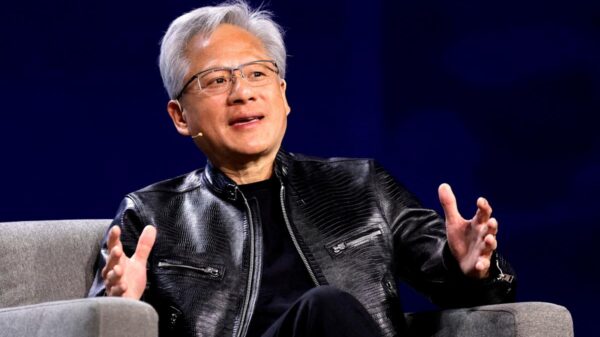
Concerns among U.S. officials, particularly those critical of China, focus on the belief that H200 exports could enhance China’s ability to develop advanced AI models without benefiting U.S. economic interests. However, Nvidia CEO Jensen Huang previously persuaded President Trump that such exports could foster a “positive economic relationship with China.”
Nvidia’s internal rationale suggests that maintaining Chinese AI companies’ reliance on American technology would hinder Huawei’s capacity to create a competitive global ecosystem. Commerce Secretary Howard Lutnick acknowledged in January that “there are plenty of people who disagree” with this assessment, but noted it was Huang’s argument driving the administration’s stance.
Implementing the regulatory framework has proven challenging since Trump’s December announcement authorizing H200 exports. U.S. officials have introduced constraints to mitigate potential negative outcomes, including ensuring that chip sales do not impact the availability for American firms and mandating that Chinese customers undertake thorough due diligence to prevent military applications.
Nvidia has expressed frustration with what it perceives as bureaucratic hurdles that undermine the vision originally outlined by Trump, at times claiming that U.S. export conditions are so stringent they deter Chinese companies from purchasing H200 chips altogether.
As geopolitical tensions and regulatory complexities continue to shape the semiconductor landscape, the future of Nvidia’s operations in China remains uncertain, with implications that could reverberate across the global technology market.
See also Tesseract Launches Site Manager and PRISM Vision Badge for Job Site Clarity
 Affordable Android Smartwatches That Offer Great Value and Features
 Russia”s AIDOL Robot Stumbles During Debut in Moscow
 AI Technology Revolutionizes Meat Processing at Cargill Slaughterhouse
 Seagate Unveils Exos 4U100: 3.2PB AI-Ready Storage with Advanced HAMR Tech