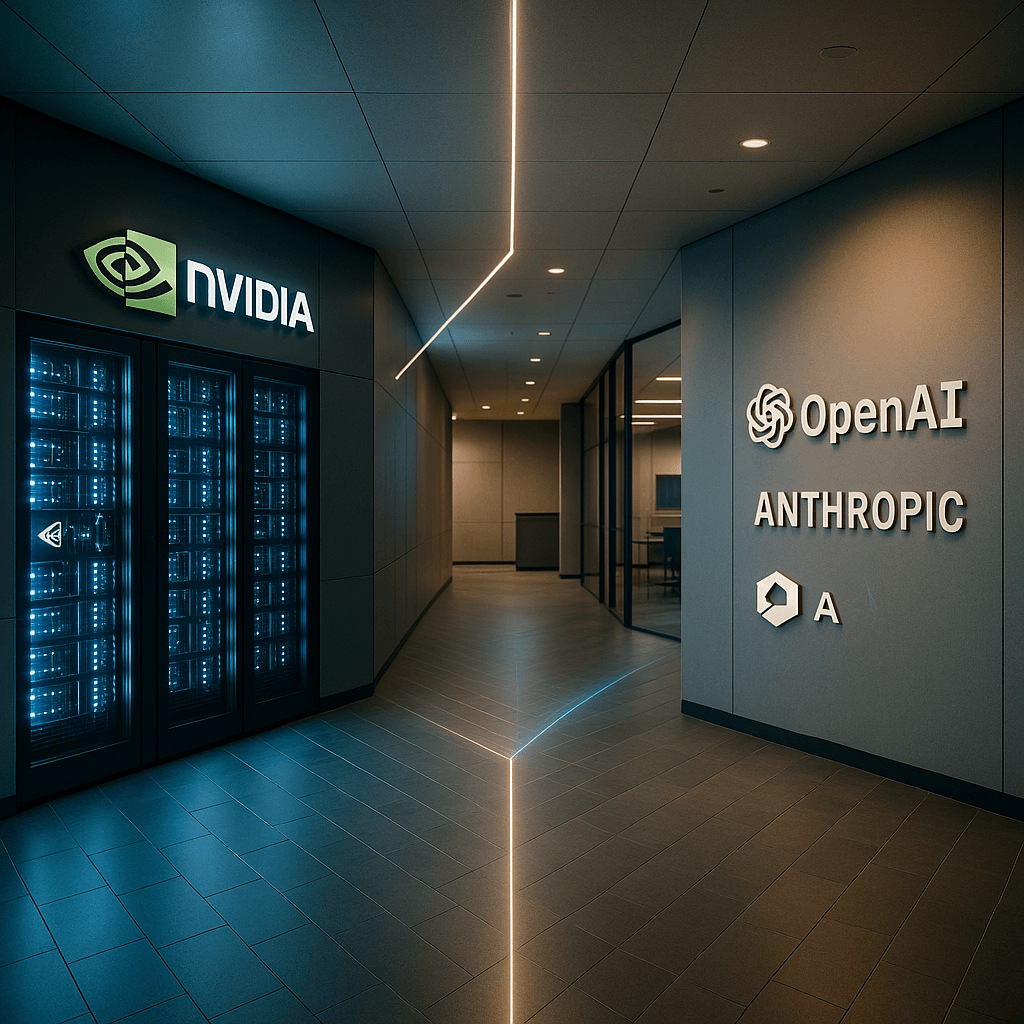
Nvidia CEO Jensen Huang announced on Wednesday that the company will cease further investments in OpenAI and Anthropic, a significant shift for the $2 trillion chip maker that has been a driving force behind the AI revolution. Huang’s comments, reported by TechCrunch, suggest that these investments could be the last that Nvidia makes in the AI lab space, raising eyebrows across the industry about the motivations behind this decision.
For years, Nvidia has been a pivotal player in the AI sector, supplying its powerful H100 and A100 GPUs, which have been essential for training large language models used in applications like ChatGPT and Claude. However, Huang’s decision to step back from direct venture capital investments in OpenAI and Anthropic, both significant customers consuming vast quantities of Nvidia’s GPUs, begs the question: why abandon equity stakes in companies that are effectively generating substantial revenue for Nvidia?
Huang’s explanation during the announcement was notably vague. He did not cite any regulatory concerns or mention financial returns, even though OpenAI’s valuation recently soared to over $150 billion and Anthropic is gaining momentum in the market. This lack of clarity has led to speculation about underlying issues that may be influencing Nvidia’s strategic direction.
One prevailing theory is that a conflict of interest may be at play. Nvidia has been rapidly expanding its own AI services, which include cloud AI offerings, enterprise platforms, and consulting. This expansion puts the company in direct competition with the very startups it once supported. Holding equity in OpenAI and Anthropic while simultaneously building rival products could create tensions that are difficult to navigate.
The strategic shift away from investments in these AI labs may also change the funding landscape for startups in the sector. Many emerging companies have relied on Nvidia’s backing alongside its hardware, and this pullback could alter the dynamics of investment in AI technologies. With Nvidia not actively investing, startups may need to seek alternative funding sources, which could lead to a more diversified investment ecosystem but also greater uncertainty.
Huang’s announcement marks a pivotal moment for Nvidia, as it repositions itself amidst a rapidly evolving AI landscape. The company has played a vital role in fostering the generative AI boom, and its decision to step back from its previous investment strategy may reflect broader challenges within the industry. As Nvidia pivots its focus toward its own AI initiatives, industry observers will be closely watching how this decision impacts both established players and new entrants in the AI space.
This shift in strategy could have far-reaching implications, not only for Nvidia but also for the AI startup ecosystem. If Nvidia’s competitors recognize the potential for a vacuum in investment, they may seize the opportunity to step in, potentially leading to an evolving competitive landscape. As the AI sector continues to grow, the dynamics of funding and investment may undergo significant transformations, reshaping how companies navigate this rapidly advancing field.
See also Defense Contractors Phase Out Anthropic AI Following Trump’s Federal Ban
 Tech Mahindra and Microsoft Launch Ontology-Driven AI Platform for Telecom Optimization
 Meta Develops Custom AI Chips to Enhance Efficiency and Expand AI Ecosystem
 Apple Launches MacBook Air and Pro with M5 Chips, Promises Up to 8x Faster AI Performance
 Accenture Acquires Ookla, Partners with Mistral AI to Boost Connectivity and AI Solutions