
















































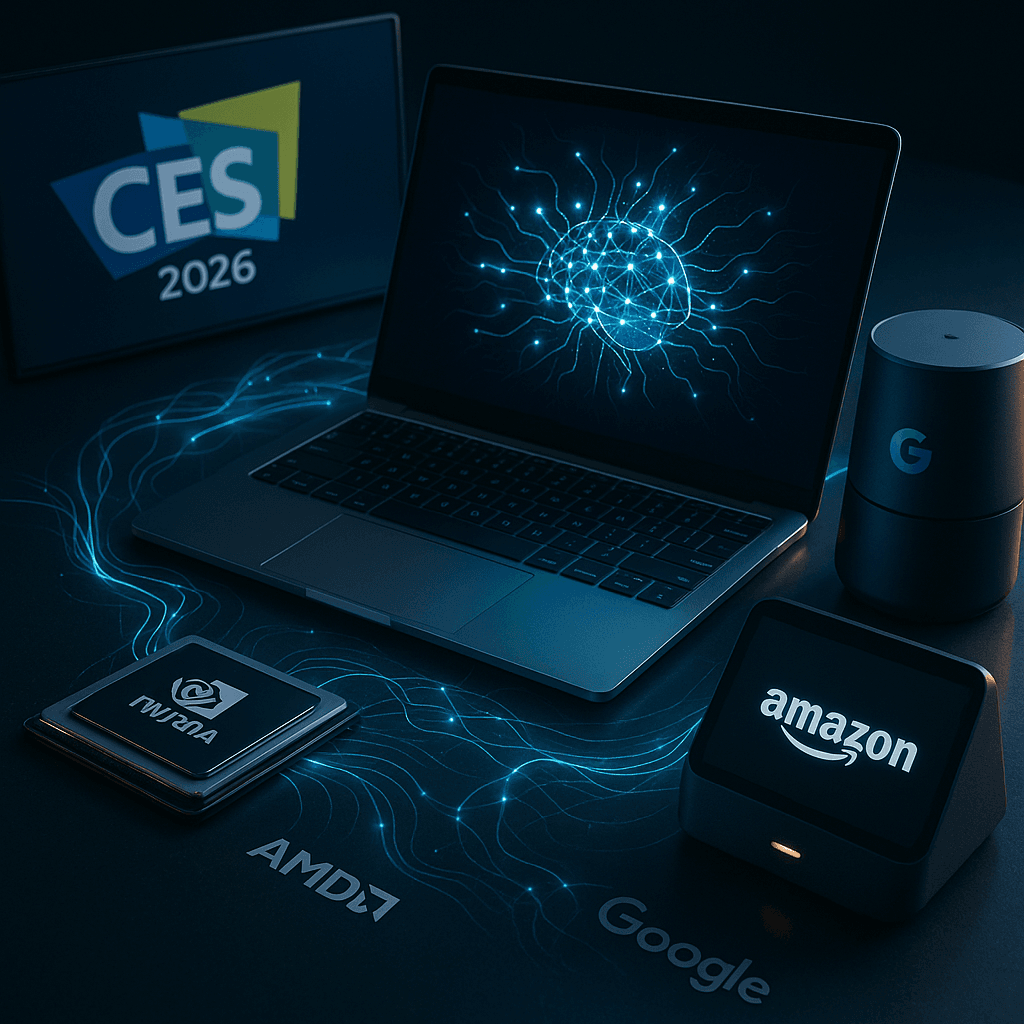
CES 2026 is officially underway in Las Vegas, showcasing a dramatic shift in the tech industry’s hardware strategy dominated by artificial intelligence. The first two days of press conferences highlighted how major companies are pivoting towards integrating AI directly into their hardware offerings. Nvidia began the event with its new Rubin computing architecture and advancements in autonomous vehicle models, while both AMD and Amazon announced robust initiatives aimed at embedding generative AI capabilities into consumer PCs and smart home devices.
The bustling atmosphere of Las Vegas reflects the usual CES chaos, yet there is a newfound clarity in the messaging from tech giants. A common theme has emerged, with companies collectively addressing the question: how can AI be made beneficial on the devices people use, rather than merely relying on cloud solutions?
Nvidia CEO Jensen Huang kicked off the event with a presentation that blended technical insights with a sense of triumph. Over the past two years, Nvidia has transformed its graphics processing units (GPUs) into the standard framework for both AI training and inference. The rollout of the Rubin architecture in the latter half of 2026 promises significant enhancements in speed and storage compared to the current Blackwell generation. More crucially, this move underscores Nvidia’s ambition to maintain a competitive edge in an increasingly crowded chip market, with rivals like AMD and Google developing custom silicon tailored for AI applications.
However, it was Nvidia’s focus on embodied AI that captured considerable attention. The company introduced its Alpamayo family of open-source models designed specifically for autonomous vehicles, positioning itself as the foundational infrastructure for both roboticists and automakers. This strategy reflects Nvidia’s ambition to become the “Android for robots,” providing the essential software layer that allows companies to concentrate on hardware and applications without the burden of training foundational AI models from scratch.
Following Nvidia, AMD launched its Ryzen AI 400 Series processors, attracting endorsements from influential figures like OpenAI President Greg Brockman and prominent AI researcher Fei-Fei Lei. The company’s message was clear: AI capabilities should not be limited to cloud data centers. AMD is betting that consumers seek generative AI functionalities operating locally on their laptops, ensuring privacy and minimizing latency. This announcement represents a strategic challenge to Nvidia’s dominance in the consumer PC chip market, asserting that AMD can compete effectively without ceding ground in data centers.
Significant robotics announcements also emerged, particularly from Hyundai, which revealed an unexpected partnership with DeepMind to train and operate its humanoid Atlas robots. This collaboration was highlighted during Hyundai’s press conference and carries substantial implications. The new generation of Atlas robots, showcased alongside existing models, are being powered by Google’s AI research, indicating that the creation of advanced humanoid robots now hinges not only on hardware engineering but also on access to cutting-edge AI infrastructure.
As CES 2026 unfolds, the overarching narrative emphasizes the critical role of AI in shaping the future of hardware technology. Companies are not merely launching products; they are redefining their entire approach to hardware development to meet the evolving demands of consumers and industries alike. The integration of AI at both the consumer and autonomous levels marks a pivotal moment in tech history, setting the stage for deeper collaboration and innovation across sectors. As the conference continues, the industry watches closely, poised to see how these developments will impact future product cycles and consumer adoption.
See also Razer Reveals AI-Powered Project AVA Companion and Next-Gen Gaming Innovations at CES 2026
 Siemens, NVIDIA Announce AI Industrial Revolution; Razer Unveils Game-Changing Tech at CES 2026
 Quantum AI: Researchers Highlight Hybrid Systems to Tackle AI’s Computational LimitsQuantum Computing and AI Collaborate to Enhance Computational Efficiency in Hybrid Systems
 Razer Launches Forge AI Dev Workstation with Purpose-built Hardware for Developers