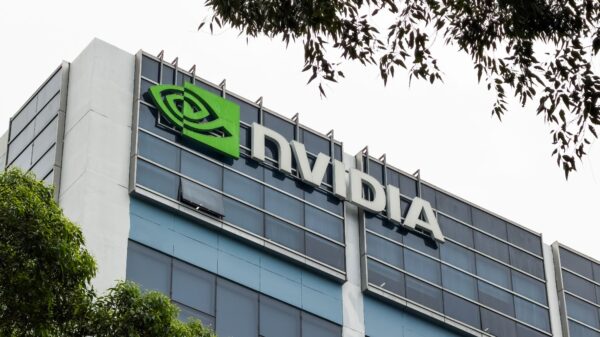
























































Nvidia’s stock performance has been remarkable in 2025, surging 32% as investors flock to generative AI-related hardware. This impressive growth has outpaced the S&P 500’s 15% return, raising questions about whether Nvidia can sustain its momentum into 2026 as the generative artificial intelligence boom shows signs of maturity.
With a market capitalization of $4.3 trillion, Nvidia stands as the largest company globally. Founded in 1993, the chipmaker has established a significant competitive edge, primarily through its proprietary Compute Unified Device Architecture (CUDA) software, which optimizes the performance of its graphics processing units (GPUs). This advantage has cultivated a vast ecosystem, making it challenging for competitors like Advanced Micro Devices (AMD) to gain market share despite offering comparable raw specifications.
The recent surge in demand for AI hardware has allowed Nvidia to capitalize on these longstanding advantages. In its third quarter, Nvidia reported a 62% year-over-year revenue increase, reaching $57 billion, largely fueled by the popularity of its new data center AI chips, including the Blackwell series. CEO Jensen Huang indicated that the demand for computational power continues to grow, and the company is preparing to release a new line of GPUs called Rubin, aimed at AI video generation, slated for late 2026.
However, amid such strong performance, some challenges loom on the horizon. Nvidia’s business model, while lucrative for shareholders, is becoming less favorable for its customers. The company enjoys a gross margin of 73.4%, a figure more akin to software firms than hardware manufacturers. While Nvidia is within its rights to maximize profits, its clients are under pressure to manage costs, particularly as industry leaders like OpenAI grapple with significant financial losses. Reports suggest that OpenAI lost over $11.5 billion in its latest quarter, with analysts projecting that combined losses across the sector could reach $140 billion by 2029.
Nvidia, as a key infrastructure provider for AI, could continue to thrive even as some of its prominent clients face difficulties. Nonetheless, the financial distress among consumer-facing AI entities signals an unstable foundation for the industry, potentially prompting investors to reassess their commitments. Additionally, many of Nvidia’s clients, including Alphabet, OpenAI, and Amazon, are increasingly investing in Application-Specific Integrated Circuits (ASICs)—custom chips designed for specific tasks that can outperform Nvidia’s general-purpose GPUs at a lower cost.
Despite the growing challenges from clients looking to reduce expenditures or develop in-house solutions, a significant crash in Nvidia’s stock appears unlikely. Even with a market valuation of $4.3 trillion, the stock’s forward price-to-earnings (P/E) multiple stands at 23, which is more affordable than the Nasdaq 100 average of 26. This suggests that market participants may have already factored in a slowdown in growth.
Investors considering Nvidia should be aware that the company did not make the latest list of the top stocks recommended by The Motley Fool Stock Advisor. Their analysts identified ten other stocks, which they believe could yield substantial returns in the upcoming years. For context, if an investor had put $1,000 into Netflix when it was recommended in December 2004, it would have grown to $506,935 today. Similarly, an investment in Nvidia on April 15, 2005, has appreciated to $1,067,514.
As the landscape of generative AI continues to evolve, Nvidia’s ability to navigate these potential hurdles while maintaining its competitive edge will be critical. The coming years could reveal whether the company’s stronghold in the AI hardware market can endure amidst increasing competition and financial strain on its customer base.
See also Strata Expanse Launches AI Data Center in Lawrence County, Ohio, to Boost Local Economy
 AI Transforms Healthcare: GE’s Digital Twins Enhance Hospital Operations and ROI
 HCLTech Acquires HPE’s Telco Solutions to Enhance AI and Network Engineering Capabilities
 ESDS Launches Sovereign GPU-as-a-Service, Achieves 29% Revenue Growth in FY25
 Advanced Circuits Revolutionize AI Hardware, Boosting Processing Speed by Up to 100x