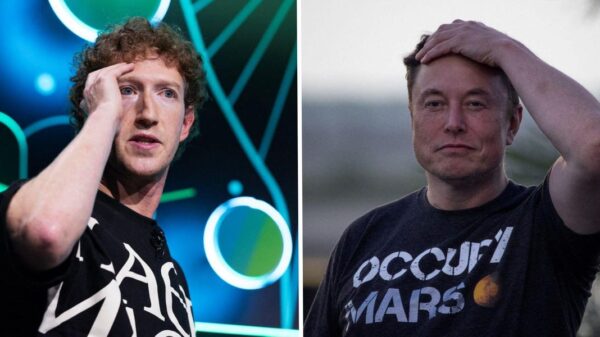



































The technology sector is abuzz with discussions surrounding the notion of the singularity, a concept recently endorsed by Elon Musk, who declared on X that we have entered this pivotal phase. He asserted, “2026 is the year of the Singularity,” in light of engineers’ astonishment at how artificial intelligence tools are rapidly compressing years of work into mere weeks. While such claims may seem dramatic, they reflect a burgeoning sentiment in Silicon Valley and beyond that a significant technological transformation is imminent, akin to the business concept of a flywheel popularized by Jeff Bezos, where recursive self-improvement leads to unprecedented progress.
Ray Kurzweil, a leading advocate for this idea since his book “The Singularity Is Near” was published in 2005, remains a pivotal figure in these discussions. Having spent over six decades in the field of artificial intelligence, Kurzweil’s track record for predictions about technology has been remarkably accurate. He forecasted that AI would reach human-level intelligence by 2029, a timeline that now seems increasingly conservative. His latest work, “The Singularity Is Nearer,” revises his original thesis for today’s AI landscape, reaffirming his belief that by 2045, human intelligence will amplify a billionfold through integration with AI.
It is vital to clarify what is meant by singularity in this context. Unlike a physics singularity, this concept refers to a compute singularity, a moment when technological advancement accelerates to a point where prediction becomes impossible, and machines begin to improve at a rate that outpaces human capacity to comprehend. Musk’s reference to being “on the event horizon of the singularity,” likens the concept to a black hole, suggesting an irreversible trajectory of rapid progress.
Sam Altman, CEO of OpenAI, echoes Musk’s sentiments, stating, “We are past the event horizon; the takeoff has started.” In a recent essay, Altman posited that humanity is on the brink of creating digital superintelligence. He anticipates that by 2025, AI agents capable of meaningful cognitive work will emerge, with systems generating novel insights by 2026, and robots capable of real-world tasks by 2027. Whether these predictions are overly optimistic or grounded in reality, they reflect a prevailing mood among AI developers.
Dario Amodei, CEO of Anthropic, takes a more measured approach, predicting that AI systems will match or surpass the abilities of Nobel Prize winners in most fields by late 2026 or early 2027. Amodei warns that humanity is entering a phase of “technological adolescence,” where newfound powers bring significant risks, questioning whether societal structures are ready to manage such capabilities.
The trajectory of technological growth is increasingly evident. Moore’s Law has historically driven a million-fold increase in computing power every 60 years, doubling roughly every 18 to 24 months. However, recent advancements in AI training have heightened this pace, with the compute power for large language models increasing fivefold annually. This translates to an astounding 15,000 times more compute in just six years, equivalent to three decades of traditional Moore’s Law progress. Researchers are contemplating “slow takeoff” versus “hard takeoff” scenarios; either way, the upward curve suggests we are nearing the point of escape velocity, where traditional constraints may no longer apply.
Quantum computing figures prominently in this evolving narrative. While classical computing has made remarkable strides, it faces inherent limitations. The potential of quantum systems, with their exponentially growing Hilbert space, offers computational capabilities that classical systems cannot efficiently navigate. Richard Feynman recognized this need in his 1981 MIT lecture when he stated that simulating nature necessitates a quantum mechanical approach. Classical computation struggles with even modest quantum systems, thus establishing the foundation for quantum computing’s emergence.
Beyond simulation, quantum mechanics plays a critical role in natural processes. Photosynthesis, for instance, achieves nearly perfect energy transfer by leveraging quantum coherence, a phenomenon that classical models fail to adequately explain. This integration of quantum mechanics into biological systems, honed over billions of years, suggests that our computing technologies should likewise harness these principles.
The interaction between AI and quantum computing is creating a feedback loop that accelerates both fields. Machine learning is enhancing quantum hardware and materials discovery, while quantum capabilities are poised to improve AI systems. For example, Google’s GNoME system has identified millions of stable inorganic crystal structures, compressing decades of research into mere months. Researchers at institutions like Yale and Emory are employing machine learning to identify complex quantum phases in materials with unprecedented speed.
As these dynamics unfold, the trajectory of quantum computing is gaining momentum. Google CEO Sundar Pichai likened the current state of quantum technology to AI five years ago, suggesting that a breakthrough phase is on the horizon. Google’s recent advancements, such as the Willow chip solving a problem in five minutes that would take classical supercomputers longer than the universe has existed, highlight the transformative potential of quantum capabilities.
While quantum systems still face challenges, including noise and error, the trajectory indicates that improvements are steadily being made, paralleling historical advancements in classical computing and integrated circuits. Quantum computing is not destined to replace classical systems entirely; rather, it represents a frontier that will augment computational capabilities necessary for sustaining exponential growth in technology.
As the technology landscape evolves, quantum computing is becoming increasingly integral. Industry investments are surging into the billions, with major providers offering quantum services and governments initiating national quantum initiatives. The compute singularity, when it arrives, will not be solely reliant on classical computation. Rather, it seems poised to be a multifaceted evolution, with quantum computing serving as a crucial component in the journey toward unprecedented technological advancement.
See also Check Point Reports 5.2% Stock Drop Post AI-Focused Strategy Update and 2026 Guidance
 Smartkarma Launches AI-Enhanced Investing Platform with 55,000+ Users, Free Preview Pass Available
 Peter Steinberger Joins OpenAI; OpenClaw to Remain Open Source Project
 Shanghai’s Model Speed Space Launches MiniMax M2.5, Promising 100 TPS for AI Innovations
 Big Tech’s $700B AI Spending in 2026 Threatens Europe’s Data Sovereignty