

















































A significant shift in the semiconductor market is anticipated, with forecasts from major players such as AMD, Nvidia, and Broadcom, along with leading research firms, suggesting that the industry will surpass the trillion-dollar mark before the decade concludes. This monumental growth is attributed primarily to a massive buildout of artificial intelligence (AI) infrastructure, which is expected to dwarf previous expansions in the sector’s history.
New insights from Creative Strategies characterize this trend as a “giga cycle,” indicating that the unprecedented demand for AI is fundamentally restructuring the economics of compute, memory, networking, and storage simultaneously. Currently, global semiconductor revenue is estimated at approximately $650 billion for 2024, yet projections now suggest that the market could reach the trillion-dollar threshold by 2028 or 2029, largely fueled by advancements in AI.
During a recent discussion, AMD CEO Lisa Su raised the company’s long-term expectations, describing the AI hardware market as a potential $1 trillion opportunity by 2030. She forecasted a 35% compound annual growth rate for AMD overall, with a striking 60% growth predicted for its data-center segment. Su emphasized the need for a measured approach to discussions surrounding the so-called AI bubble that has gained traction in recent months.
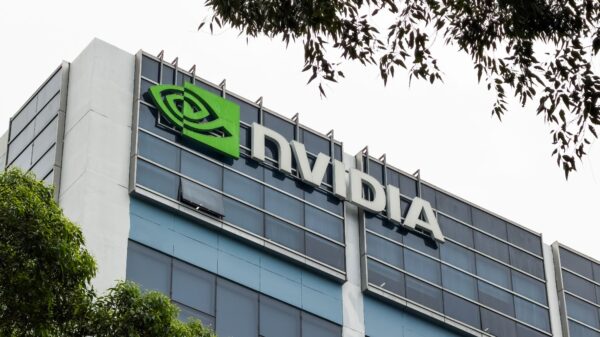
On the other hand, Nvidia has set even more ambitious forecasts, predicting a $3 trillion to $4 trillion opportunity in AI infrastructure over the next five years. This projection, articulated during the company’s Q2 2026 earnings call, is based on anticipated system-level deployments across hyperscalers, government AI initiatives, and enterprise clusters.
The implications of these developments are profound. Creative Strategies anticipates that data-processing silicon will account for over half of total semiconductor revenue by 2026. AI accelerators, which were valued at under $100 billion in 2024, are expected to surge to between $300 billion and $350 billion by 2029 or 2030. This exponential growth in AI spending is projected to significantly elevate system expenditures, with the AI server market estimated to expand from around $140 billion in 2024 to as much as $850 billion by 2030, which will radically alter chip demand even before considering custom silicon development.
As AI adoption accelerates, the role of ASIC, or application-specific integrated circuit, development has become increasingly critical within hyperscaler roadmaps. Broadcom, for instance, anticipates that its custom-silicon division will exceed $100 billion in revenue by the end of the decade. The company has already announced a $10 billion AI infrastructure order from a client believed to be OpenAI, underscoring the substantial market potential.
However, the industry is grappling with significant constraints in memory and packaging. Revenue from high-bandwidth memory (HBM) is projected to grow from about $16 billion in 2024 to more than $100 billion by 2030. Each generation of HBM consumes a larger percentage of wafer supply compared to conventional dynamic random-access memory (DRAM), further driving up the broader memory market as AI clusters scale. Similarly, advanced packaging solutions are under pressure, with CoWoS capacity expected to increase by over 60% from the end of 2025 to the end of 2026.
According to Creative Strategies, “The defining characteristic of the semiconductor giga cycle is that the market expansion is large enough to create greenfield opportunities across every segment of the value chain.” This indicates a unique moment in the industry, where growth is not confined to any single area but is instead widespread across all segments.
As this transformation unfolds, the semiconductor market is poised to undergo a paradigm shift, impacting broad sectors of the economy and redefining the landscape of technology innovation. The rise of AI is not only enhancing capabilities but also catalyzing new avenues for expansion and investment across the industry.
See also Nvidia Develops Software to Monitor AI Chip Locations Amid Export Control Pressures
 Alibaba Launches Qwen Consumer Business Group to Accelerate AI Adoption with 10M Downloads
 AI Revolutionizes HR: Major Firms Automate 40% of Processes, Boost Efficiency
 AI-Enabled Cyber Operations Raise Legal Complexities, Warns Military Symposium Experts
 China Approves Cambricon and Huawei as AI Hardware Suppliers, Excludes Nvidia