












































LAS VEGAS — Crowds filled the newly opened showroom floors on Day 2 of CES, encountering a vast array of innovations, including thousands of robots, AI companions, and health longevity technology. The event serves as a significant showcase for companies to present products slated for release throughout the year.
Siemens President and CEO Roland Busch delivered a keynote address outlining how customers are leveraging artificial intelligence to transform their businesses. He was joined onstage by Nvidia CEO Jensen Huang, who announced an expanded partnership aimed at launching a new AI-driven industrial revolution, set to reinvent manufacturing, production, and supply chain management.
Lenovo concluded the day with a visually rich presentation emphasizing its AI platforms tailored for personal use, business applications, and global impact. CEO Yang Yuanqing showcased the company’s vision alongside tech leaders such as Huang, AMD CEO Lisa Su, and Intel CEO Lip-Bu Tan.
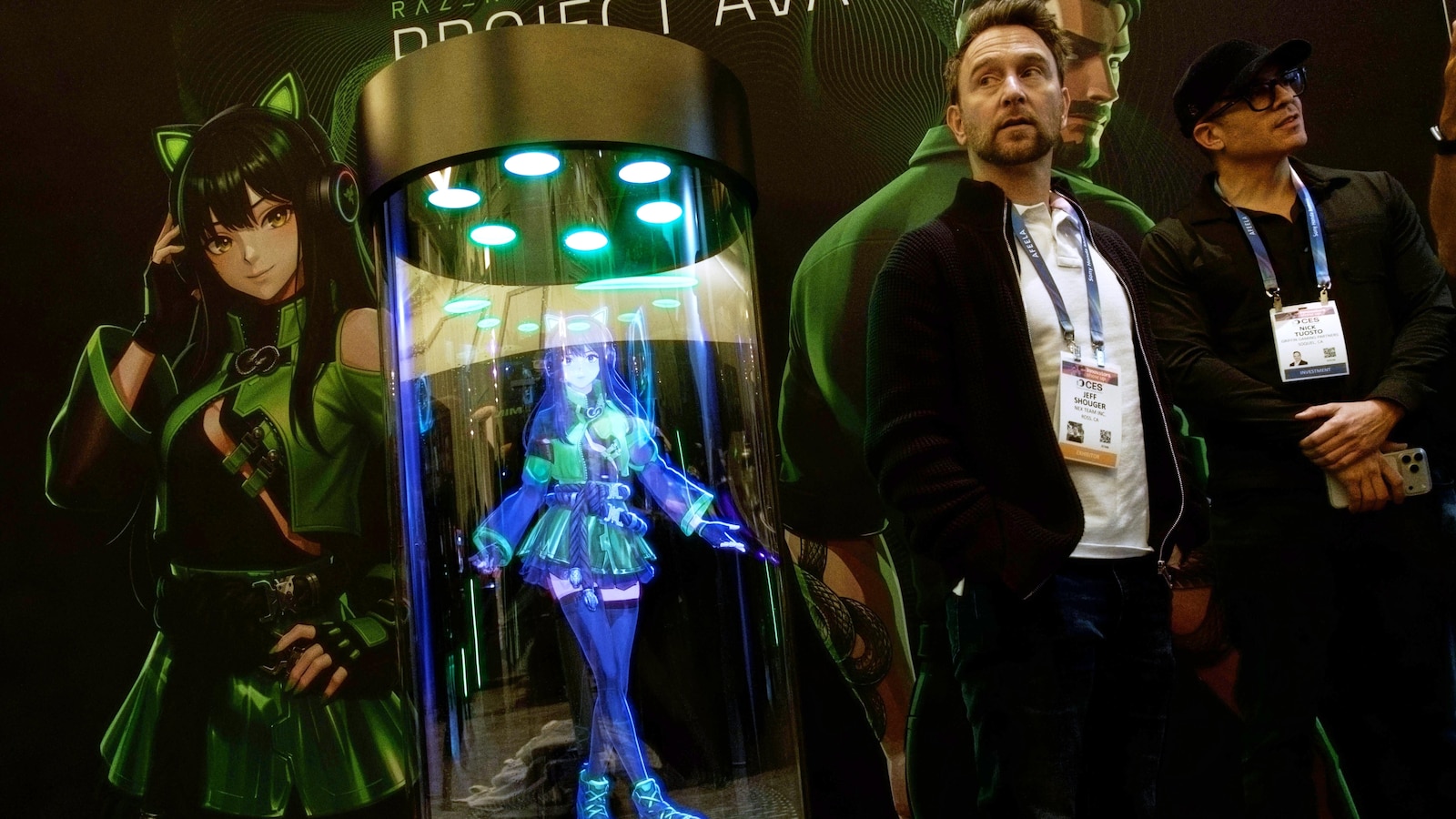
Among the notable highlights, gaming tech company Razer introduced two AI-powered prototypes designed to extend beyond its gaming roots. The first is an over-ear gaming headset that doubles as a general-purpose assistant, while the second is an AI desk companion capable of providing gaming advice and managing daily tasks. The headset, named Project Motoko, and the companion, Project Ava, which transitioned from an on-screen AI assistant to a holographic form inside a small glass tube, are expected to be commercially available later this year. For the demonstrations, Project Motoko operated using OpenAI’s ChatGPT, and Project Ava utilized xAI’s Grok.
In a vision for the future of airport operations, Oshkosh Corporation unveiled a fleet of autonomous robots designed to streamline the post-landing processes for aircraft. CEO John Pfeifer described the initiative as part of achieving “the perfect turn,” which encompasses tasks such as refueling and cleaning after a plane lands. The technology aims to reduce delays while maintaining safety, particularly in adverse weather conditions. Testing with major airlines is already underway, with plans for deployment at major airports like Atlanta and Dallas over the next few years.
In another innovative approach to cleaning, Roborock, a Chinese robovac manufacturer, introduced a vacuum cleaner featuring chicken-like legs designed to navigate stairs effectively. The newly launched Saros Rover demonstrated its capabilities during a CES demo, although it was noted to be somewhat slow in its movements. Roborock has yet to announce a release date for the product, which is still undergoing development.
Health tech also took a front seat as Withings showcased its new Body Scan 2, a smart scale that measures more than just weight. This $600 device, set for release in the spring, provides users with a comprehensive analysis of 60 biomarkers, including heart age and metabolism, using sensors in the scale’s pads. The product is accompanied by an app available for a monthly or annual subscription, aimed at helping users monitor their health and promote longevity.
In a significant collaboration, Commonwealth Fusion Systems, Nvidia, and Siemens announced plans to accelerate the development of nuclear fusion as a new source of carbon-free energy. Based in Massachusetts, Commonwealth Fusion Systems is constructing a prototype fusion power plant called SPARC, which is approximately 70% complete. The partnership aims to create a “digital twin” of the physical machine to enhance the speed and effectiveness of the research and development process. CEO Bob Mumgaard indicated that this approach will compress years of experimentation into weeks of actionable insights.
SPARC serves as a precursor to Commonwealth Fusion Systems’ planned power plant, ARC, intended to connect to the grid in the early 2030s. The project will utilize strong magnets to create conditions conducive to fusion. Mumgaard also confirmed that the first high-temperature superconducting magnet has been installed in SPARC, a crucial step towards achieving the company’s goals.
See also Quantum AI: Researchers Highlight Hybrid Systems to Tackle AI’s Computational LimitsQuantum Computing and AI Collaborate to Enhance Computational Efficiency in Hybrid Systems
 Razer Launches Forge AI Dev Workstation with Purpose-built Hardware for Developers
 Nestlé’s CIO Highlights AI’s Value Beyond Efficiency, Focusing on Enhanced Fulfillment
 Big 7 AI Companies Propel Edge Computing Innovations with 2026 Market Insights