





















































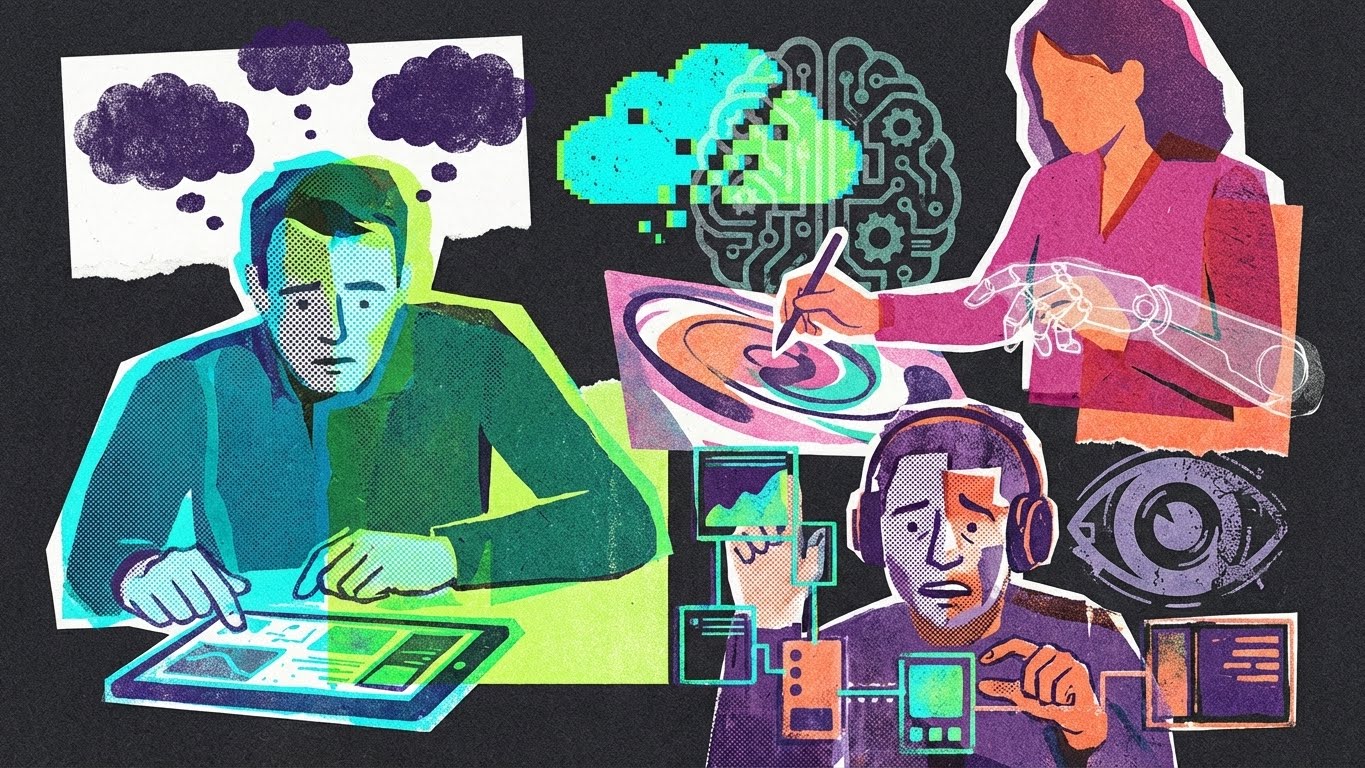
A recent study by Anthropic indicates that while creative professionals experience productivity boosts from AI tools, many conceal their usage from peers due to social stigma and concerns over job security. The Anthropic Interviewer, a new AI-powered research tool, surveyed 1,250 professionals across various fields about their interactions with AI. Although a majority of respondents assert that AI enhances their productivity, those in creative roles express apprehensions about its implications for their careers and social reputation.
The study utilized automated conversations with three distinct groups: 1,000 workers from diverse industries, alongside 125 scientists and 125 creative professionals. Each interaction lasted approximately 10 to 15 minutes. The findings were analyzed with the help of an automated clustering tool designed to identify recurring themes and their frequency.
Despite positive reports on efficiency gains, these advancements come with drawbacks. Among creative professionals, 97 percent indicated that AI saves them time, and 68 percent believe it has improved their work quality. For example, a web content writer noted an increase in output from 2,000 to over 5,000 words daily, while a photographer shared how AI expedited routine editing tasks, reducing turnaround times from 12 weeks to just 3.
However, these productivity enhancements are shadowed by social challenges. Anthropic reports that 70 percent of creative professionals face stigma from colleagues regarding their use of AI. One map artist stated, “I don’t want my brand and my business image to be so heavily tied to AI and the stigma that surrounds it.” This sentiment extends to the broader workforce, where 69 percent of respondents express similar concerns. A fact checker remarked, “A colleague recently said they hate AI and I just said nothing. I don’t tell anyone my process because I know how a lot of people feel about AI.”
Economic anxiety is another significant theme among creatives. Many voiced fears about job displacement and the perceived devaluation of human creativity. One voice actor lamented that certain sectors, such as industrial voice acting, have nearly vanished due to the rise of AI. A composer expressed worry about platforms that might use AI to flood markets with inexpensive substitutes for human-created music. “Realistically, I’m worried I’ll need to keep using generative AI and even start selling generated content just to keep up in the marketplace so I can make a living,” noted another artist.
Despite these concerns, all surveyed creatives indicated a desire to maintain control over their work. However, many admitted that AI often influences creative decisions. “The AI is driving a good bit of the concepts; I simply try to guide it… 60% AI, 40% my ideas,” one artist explained. A musician added, “I hate to admit it, but the plugin has most of the control when using this.”
In contrast, scientists report a more collaborative experience with AI. Their primary applications include literature review, coding, and writing, although they maintain that AI struggles with core research tasks such as generating hypotheses. An information security researcher noted, “If I have to double check and confirm every single detail the [AI] agent is giving me to make sure there are no mistakes, that kind of defeats the purpose of having the agent do this work in the first place.” Nonetheless, 91 percent of scientists expressed a desire for greater AI support in their research, with one medical scientist stating, “I would love an AI which could feel like a valuable research partner… that could bring something new to the table.”
The Anthropic study revealed that 65 percent of respondents view AI as a tool for augmentation—enhancing human capabilities—while 35 percent see it as a form of automation. This self-perception contrasts with Anthropic’s earlier analysis of actual AI usage, which indicated a nearly even split. Various factors may contribute to this discrepancy, including users potentially editing AI outputs or employing different AI services for distinct tasks.
According to the study, nearly half of the respondents are contemplating transitions to roles focused on monitoring AI systems. A pastor remarked, “If I use AI and up my skills with it, it can save me so much time on the admin side which will free me up to be with the people.”
As Anthropic plans to broaden the application of its interview tool, users of Claude.ai may soon encounter prompts inviting them to participate in similar studies. The company intends to analyze and publish the anonymized results as part of its ongoing social impact research, although the study does acknowledge methodological limitations, including potential selection bias and the predominance of Western participants.
See also AI and Machine Learning Set to Transform India’s Power Distribution Networks, Says Khattar
 AI Bubble Risks Emerge as Tech Giants Invest Trillions Without Profitable Returns
 Demis Hassabis Urges Maximum AI Scaling to Achieve AGI Amid Industry Concerns
 UAE’s $148B AI Investment Set to Boost Economy by 0.7%, Says IMF’s Jihad Azour
 Marvell Acquires Celestial AI to Revolutionize Optical Interconnects for AI Data Centers