























































An Increased Use of AI Tools Across Industries
According to Stanford’s 2025 AI Index report, a massive 78 percent of organizations are already using AI in at least one part of their work, up from 55 percent just a year ago. This rapid adoption underscores the growing reliance on powerful, proprietary models known as Large Language Models (LLMs), which drive tools such as ChatGPT, Gemini, and Claude.
The increase in AI utilization is reshaping workforce dynamics, particularly for junior roles. A study from Harvard University, which tracked 62 million workers across 285,000 US firms, found that entry-level positions are shrinking in companies that have integrated AI since 2023. This trend appears to be eroding the “bottom rungs” of career ladders, automating many tasks typically handled by junior employees.
Further research from Stanford University corroborates these findings, indicating that workers aged 22–25 in AI-exposed fields experienced a 13 percent relative decline in employment, even as older colleagues saw gains in the same sectors. This indicates a significant and disproportionate impact on entry-level workers.
Professor Giancarlo Crocetti, D.P.S., at The Lesley H. and William L. Collins College of Professional Studies at St. John’s University, cautioned that companies are deploying AI so rapidly that they may be restructuring their workforces without understanding the long-term implications. “The real challenge isn’t just that AI is changing work, it’s that we’re deploying it faster than we can understand its implications,” he said. “Companies are making irreversible decisions about workforce structure based on projected efficiencies that may not materialize or that may create new, unforeseen problems.”
To better understand the effects on early-career roles, Bob Beaudet, Director of Employer Relations at The Peter J. Tobin College of Business, noted that “anything repetitive, in any industry, is being affected.” In fields like accounting and data-heavy finance roles, businesses are slowing down hiring due to uncertainties about how AI will reshape job functions.
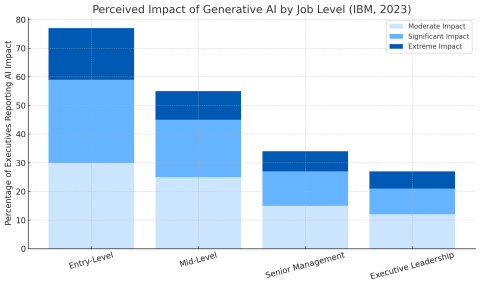
Data indicates that entry-level roles are expected to be hit the hardest, with 77 percent of executives predicting moderate to extreme disruption from AI technologies. However, experts emphasize that this does not imply that all beginner jobs will disappear. Rather, as AI takes over repetitive tasks, employees can redirect their efforts toward higher-value work, enhancing productivity.
According to Google Chief Executive Officer Sundar Pichai, AI acts as a performance booster, allowing organizations to achieve more with the same workforce. The emergence of AI agents—autonomous tools capable of completing multistep tasks—further illustrates this trend. These agents can handle scheduling, data retrieval, and documentation, acting as digital teammates rather than replacing human roles.
An example of this can be seen at NYU Langone, a healthcare facility that deployed an AI assistant to aid medical scribes in summarizing patient notes and suggesting billing codes. This implementation sped up documentation processes without displacing staff, enabling them to focus more on patient care.
Despite these advancements, educators and business leaders caution against the drastic elimination of junior roles. Amy Edmondson from Harvard Business School argues that cutting entry-level positions is short-sighted, as these roles are crucial for developing future leaders. Instead, companies are encouraged to redesign these positions to leverage AI for routine tasks while allowing humans to focus on judgment and creativity.
As AI continues to permeate various industries, traditional job preparation is becoming insufficient. A 2023 IBM global study found that 40 percent of the workforce will require reskilling within just three years, particularly in entry-level positions. The demand for AI-related skills is rising across nearly every sector of the economy, not limited to technology.
Moreover, there is an increasing emphasis on responsible AI use. Microsoft’s 2025 AI in Education report indicates that while over 60 percent of students have experimented with AI tools, many lack guidance on effective and ethical usage. Educational institutions are starting to address this gap by incorporating AI literacy and hands-on training into their curricula.
“Employers expect students to have some knowledge of AI tools, even if they’re not specific about which ones,” says Beaudet. “Some companies even have internal AI platforms that employees must use, so they want candidates who can navigate these tools confidently.”
In the evolving job market, the need for new skills is pressing. A 2023 Work Trend Index report from Microsoft found that 82 percent of leaders believe employees will need new competencies as AI continues to grow. Learning to work alongside AI will require not only technical capacity but also the development of soft skills that AI cannot easily replicate, such as creativity and empathy.
As workers face this new landscape, they will need to be adaptable problem solvers who can collaborate effectively with both humans and AI tools. Companies that embrace this reality will not only secure their workforce but also foster a more innovative environment, ensuring that AI serves as an enhancement rather than a replacement.
See also DeepSeek Develops AI Model Using Smuggled Nvidia Chips Amid US Export Ban
 SIMPLE CHARM Transforms Beauty Tech with AI-Powered Precision and Safety Standards
 Pew Research Reveals 64% of U.S. Teens Use AI Chatbots Daily, Led by ChatGPT
 UAE’s BRIDGE Summit 2025 to Host 60,000+ Attendees, Set to Transform Global Media Landscape
 Florida Lawmakers Review AI Data Center Infrastructure Amid Rising National Demand