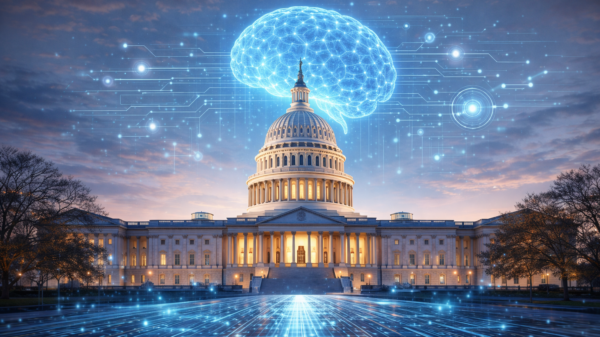

















































Artificial intelligence (AI) has emerged as a pivotal element in the geopolitical landscape, reshaping state sovereignty and influencing global power dynamics. An essay by Paolo Falconio delves into AI’s role as a structural factor in 21st-century geopolitical competition, highlighting its significance not just as a technological advancement but as a critical infrastructure for economic, military, and regulatory power. The analysis contrasts three governance models: American, Chinese, and European, emphasizing their inherent value differences and the ensuing struggle for normative hegemony.
The paper further explores the Sino-American rivalry, focusing on the semiconductor supply chain, AI militarization, and the systemic risks associated with automated decision-making. Special attention is given to the Arab world, which presents a complex picture of modernization ambitions, particularly in the Gulf monarchies, alongside the structural constraints faced by North African states and post-conflict regions. The discussion extends to the proliferation of digital authoritarianism, new forms of technological dependence, and emerging challenges to states’ epistemic sovereignty. The narrative underscores the fragmentation of global AI governance and the contradictions between AI’s potential for ecological transition and its substantial energy footprint.
AI’s role as a transformative force goes beyond its technological attributes; it integrates deeply into various facets of civil, military, and economic life, which complicates the boundaries between national security and social control. This multifaceted nature of AI requires a control framework over an interdependent ecosystem composed of advanced semiconductors, cloud architectures, massive datasets, and specialized skills. In this regard, access to AI technology becomes a new strategic asset, creating vulnerabilities for nations excluded from this essential infrastructure.
The three AI governance models differ significantly, reflecting distinct visions of the state-technology relationship. The U.S. model emphasizes a liberal-market approach characterized by minimal regulation, fostering rapid innovation through strong private sector involvement. Companies like Google, Microsoft, and OpenAI not only drive technological progress but also assume quasi-legislative roles in defining global digital norms. However, this unregulated model raises concerns about accountability and democratic legitimacy, prompting debates in Congress about the necessity of stricter regulations.
Conversely, the Chinese governance model represents a stark contrast, with a centralized approach that intertwines AI development with state objectives. The “New Generation Artificial Intelligence Development Plan” articulates AI’s role in achieving military superiority and social stability, exemplifying how technological advancements can reinforce authoritarian governance. The Social Credit System illustrates the potential for AI to function as a tool for state control, thereby raising international alarm about the exportation of these governance models.
The European regulatory model aims to protect fundamental rights while fostering innovation. The AI Act, passed in 2024, exemplifies Europe’s attempt to create a comprehensive regulatory framework based on risk classification for AI systems. However, this approach faces criticism regarding its potential to hinder innovation and exacerbate Europe’s lag behind the U.S. and China in AI capabilities. Proponents argue that Europe’s regulatory efforts could generate soft power akin to the GDPR, establishing global norms in the digital space.
Amid these dominant models, an alternative path lies in the open-source AI ecosystem. This approach champions radical transparency and redistributive accessibility, allowing anyone with the requisite skills to utilize and adapt AI models. This democratization of AI could empower countries in the Global South to develop native AI capabilities aligned with local needs, reducing reliance on proprietary technologies. However, challenges persist, particularly concerning resource intensity and dependencies on proprietary hardware.
The Sino-American competition for AI supremacy outlines a new cold war dynamic, steeped in complexities stemming from economic interdependence. The semiconductor industry stands as a critical battleground, with both nations vying for control over advanced chip production. The U.S. has implemented export restrictions to limit China’s technological advancements, while China accelerates its push towards semiconductor self-sufficiency through substantial investments.
In the Arab world, the pursuit of AI varies significantly. Gulf monarchies like the UAE and Saudi Arabia have incorporated AI into their long-term strategies, aiming to transition from oil reliance to technology-driven economies. However, challenges such as reliance on foreign technology providers and a lack of indigenous innovation remain. In contrast, North African countries face even greater constraints, with limited resources and political instability hampering AI adoption.
In conclusion, the geopolitical implications of AI extend far beyond technology, influencing power dynamics, state sovereignty, and social order. As AI continues to evolve, the competition for establishing governance structures will be crucial in shaping the future digital landscape. The pressing challenge is to foster an inclusive technology framework that aligns development priorities with local contexts, ensuring that the benefits of AI are equitably distributed rather than reinforcing existing inequalities.
See also 2026: Focus on Profitable AI Firms, 15 Companies Emerge as Industry Leaders
 Perplexity Launches BrowseSafe to Mitigate AI Browser Security Flaws
 Industrial AI Adoption Stalls: 88% Utilize Tech, Yet Only 39% See Earnings Impact
 OSCE Empowers Uzbekistan’s Future: Young Journalists Trained in Media, AI, and Ethics
 OpenAI Faces Competition from Microsoft, Anthropic as AI Firms Target Australia’s Big Banks