
















































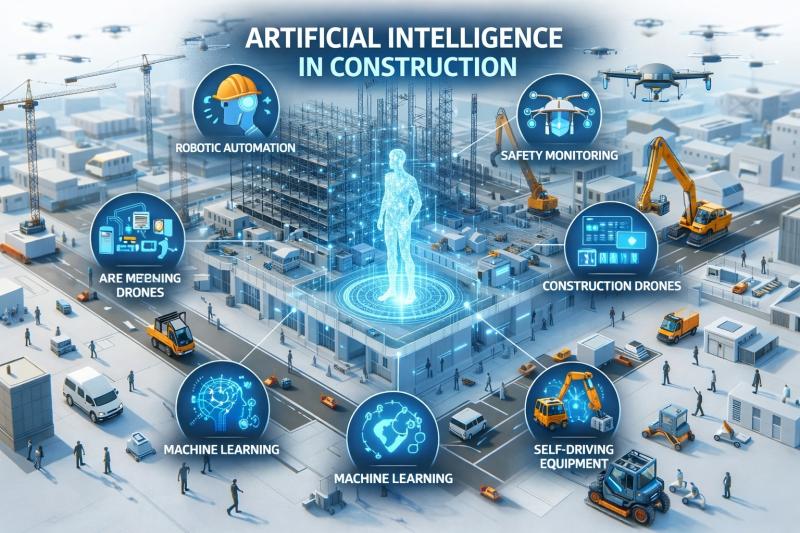
Artificial Intelligence is set to transform the construction industry, with the global market for AI in construction projected to reach US$ 15.88 billion by 2032, up from US$ 4.22 billion in 2024. This growth represents a CAGR of 21.1% during the forecast period from 2025 to 2032. The surge in market demand is driven by the increasing adoption of AI-powered technologies aimed at enhancing project planning, cost estimation, risk management, and on-site safety.
The implementation of AI solutions, including predictive analytics, computer vision-based site monitoring, autonomous construction equipment, and AI-enabled building information modeling, is enabling contractors to boost productivity, minimize delays, and optimize resource utilization throughout the project lifecycle. As urban infrastructure develops and smart city initiatives expand, there is a rising demand for efficient and sustainable construction practices, further fueling AI integration in various construction sectors.
In 2025 and 2026, construction firms in North America, particularly in the United States and Canada, accelerated the adoption of AI tools to enhance project planning, conduct risk analysis, and optimize resources. This strategic shift is believed to improve adherence to timelines and reduce cost overruns. Meanwhile, European countries are focusing on regulatory measures related to construction safety and sustainability, driving the deployment of AI-enabled site monitoring and energy-efficient design analytics in major commercial and infrastructure projects.
Japan faces unique challenges such as an aging workforce, prompting the implementation of AI-driven robotics and autonomous equipment to improve on-site automation, quality control, and workflow efficiency. In the Asia-Pacific region, excluding Japan, rapid urbanization and substantial infrastructure investments are increasing the demand for AI solutions that facilitate real-time project tracking and automated materials management.
Globally, advancements in machine learning, computer vision, and drone-based inspection technologies are enhancing construction site safety, monitoring progress, and improving defect detection accuracy. In Latin America, a growing number of public and private construction projects are driving the adoption of AI-based bidding, scheduling, and cost estimation software, aiming to enhance project competitiveness and resource planning.
Significant mergers and acquisitions are taking place as major players seek to enhance their portfolios. In January 2026, a global construction technology provider acquired an AI-driven project analytics firm to bolster its offerings in intelligent planning and predictive performance solutions. Similarly, a multinational software company acquired a computer-vision-based construction inspection startup, aiming to integrate automated site analysis and quality reporting into its core platform.
The market is dominated by key players such as Building System Planning, Inc., SAP SE, Autodesk, Inc., NVIDIA Corporation, and Microsoft Corporation, among others. The expansion of AI-powered construction management platforms that offer predictive scheduling and risk assessment capabilities is notable, as is the integration of digital twins and building information modeling for optimized design and lifecycle management.
Geographically, North America commands a 35% share of the market, bolstered by early adoption and substantial infrastructure investments. The Asia-Pacific region follows with a 31% share, spurred by rapid urbanization and government support for digital construction technologies. Europe holds a 26% share, largely due to sustainability regulations and increased smart infrastructure development. The Middle East and Africa account for 5%, driven by mega infrastructure projects, while Latin America captures 3% as gradual digitalization takes hold.
As the construction industry grapples with the need for cost optimization and efficiency, the integration of AI technologies is expected to expand further. Industry developments, such as the use of autonomous equipment and AI-based safety monitoring, are set to enhance operational efficiency and reduce accidents. Strategic collaborations among construction firms, technology providers, and cloud companies are accelerating digital transformation initiatives, making the AI in construction market one of the most dynamic sectors to watch in the coming years.
For further insights and detailed analysis, industry stakeholders can access comprehensive reports and strategies through platforms such as DataM Intelligence, which offers extensive market intelligence and consulting services.
See also Voxtral Launches Transcribe 2 with 13-Language Support and Sub-200ms Latency
 IBM Secures $151B Defense Contract, Signals AI-Driven Workforce Transformation
 AI Generates Disturbing Fake Images of Epstein with World Leaders, Revealing Deep Risks in Deepfake Technology
 Google DeepMind Unveils Reinforced Attention Learning to Combat AI Amnesia
 India’s AI Impact Summit 2026: Pioneering Global Solutions for Humanity and Climate Action