













































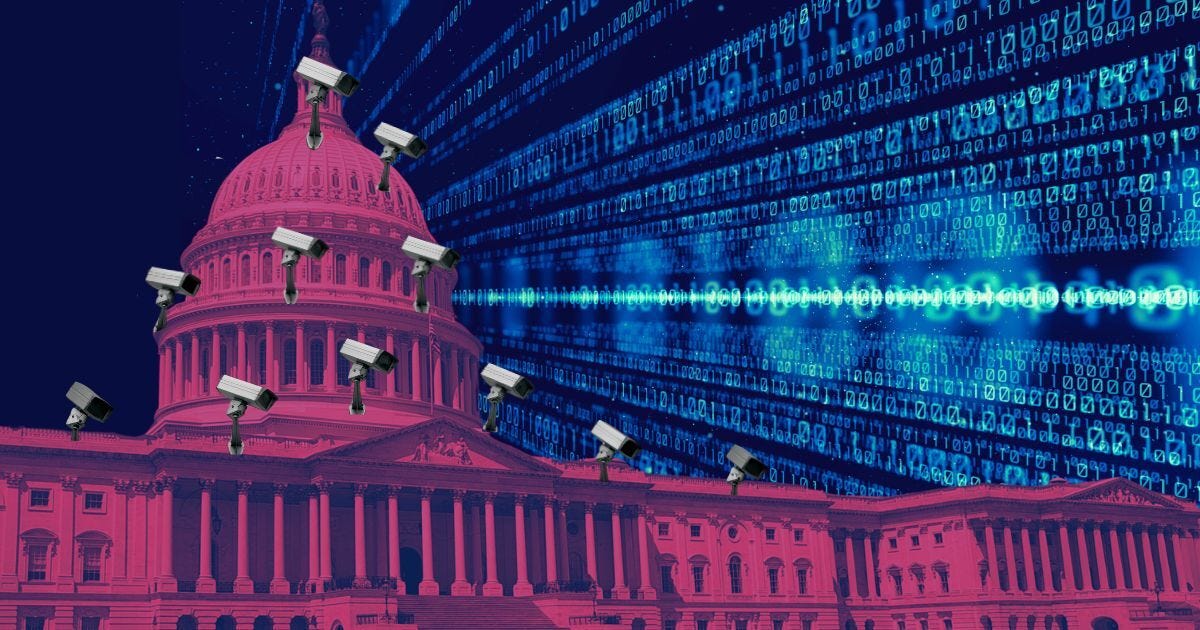
In a significant confrontation between the U.S. Department of Defense and AI startup Anthropic, the Pentagon’s interest in employing Anthropic’s AI model, Claude, for domestic surveillance has raised profound privacy concerns. According to a report from The Atlantic, the government intended to utilize Claude to process sensitive data, including Americans’ GPS movements, credit card transactions, and Google search queries. This incident has sparked urgent discussions about the implications of integrating AI into surveillance practices.
Two pivotal questions emerge from this controversy: How much do Americans truly care about surveillance? And how might AI-driven surveillance differ from existing practices? A 2023 survey by the Pew Research Center revealed that while 81% of Americans expressed concern about corporate data usage, and 71% shared similar apprehensions about government surveillance, many seem resigned. Notably, 61% of respondents felt powerless to effect change regarding their data privacy.
This acceptance of surveillance could be likened to a “strange form of Stockholm syndrome,” as described by former OpenAI researcher Zoe Hitzig in her essay on the pervasive “Find my Friends” phenomenon. In this context, the act of sharing one’s location with friends becomes trivial when one has already shared it with corporations. Such resignations prompt a reconsideration of public attitudes toward surveillance technologies.
The introduction of AI into surveillance practices could mark a radical shift. AI’s capacity to aggregate and analyze vast amounts of data can enhance government efforts to scrutinize citizen behavior. Moreover, AI systems possess a unique ability to derive significant inferences from limited data, as highlighted by recent studies suggesting that voice tone could reveal physical and mental health issues. The technology can even deduce locations from images, further expanding the scope of potential surveillance.
Hitzig’s work distinguishes between surveillance and spying, stating, “Surveillance is about tracking actions — what you do, where you go, what you buy. Spying, on the other hand, is about gleaning intent through a careful study of what you say, what you think, and what you feel.” This distinction emphasizes that while surveillance tracks behavior, spying seeks to understand motivations, potentially leading to a more profound intrusion into personal lives.
Historically, the data collected by surveillance has outstripped the ability to derive meaning from it. However, AI fundamentally alters this dynamic. Dario Amodei, CEO of Anthropic, articulated this shift in a recent essay, asserting that AI could make more extensive data collection attractive, as it enables the transcription, interpretation, and triangulation of massive information volumes. With AI, the existing post-9/11 surveillance framework can evolve, allowing for more nuanced insights into individual citizens.
Beyond mere summarization, AI’s primary strength lies in its pattern recognition capabilities. A notable example from 2012 demonstrated AI’s ability to identify cardiovascular risks through image analysis, a feat that human experts had not previously achieved. Fast forward to the present, recent research has shown that AI can analyze publicly available LinkedIn profiles and MBA program images to assess the personality traits of nearly 100,000 graduates from their headshots alone.
This evolving landscape raises critical questions regarding the potential consequences of AI-enhanced surveillance. As artificial intelligence continues to develop, its applications could redefine the nature of privacy and data security in the digital age. With technologies capable of unprecedented analysis and interpretation, the lines between surveillance and privacy may become increasingly blurred, challenging the societal norms that currently govern data use.
See also Germany”s National Team Prepares for World Cup Qualifiers with Disco Atmosphere
 95% of AI Projects Fail in Companies According to MIT
 AI in Food & Beverages Market to Surge from $11.08B to $263.80B by 2032
 Satya Nadella Supports OpenAI’s $100B Revenue Goal, Highlights AI Funding Needs
 Wall Street Recovers from Early Loss as Nvidia Surges 1.8% Amid Market Volatility