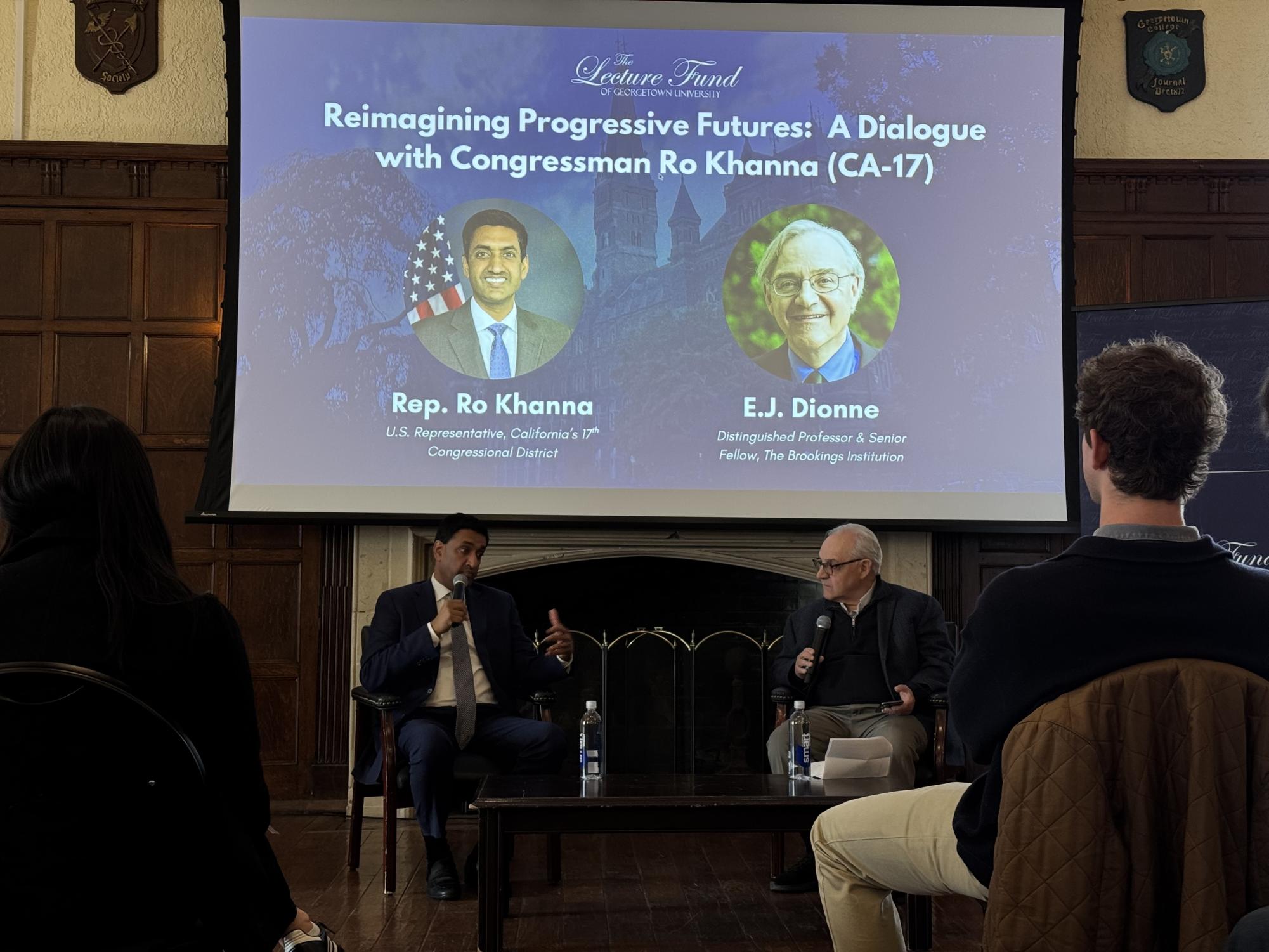
Rep. Ro Khanna (D-Calif.) urged the Democratic Party to adopt more progressive policies and called for increased government oversight of artificial intelligence (AI) during a talk at Georgetown University on March 17. The event, organized by the GU Lecture Fund, focused on the future of progressive politics in the United States, with Khanna encouraging students to engage with local communities and understand the complexities of democracy.
Speaking to an audience of students, Khanna emphasized the importance of real-world experience in public service. “What I would say is that, given the complexity of our democracy, just being smart, as all of you are — diving into Georgetown and taking these courses and showing up here — just being diligent isn’t enough; that one has to be weathered with real experience,” he stated. Khanna’s remarks resonated particularly with students from his district, with Anay Shah (SFS ’29) noting that the representative’s focus on everyday concerns showed a path toward a more inclusive democracy.
Khanna, who has represented California’s 17th congressional district since 2017, is known for his advocacy on technology and economic issues, including workers’ rights and U.S. competitiveness with China. He resonated with the audience as he reflected on his initial electoral struggles, advising students interested in public service to prioritize understanding voters’ challenges. “For me, the persistence was expanding my comfort zone, expanding who I was, really understanding the pulse of the local community,” he added.
The congressman, who gained national attention in December 2025 for leading a bipartisan resolution demanding the U.S. Department of Justice (DOJ) release the Epstein files, shared insights into his legislative experience. He noted that his ability to pass the bill was facilitated by his established relationship with co-sponsor Rep. Thomas Massie (R-Ky.). “I would never have been able to do what we did if I was a freshman or even a second-term member of Congress,” he said.
Khanna criticized the DOJ’s handling of the Epstein files, which have faced scrutiny for redaction errors. He expressed frustration that the department had not adequately engaged with survivors’ lawyers. “There was no reason for the survivors not to be redacted,” he remarked. His comments highlighted broader concerns about transparency and accountability in government actions.
In addition to discussing the Epstein case, Khanna turned his attention to the growing significance of AI and the need for appropriate regulatory frameworks. He criticized Congress for failing to create adequate oversight for emerging technologies, stating, “In this case, what we have failed to do as a democracy is to have the safeguards for the use of surveillance or the use of AI, and we’re leaving it to unfortunate private companies to have to do that.”
Khanna’s vision for the Democratic Party extends beyond regulatory policies; he advocates for more visible, tangible actions that directly improve people’s lives. “What we need to do, in addition to the long-term investment of competitiveness and building the country, is tangible, visible things so that people feel like we’re trying to improve their daily life,” he emphasized.
Students at the event expressed appreciation for Khanna’s insights. Ben Horning (SFS ’28) described him as a “visionary leader” for progressive politics, reflecting on the potential future of the movement. Khanna expressed optimism about the direction of the country, asserting that a progressive movement would gain momentum in the upcoming years. “I am convinced that after Donald Trump, we’re going to take a vision towards a multiracial democracy with a progressive vision that can lower the massive income inequality,” he concluded.
Khanna’s remarks at Georgetown University not only laid out a framework for current political discourse but also underscored the vital role of understanding community needs in shaping effective policies. His emphasis on the intersection of technology and governance marks a crucial conversation as society grapples with rapid advancements in AI and the challenges they pose.
See also Florida OIR Summit Features AI Insights from Commissioners and Key Industry Experts
 Republican Lawmakers Express Concerns Over White House’s AI Regulatory Push
 White House Proposes Federal AI Regulation Framework to Preempt State Laws
 Florida’s AI Growth at Risk: SB 482 Could Stifle Innovation and Investment