























































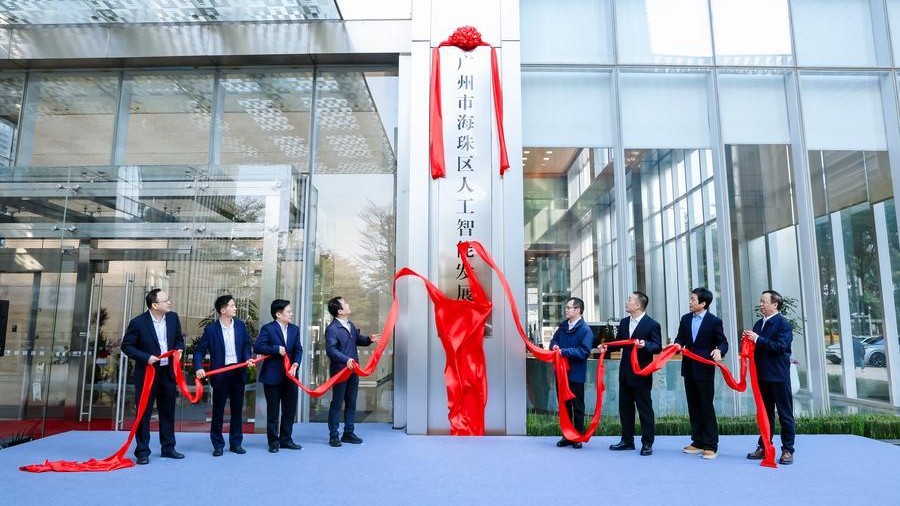
The AI development bureau is inaugurated in Haizhu District of Guangzhou, south China’s Guangdong Province, Dec. 28, 2025. (Xinhua)
On December 28, 2025, the Haizhu District of Guangzhou officially inaugurated its artificial intelligence (AI) development bureau, positioning itself as the first district-level government department in China specifically dedicated to advancing AI. This initiative aims to enhance coordination and foster the growth of new business models within the intelligent economy.
Yu Lihui, a representative for the newly established bureau, emphasized that the agency’s creation is crucial for tackling challenges within the AI sector, including fragmented management and a lack of strategic direction. The bureau is set to proactively plan the integration of advanced AI technologies while working to attract leading enterprises and innovative companies skilled in core technologies.
Haizhu District has laid a robust foundation for AI development, being home to Pazhou, which is one of three significant AI industry clusters designated by the Guangdong provincial government. The district boasts nearly 8,000 AI-related enterprises and has initiated over 200 large-scale AI model and algorithm projects, contributing to substantial growth in next-generation information technology services over the past three years.
One notable player in this burgeoning ecosystem is ZJTECH, a leading internet platform in the textiles and apparel industry. The company is leveraging AI to drive digitalization in its supply chain, enabling clients to match fabrics from thousands of categories in under two minutes and generate market-responsive fashion designs with a single click.
Another innovative firm, the South China Brain-Computer Interface Technology Co., has developed a brain-computer AI mouse, enabling paralyzed individuals to control a virtual cursor using their thoughts. This technology allows users to engage with digital content like short videos and tablets without physical movement.
During the inauguration, the district also unveiled plans for the Pazhou space intelligent computing center. The first phase will establish a 100-petaflop-scale computing cluster aimed at bolstering innovation and research and development for enterprises.
Space computing represents a technological advancement that deploys processing power to satellites, facilitating data management and collaborative computing through onboard intelligent hardware. This innovation is expected to play a significant role in enhancing AI capabilities.
“The establishment of the Haizhu AI development bureau underscores the government’s commitment to the AI industry,” remarked Zhang Yaqin, founding dean of the Institute for AI Industry Research at Tsinghua University. He noted that the bureau is anticipated to explore inventive solutions for developing the industrial ecosystem and facilitating institutional reforms.
The Chinese government has placed a significant focus on AI development. In August 2025, the State Council released a strategic document detailing the implementation of the “AI Plus” initiative, which aims for China to lead the integration of AI across six key sectors by 2027. By 2030, AI technologies are projected to play a pivotal role in enhancing China’s high-quality development, with an adoption rate of new-generation intelligent terminals exceeding 90 percent.
Local governments are following suit, with several establishing dedicated AI departments to stimulate industry growth. For instance, Wenzhou City in Zhejiang Province set the pace with its municipal AI bureau in September 2025, tasked with formulating citywide AI development plans and coordinating infrastructure related to computing power, data, and algorithms.
On December 9, the city of Zhuhai in Guangdong also inaugurated its municipal AI development bureau, which aims to support the city’s “cloud intelligent city” strategy by collaborating with AI enterprises and provisioning for high-value application scenarios.
Qiu Weiming, deputy secretary-general of the Asia-Pacific Artificial Intelligence Association, commented that these dedicated AI bureaus can effectively coordinate resources and implement development policies, ultimately fostering sustainable industry growth. He also noted that as AI continues to evolve, addressing safety, ethics, and privacy issues will be essential for ensuring a stable trajectory of development.
The establishment of specialized AI agencies reflects not only a local commitment to technological innovation but also signals a broader national strategy aimed at positioning China as a leader in the global AI landscape.
For more information on AI initiatives, visit the State Council website or explore developments at Tsinghua University.
See also Policymakers Ignore Economists, Triggering Inflation and Trade Wars in the 2020s
 OpenAI’s CLIP Achieves 81.8% Zero-Shot Accuracy, Surpassing Previous Models
 Survey Reveals AI Knowledge Gaps Among Medical Students at Top Tertiary Care Center