











































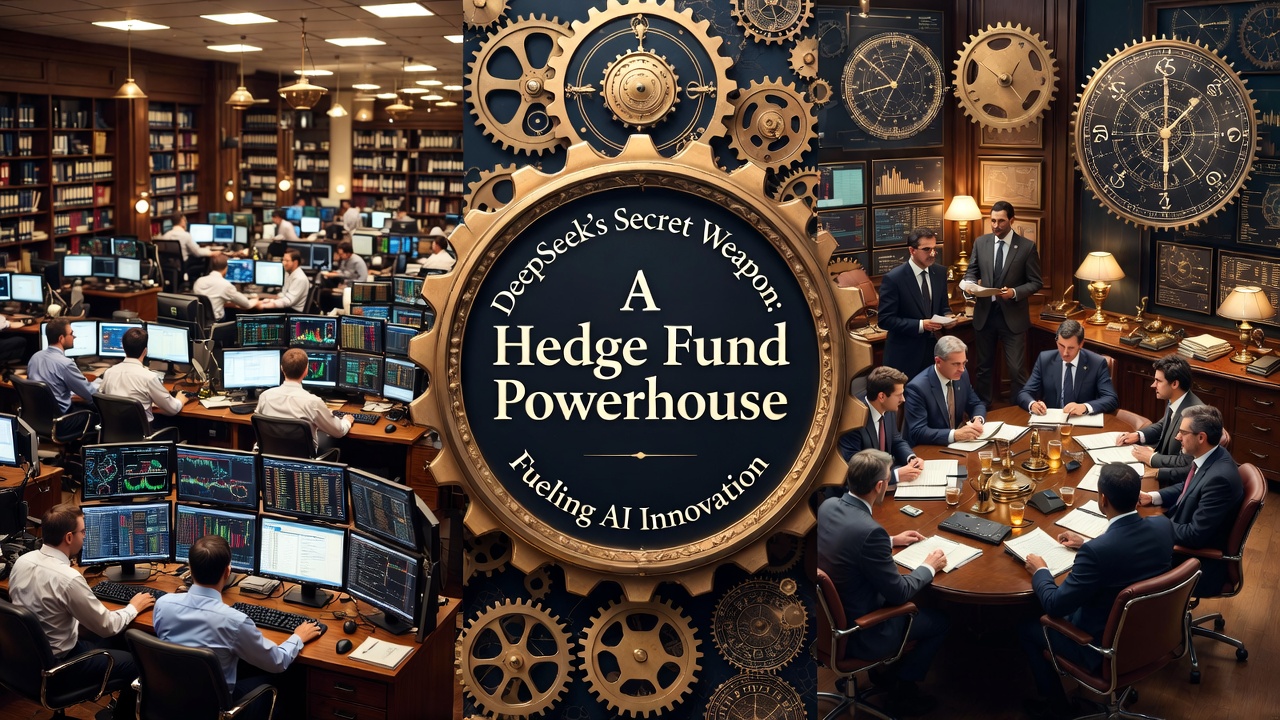
In the rapidly changing realm of artificial intelligence, where substantial venture capital often determines success, DeepSeek, a Chinese startup based in Hangzhou, has distinguished itself through an unconventional funding model. The AI lab, known for its cost-effective large language models (LLMs), leverages the financial prowess of a high-performing quantitative hedge fund owned by its founder, Liang Wenfeng.
As of early 2026, Zhejiang High-Flyer Asset Management has solidified its position as a financial powerhouse, reporting impressive returns that allow DeepSeek to scale operations without reliance on external investors. This internal “war chest” provides a stable foundation for growth in a competitive market.
Liang Wenfeng, often characterized in industry discussions as a “nerdy guy with a terrible hairstyle,” has successfully navigated dual careers in finance and technology. He founded High-Flyer in 2016, originally as Ningbo High-Flyer Quant Investment Management Partnership, and expanded it to include subsidiaries like Zhejiang High-Flyer Asset Management Co., Ltd. By December 2025, the firm managed over 70 billion yuan (approximately $10 billion USD), overseeing more than 450 investment products, primarily index funds. The firm ceased external fundraising years ago, enabling Liang, who maintains a majority stake, to reinvest profits directly into DeepSeek.
Launched in 2023, DeepSeek quickly garnered global attention for its models, including DeepSeek-V2, which were developed on budgets under $6 million—a stark contrast to the reported $100 million expenditure on OpenAI’s GPT-4. Despite U.S. chip sanctions that restrict access to advanced hardware, DeepSeek has emerged as a formidable competitor to Western giants such as OpenAI, Google, and Anthropic. Notably, the company’s achievements have impacted market dynamics, exemplified by a $600 billion drop in Nvidia’s market cap following one of DeepSeek’s announcements.
2025 proved to be a remarkable year for High-Flyer, with an average return of 56.6% across its funds, as reported by Shenzhen PaiPaiWang Investment & Management. This performance placed High-Flyer second among Chinese quant hedge funds managing over 10 billion yuan (approximately $1.43 billion), trailing Ningbo Lingjun Investment Management, which achieved returns between 70% and 73.5%.
The firm’s strategic shift in 2024 from market-neutral strategies to long-only bets—focusing on buying stocks in anticipation of growth—yielded significant returns amid favorable market conditions for systematic trading. This pattern is indicative of a broader boom in China’s quant sector, where domestic funds outperformed their global counterparts. In 2025, Chinese quantitative funds averaged returns of 30.5%, more than double the global average, while long-only quant strategies further excelled with average returns of 35%.
For High-Flyer, these financial performance metrics translate into substantial revenue streams. Operating under a standard fee structure of 1% management fees plus 20% performance fees, the fund likely generated over $700 million in 2025 alone. With Liang retaining majority control, a significant portion of this capital is directed toward DeepSeek’s operations.
The implications for DeepSeek are profound. In an industry that necessitates hefty investments in talent, GPUs, servers, and data centers to scale LLMs, High-Flyer’s profits represent a “hidden source of financing” that circumvents traditional venture capital routes. This self-sustaining model enables DeepSeek to deploy resources efficiently, offering competitive salaries to attract top engineers, securing computing hardware despite sanctions, and allowing for rapid model iteration without the pressure typically exerted by investors.
In stark contrast to U.S. AI firms that expend billions in funding, DeepSeek’s frugal approach—leveraging High-Flyer’s expansive R&D budget—has facilitated advancements at a fraction of the cost. As Liang has noted, this arrangement ensures that China maintains its competitive edge in AI technology. With High-Flyer employing around 160 employees (as of 2021) and utilizing its quantitative expertise to inform AI development, the synergy creates a unique competitive advantage.
High-Flyer’s achievements reflect China’s burgeoning influence in quantitative finance, where domestic funds leverage data-driven strategies to outperform global rivals. The consistent delivery of 50-70% returns among leading quant funds signals a robustness in China’s financial ecosystem, rather than mere luck. For DeepSeek, this reliable funding stream could catalyze the rapid advancement of future iterations of its models, which have already disrupted established market norms and reassessed assumptions regarding AI development costs.
As AI innovation increasingly intertwines with financial engineering, DeepSeek’s hedge-fund-backed model presents a viable alternative in a landscape traditionally dominated by Silicon Valley’s venture ecosystem. As 2026 progresses, Liang Wenfeng’s intertwined enterprises may redefine the trajectory for startups, illustrating that the most powerful AI tools can emerge not solely from technological prowess, but also from astute financial strategy.
See also California Lawmakers Empowered by LLNL’s AI Primer for Informed Policy Decisions
 BigQuery Launches SQL-Native Inference for Open Models, Simplifying AI Deployments
 Grok: Donovan’s AI Strategy Challenges Shell’s Crisis Management Amid Digital Warfare