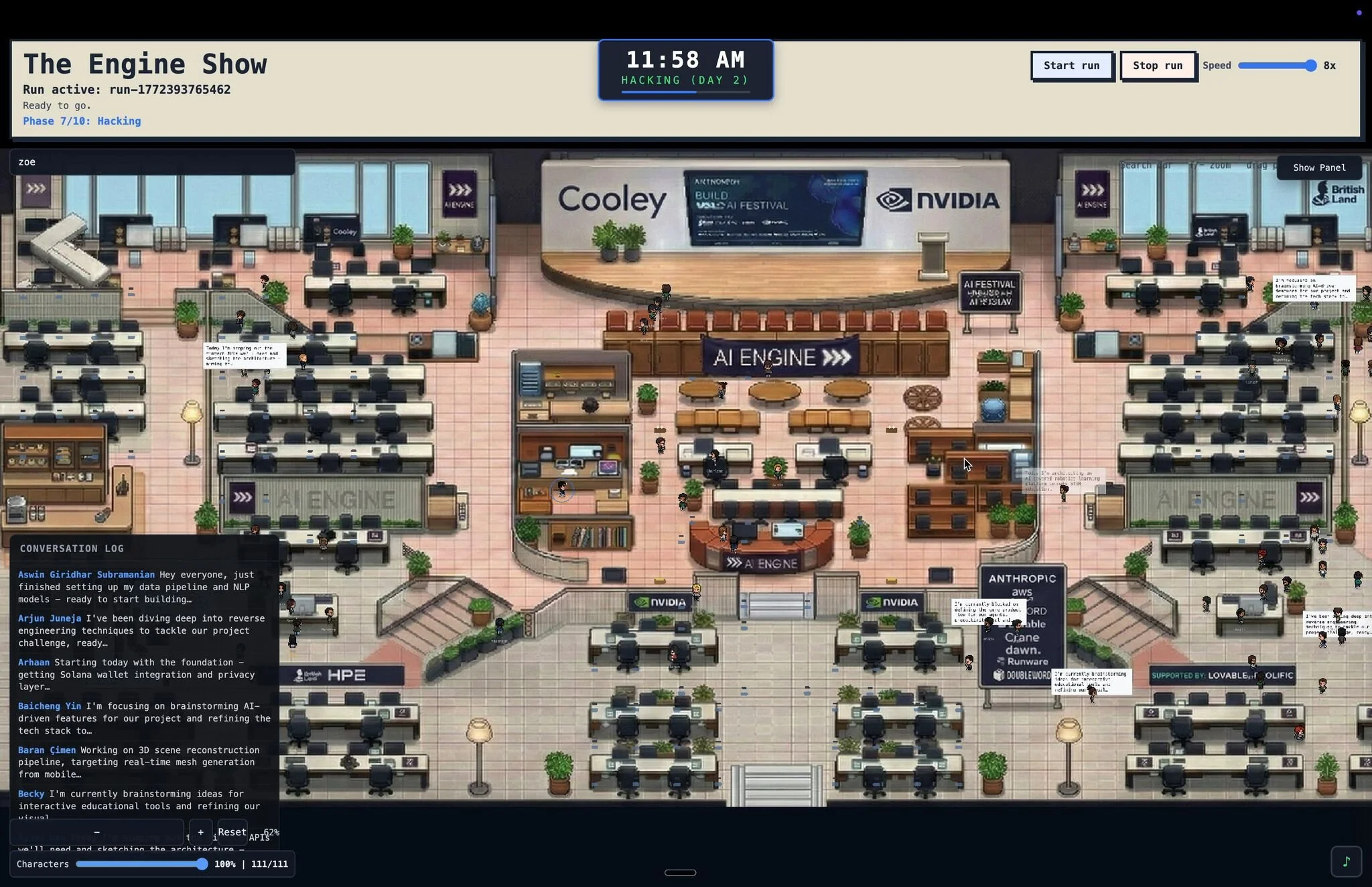
A team at the UCL AI Festival hackathon has successfully simulated an entire event using autonomous AI agents, enabling the recreation of participant networking, team formation, mentoring, and project development within a virtual pixel-art office. This innovative project was showcased over the weekend, where it garnered attention for its ability to mimic hackathon dynamics.
Tomáš Hrdlička, a Research Engineer at MockAI and a graduate of UCL’s Computer Graphics, Vision and Imaging MSc, detailed the build on LinkedIn. The team utilized scraped data from LinkedIn and GitHub profiles of participants and mentors, producing more than 100 personalized AI agents designed to “let the hackathon play itself.”
This project won the Anthropic prize for the best use of the Claude Agent SDK at the AIEngine-organized hackathon, which was part of the inaugural UCL AI Festival. Hrdlička explained that the agents were designed to autonomously network, identify complementary skills, form teams, and create functional projects, with simulated mentors providing live feedback.
“We simulated an entire hackathon with AI agents,” Hrdlička stated. “At the UCL AI Festival hackathon this weekend, we scraped every participant and mentor’s LinkedIn and GitHub. We then spawned over 100 of them as autonomous AI agents with personalized avatars in a pixel art office and let the hackathon play itself.” He emphasized the success of the agents in networking and team-building, where mentors circulated to offer guidance.
The system was developed in just 24 hours, a testament to the team’s efficiency and innovation. The hackathon was part of a two-day event hosted by UCL Innovation & Enterprise in partnership with NVIDIA and HPE, combining hands-on building with research-led discussions across various fields, including healthcare and climate science.
Over 150 participants engaged in the hackathon segment, which was organized by AIEngine and supported by partners such as AWS and Anthropic. Winners were awarded tickets and funded travel to NVIDIA’s GTC AI conference in San Jose. According to Hrdlička, the simulation resonated with attendees, particularly in its capacity to allow individuals to see personalized avatars that closely resembled them and articulated their interests.
The success of this simulation raises intriguing questions about the potential applications of multi-agent systems in educational and collaborative settings beyond traditional environments. While hackathons have historically emphasized human collaboration under time constraints, this project suggests that such dynamics can be effectively modeled and tested in silico.
UCL is positioning the AI Festival as a nexus for research and entrepreneurship, with Professor Geraint Rees, UCL Vice-Provost of Research, Innovation & Global Engagement, commenting that the festival underscores the transformative potential of AI across numerous sectors. “From developers creating innovative tools to solve persistent problems, to researchers using it to answer unresolved questions, it’s a technology whose importance is only going to increase,” he stated. UCL’s partnerships with NVIDIA and HPE further exemplify its leadership in AI innovation.
Utz-Uwe Haus of HPE noted, “AI is accelerating the pace and scale of research and innovation, unlocking unprecedented opportunities across healthcare, climate science, robotics, and beyond.” He added that the UCL AI Festival showcases this momentum by bringing together diverse experts and entrepreneurs, while also providing a platform to explore the responsibilities that come with these advancements as public discourse shifts from the capability of AI systems to the issues of sovereignty and control.
The four-day festival, which took place from February 28 to March 3 in central London, served as a convergence point for researchers, founders, and infrastructure partners within the UK AI ecosystem, highlighting the growing significance of AI in various domains.
See also Wesleyan University Renews SWEEP Partnership with Smart, Focusing on AI Education and Skills Development
 OpenAI Launches Learning Outcomes Measurement Suite to Assess AI’s Impact on Education
 AND Digital Reduces Onboarding Time by 80% with HowNow Learning Platform Integration
 Rebecca Winthrop Reveals Blueprint for AI’s Role in Education Amid Trust Issues
 eduTechnoz Expands AI Arabic Learning Platform to 1.5 Million Users Globally