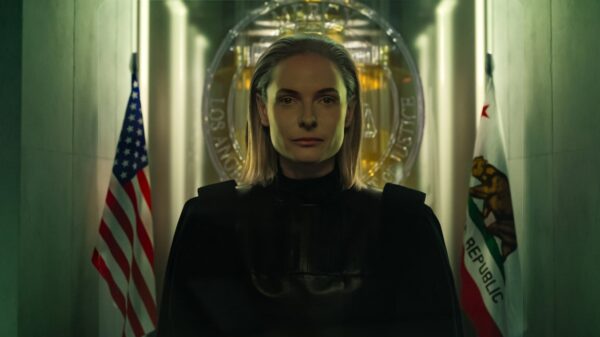

















































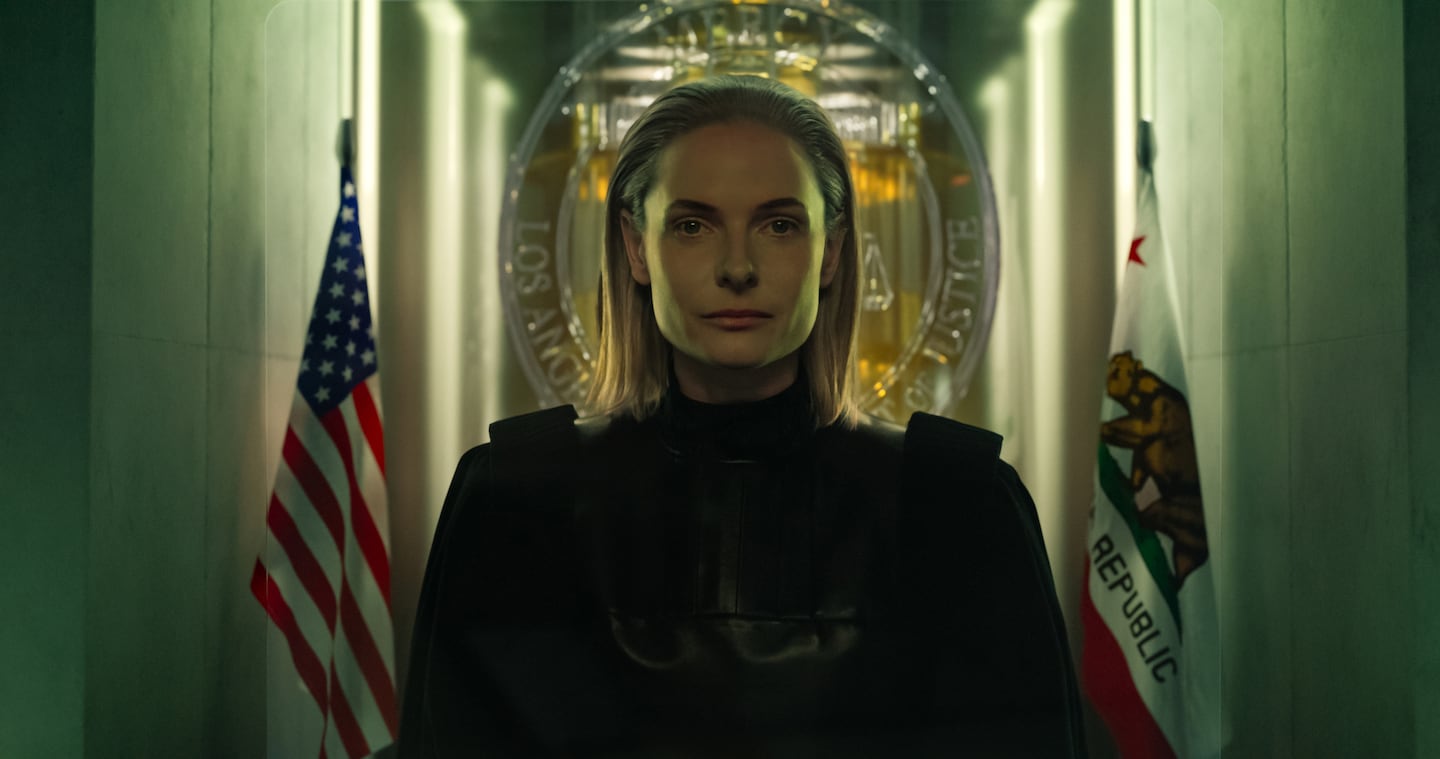
Amazon’s latest sci-fi action thriller, “Mercy,” starring Chris Pratt and Rebecca Ferguson, presents a dystopian narrative that intertwines artificial intelligence with a flawed justice system. The film, directed by Timur Bekmambetov, features Pratt as Chris Raven, a man on trial for murder in a near-future Los Angeles overwhelmed by crime and AI governance. The story unfolds in a courtroom where Raven faces Judge Maddox, an AI character portrayed by Ferguson, who serves as judge, jury, and executioner.
Throughout much of the film, the audience witnesses Raven’s frantic pleas and Maddox’s sardonic responses, often presented through a barrage of digital overlays, including FaceTime calls and app interfaces. Critics have pointed out that at least 80% of the runtime consists of Pratt shouting at the screen while Ferguson’s AI character rolls her eyes in what has been described as a “snarky” performance. The film’s execution has drawn comparisons to a poorly crafted script, with predictable plot devices such as a ticking countdown and a mystery that can be unraveled by simple character counting.
“Mercy” begins with Raven awakening restrained in a high-tech courtroom. An advertisement plays on a screen outlining the chaos in Los Angeles, a city ravaged by economic collapse and rampant crime. In this bleak setting, defendants are presumed guilty until proven innocent, forced to navigate their trials in a mere 90 minutes, all while depending on AI resources, which include access to vast surveillance networks. The implications of this system raise concerns over privacy and the ethical use of technology in law enforcement.
The film aims to critique the absurdities of a system that offers no real justice, as evidenced by Raven’s own role in establishing the very court that now threatens his life. As he struggles to gather evidence in his defense, the narrative explores themes of guilt and hypocrisy, particularly in Raven’s character, who once championed this draconian judicial process. However, audiences may find it challenging to sympathize with a protagonist marked by personal failings and violent tendencies.
The film’s script, penned by Marco van Belle, has received criticism for its lack of depth and originality. In contrast to Raven, Ferguson’s Maddox emerges as a more engaging character, showcasing a kind of charm that highlights the missed potential in the lead role. Critics lament that Pratt’s portrayal lacks the charisma necessary to elicit any empathy for what is fundamentally a deeply flawed character.
In a notable subplot, Raven’s relationship with his wife, Nicole, portrayed by Annabelle Wallis, adds layers to his character, yet the execution feels hollow. The film’s depiction of a deteriorating marriage, coupled with Raven’s violent outbursts, is juxtaposed with his desperate bid for exoneration as he faces an AI judge intent on maintaining a perfect record of convictions.
The film also raises critical questions about surveillance and the role of technology in society. The use of facial recognition and other AI-driven tools suggests a troubling endorsement of privacy invasions in the name of public safety. The climax of the movie culminates in a chase scene characterized by a lack of coherent geography, leading to a spectacle that feels more like a CGI construct than a believable narrative.
Overall, “Mercy” fails to deliver a compelling critique of its themes, instead presenting a disjointed experience that may leave viewers feeling disengaged. Its reliance on visual effects and rapid-fire dialogue fails to compensate for a lack of substantive storytelling. As many have noted, it may serve better as background entertainment rather than a focal point of attention, leaving audiences to wonder if this is the intended experience.
MERCY
Directed by Timur Bekmambetov. Written by Marco van Belle. Starring Chris Pratt, Rebecca Ferguson, Kali Reis, Chris Sullivan, Kylie Rogers, Annabelle Wallis. Now showing at AMC Boston Common, Alamo Drafthouse Seaport, and AMC Causeway. Running time: 100 minutes. Rated PG-13 for violence and profanity.
Odie Henderson is the Boston Globe’s film critic.
See also Oracle’s Multicloud AI Strategy Fuels 817% Growth, Enhancing Sustainable Revenue Streams
 Corporate Prediction Markets Surge: $814M Daily Turnover on Meta AI, Amazon Layoffs, and Starbucks Strategies
 Germany”s National Team Prepares for World Cup Qualifiers with Disco Atmosphere
 95% of AI Projects Fail in Companies According to MIT
 AI in Food & Beverages Market to Surge from $11.08B to $263.80B by 2032