






















































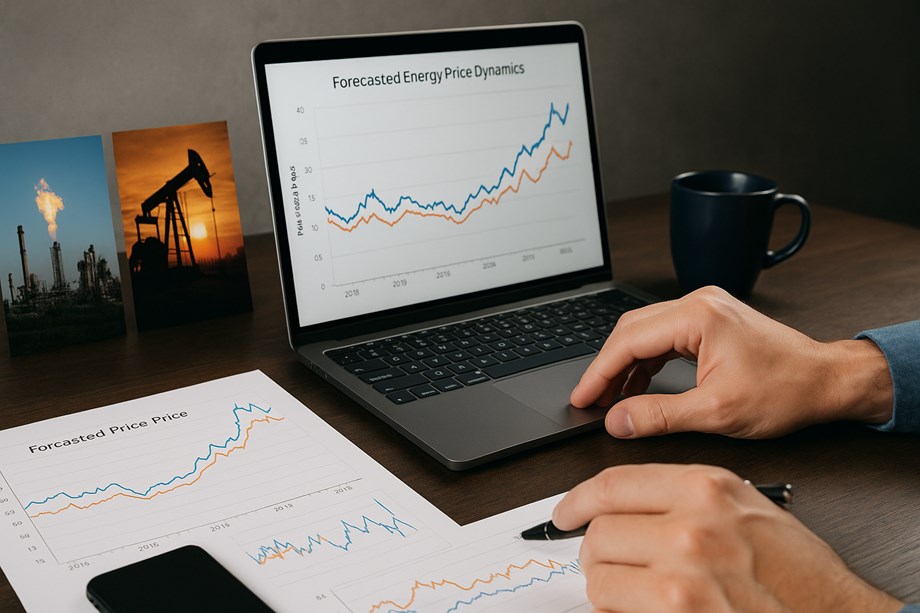
Global energy markets are poised for a significant transformation as a recent study suggests that advanced deep learning systems could revolutionize the way traders, regulators, and policymakers anticipate price fluctuations. Published in the journal Algorithms, the research titled “Forecasting Fossil Energy Price Dynamics with Deep Learning: Implications for Global Energy Security and Financial Stability” evaluates various machine learning architectures against daily price data for crude oil, Brent oil, natural gas, heating oil, and RBOB gasoline from 2016 to 2025. The findings challenge existing forecasting methodologies, emphasizing the potential of machine intelligence to uncover patterns that traditional econometric tools often overlook.
The study rigorously examines six different architectures: GRU, LSTM, Bi-LSTM, RNN, CNN, and DNN, demonstrating a clear shift from older statistical methods to memory-based deep learning designs. Notably, the LSTM family and the GRU models emerge as the most accurate for forecasting, particularly for long-range predictions. For crude oil, the LSTM architecture consistently delivers superior performance, achieving the lowest error rates. This reflects its capability to retain long-range contextual information, which aligns well with the gradual cycles driven by macroeconomic factors such as OPEC production and geopolitical tensions.
This trend is mirrored in Brent oil forecasts, where the Bi-LSTM model ranks highest, followed closely by the LSTM. Both models outperform GRU, RNN, CNN, and DNN, reiterating the effectiveness of deep learning systems in capturing long-term, predictable patterns in globally significant commodities. The study highlights how Brent oil markets are similarly influenced by macroeconomic and geopolitical factors, generating long-horizon trends that are better modeled by LSTM-based architectures.
However, the dynamics shift when assessing commodities characterized by rapid price movements, such as natural gas, heating oil, and RBOB gasoline. In these volatile markets, the GRU proves to be the most effective tool. For natural gas, the GRU achieves the lowest error values across all metrics, adeptly adapting to factors like winter demand and sudden supply events. Its simpler gating structure enables quicker convergence, making it ideally suited for forecasting commodities with shorter timelines.
This pattern also holds for heating oil and RBOB gasoline, where the GRU outperforms other models. Heating oil prices are heavily influenced by seasonal changes and weather conditions, while RBOB gasoline prices fluctuate based on consumer demand and refinery operations. The GRU’s design aligns seamlessly with the nature of these commodities, positioning it as the optimal model for high-variance scenarios.
The implications of these findings extend beyond energy markets, influencing global financial stability and strategic planning for investors and policymakers alike. The research advocates for the integration of LSTM and GRU forecasting systems into trading dashboards and risk management frameworks. Accurate commodity predictions can shape investment decisions related to futures contracts, hedging, and overall portfolio strategy.
For policymakers, enhanced forecasting methods provide a valuable early-warning mechanism, allowing for timely adjustments in energy security planning and market interventions. Effective prediction models could assist governments in optimizing reserve releases, import strategies, and domestic supply management, thereby mitigating the risk of inflation and financial market instability.
Looking ahead, the study acknowledges the limitations of current deep learning models and suggests avenues for further improvement. Future research could explore the integration of attention mechanisms or hybrid models that combine GRU or LSTM architectures with additional macroeconomic and geopolitical data. This could enhance predictive accuracy and provide a more comprehensive view of market dynamics.
This pivot toward next-generation energy forecasting marks a critical moment for the industry. By advancing beyond simple price patterns to include contextual signals, machine learning models are positioned to become essential tools for financial firms and energy agencies. Even at their current capabilities, deep learning systems signify a major leap in fossil energy prediction, allowing for better tracking of nonlinear dynamics and adaptability to sudden market disruptions.
See also Disney Invests $1 Billion in OpenAI’s Sora AI, Transforming Content Creation by 2026
 Time Names ‘Architects of AI’ as 2025 Person of the Year, Highlighting Industry Transformation
 Amazon Reports $9.5B Income Boost from Anthropic Revaluation Amid Market Mania
 Qatar Hosts World Summit AI 2025, Unveils Fanar 2.0 and GovAI Program to Drive Digital Transformation
 Big Tech’s Strategic Narratives Shape Global AI Regulation, Reveals New Study