
















































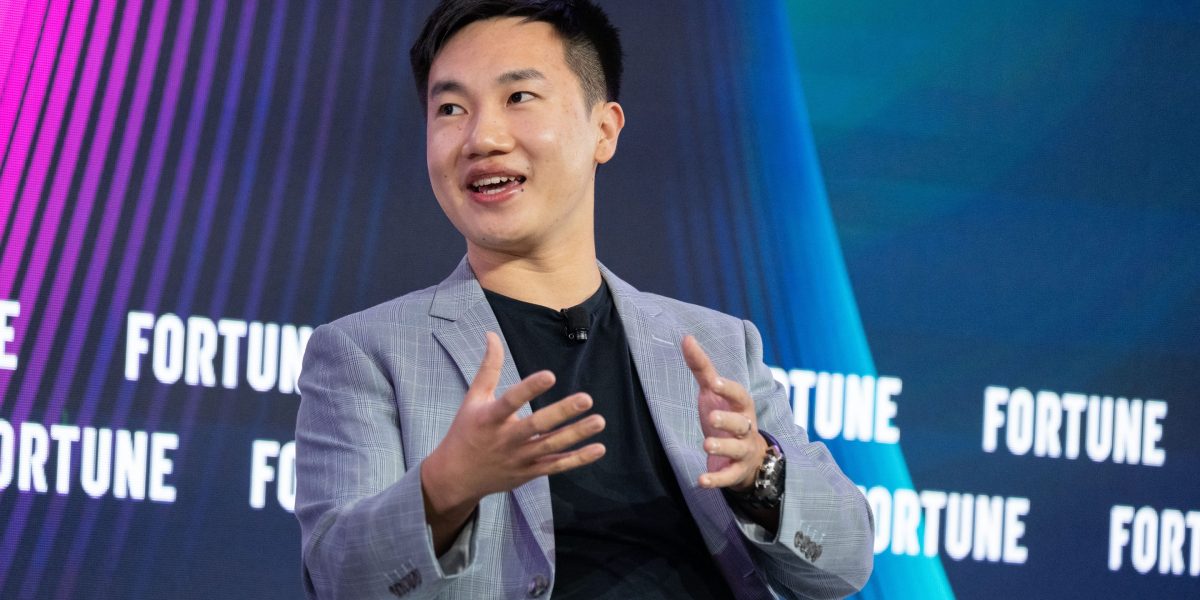
Two years ago, William Chen and Guan Wang, two 22-year-old friends from Michigan, found themselves inside Tsinghua University’s brain lab in Beijing, considering a multimillion-dollar offer from Elon Musk. The pair had developed a small large-language model (LLM) named OpenChat, which was distinctively trained on a curated selection of high-quality conversations rather than large-scale internet data. They employed a technique called reinforcement learning (RL), where the model learns through decision-making and feedback, mimicking human learning processes.
At that time, few were pursuing RL in the realm of language models, with the notable exception of DeepSeek, a Chinese competitor to OpenAI that later alarmed Silicon Valley. Chen and Wang, however, open-sourced OpenChat on a whim, leading to unexpected acclaim. “It got very famous,” Chen recounted, noting that researchers from esteemed institutions like Berkeley and Stanford began to cite their work. OpenChat emerged as a pioneering example of how a smaller model trained on superior data could outperform larger counterparts.
Then, unexpectedly, the duo received a message from Musk, who was recruiting them for his then-new enterprise, xAI. The offer was enticing, but they ultimately chose to decline. “We decided that large-language models have their limitations,” Chen stated. Instead, they redirected their focus toward developing a “brain-inspired” reasoning system that they believed could surpass existing AI models.
This decision culminated in the formation of Sapient Intelligence, which has since produced a model that reportedly outperforms some of the largest AI systems in abstract reasoning tasks. The founders are now confident that their model is poised to achieve “AGI,” or artificial general intelligence, which is considered the ultimate milestone in AI research, where machine intelligence equals or exceeds human capability in various cognitive tasks.
Chen’s journey toward this groundbreaking point began in Bloomfield Hills, Michigan, where an early fascination with technology drove him to dismantle gadgets. “When I was young, I would break things apart and never put them back together,” he said. After meeting Wang, who shared a similar passion for technology, the two bonded over their “metagoals”—the overarching purposes guiding their lives. Wang envisioned AGI long before it became mainstream, describing it as an “algorithm that solves any problem,” while Chen aimed for optimization across various engineering and real-world systems.
Despite facing challenges at Tsinghua University, where coursework proved demanding, the duo found encouragement from professors who recognized their ambitions. “They were like, ‘Hey, I know this thing you’re trying to make — it’s a very good thing,’” Chen reflected. Their efforts led to the development of the Hierarchical Reasoning Model (HRM), an architecture they believe can effectively outstrip transformer-based models.
The breakthrough for HRM arrived during an early morning session in June, when Chen and Wang discovered that their prototype—comprising just 27 million parameters—was outperforming larger systems from OpenAI, Anthropic, and DeepSeek on reasoning-specific tasks. It adeptly solved complex puzzles like Sudoku-Extreme and navigated intricate mazes, achieving impressive results on benchmarks designed to assess reasoning capabilities.
HRM diverges fundamentally from traditional transformers: while the latter rely on statistical patterns to predict outcomes, HRM employs a two-part recurrent structure that emulates human cognitive processes. This allows it to plan, dissect problems, and reason logically rather than through imitation. “It’s not guessing,” Chen asserted. “It’s thinking.” He added that their models exhibit significantly reduced instances of hallucination compared to conventional LLMs and already demonstrate state-of-the-art performance in tasks like weather prediction and medical monitoring.
Sapient Intelligence is currently focused on scaling HRM into a general-purpose reasoning engine, driven by the belief that the path to AGI lies not in ever-larger models but in more efficient architectures. Chen contends that the limitations faced by today’s massive models stem from structural issues rather than temporary setbacks. “You can stack more layers,” he noted, “but you’re still hitting the limits of a probability model.”
The company is preparing to open a U.S. office shortly, seeking additional funding to further develop and possibly rebrand their model. Chen believes that continuous learning—the ability for a model to safely absorb new experiences without complete retraining—represents the next significant advance in AI. “AGI is the holy grail of AI,” he said, projecting that it could emerge within the next decade. “One day, we’re going to have an AI that’s smarter than humans,” he added, emphasizing their determination to lead in this transformative endeavor.
See also Azerbaijan, Senegal Forge Digital Alliance to Enhance AI and Cybersecurity Strategies
 Chatbots in Healthcare and Law: Navigating Ethical Risks and Ensuring Safety
 Meta Expands AI Translation to Five New Indian Languages on Instagram and Facebook
 Honeywell Unveils AI-Driven CT70 Mobile Computer to Enhance Workforce Efficiency in Retail and Logistics
 Utility Stocks Surge Amid AI Demand, But Face Risks as Tech Pullback Looms