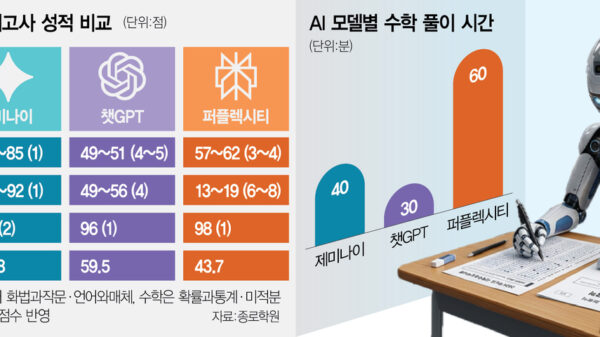
















































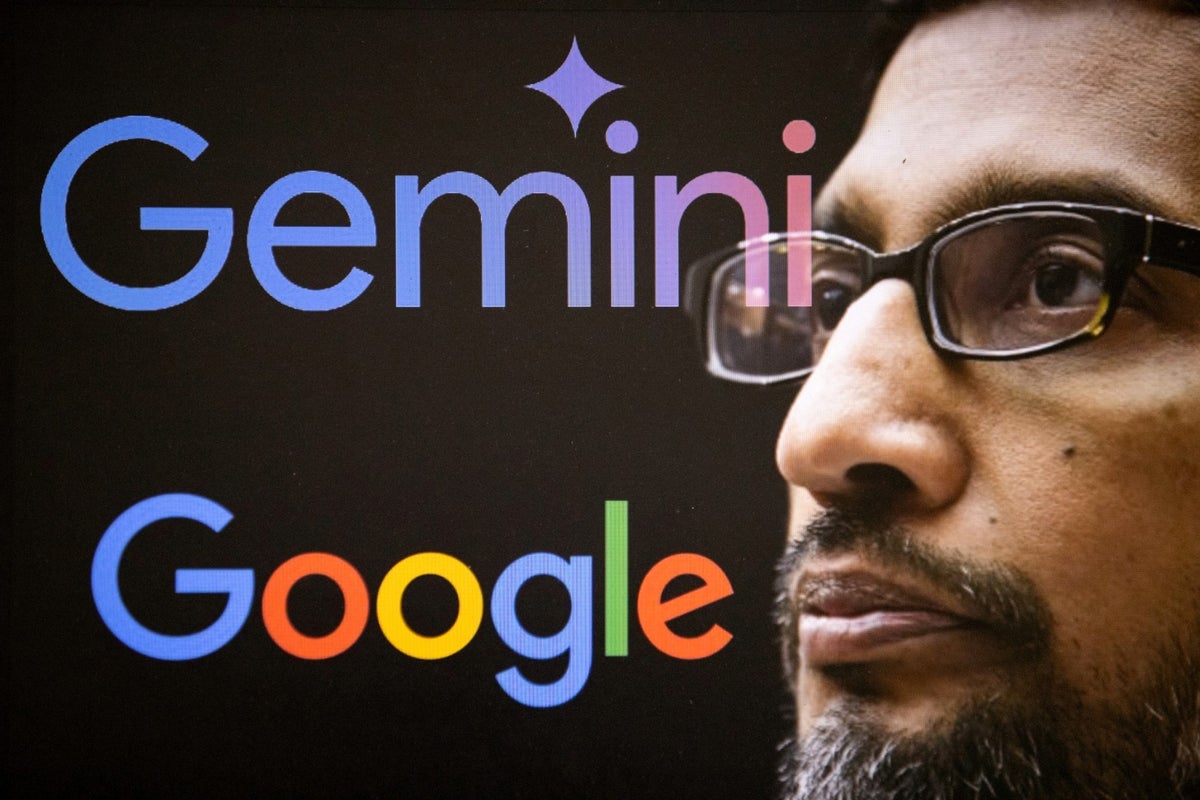
When Google unveiled its latest artificial intelligence model, Gemini 3, in November, it heralded the arrival of what it termed a “new era of intelligence.” This launch came three years after the debut of ChatGPT, a product that has significantly influenced the AI landscape. Google claimed that Gemini 3 is not only faster and better at reasoning but has also achieved a record score in Humanity’s Last Exam, a test designed by AI safety researchers to evaluate AI performance against human capabilities.
The announcement was accompanied by the trademark enthusiasm that often accompanies new AI models; however, early users indicated that this release represented a substantial evolution rather than a mere incremental update. Marc Benioff, CEO of Salesforce, enthusiastically stated that the improvements in “reasoning, speed, images, video… everything” were “insane.” In a post to X, he noted, “I’ve used ChatGPT every day for three years. Just spent two hours on Gemini 3. I’m not going back.”
Benioff was not alone in his praise. AI pioneer Geoffrey Hinton, often referred to as the Godfather of AI, remarked on how Google appears to be “beginning to overtake” ChatGPT, predicting that “my guess is Google will win.” Another analyst lauded Gemini 3 as “the best model ever,” highlighting its dominance in 19 out of 20 industry benchmark tests, with the only exception being a coding-related challenge where Anthropic’s Claude model took the lead.
The rapid advancements associated with Gemini 3 prompted OpenAI, the creator of ChatGPT, to declare a “code red,” a term reminiscent of Google’s own urgent response following ChatGPT’s initial launch. Observers have speculated about how Google achieved such a leap in a relatively short timeframe, especially given that the standalone Gemini app was introduced just last year. Employees at the tech giant attribute the model’s success to a comprehensive improvement strategy, though some industry experts suggest that the advantages may stem from Google’s extensive data access.
For over two decades, Google has served as the primary gateway to the internet, with its search engine facilitating the majority of online information retrieval. Websites often grant Google’s search crawler bots special access, allowing them to appear prominently in search results. This symbiotic relationship benefits publishers and content creators, who rely on Google to drive traffic and, by extension, revenue through ads and subscriptions.
As the internet transitions from traditional search methods to AI-driven solutions, with zero-click searches now representing over 60 percent of all queries, Google has exploited its dominant position to gain a significant edge in AI training. Cloudflare, a security firm that protects a substantial portion of the web, has observed how companies utilize AI bots for web crawling. According to Matthew Prince, CEO of Cloudflare, Google’s AI crawlers have access to 322 percent more of the web than OpenAI’s, and even more when compared to other competitors like Meta, Anthropic, and Microsoft.
Prince noted, “If you believe that whoever has access to the most data will win, then Google will always have an advantage in the market, which no one will be able to overcome. That seems pathologically unfair.” He emphasized the profound structural advantage Google holds in the AI realm, arguing that the company’s data access is directly tied to its search monopoly.
Although Gemini 3 currently has approximately 650 million users compared to ChatGPT’s 800 million, it is growing rapidly, especially following the introduction of the Nano Banana image generator integrated into the AI, which boosted user numbers by 200 million. Furthermore, Gemini 3’s integration into various Google products, including Search, Gmail, and Drive, allows it to reach billions of users globally. In fact, Google has seven products that each boast over 2 billion users.
Despite its progress, Gemini 3 is not without limitations. It continues to experience issues with inaccuracies, known as hallucinations, and can struggle with technical tasks such as debugging complex code. Additionally, some critics argue that overly restrictive safety features may hinder its overall performance.
In light of these challenges, industry observers suggest that Google’s dominance could lead to long-term monopolization of AI, similar to its control over online search. Prince advocates for regulatory intervention, proposing that separating Google’s AI crawler from its search crawler would create a more level playing field for emerging AI companies. He has engaged with the UK’s Competition and Markets Authority (CMA) to push for stricter regulations that would prevent Google from leveraging its search monopoly for AI dominance.
As the CMA has recently designated Google Search with Strategic Market Status under the UK’s new digital markets regime, new rules and regulations could be on the horizon. Google has reacted to these potential changes by warning that excessive regulations could stifle innovation and slow product development. However, the company does provide tools, such as Google-Extended, which allow publishers to control how their content is used in AI training—a feature Google claims does not affect their search visibility.
Prince warns that without regulatory changes, the current AI race may be effectively over, allowing Google to monopolize the sector as it has done with search. “Google is refusing to play by fair rules. The market may never catch up, and that seems radically unfair,” he concluded.
See also Integrating AI Ethics into Education: Essential Skills for Navigating Digital Risks
 Microsoft CEO Demands Total AI Commitment Amid Operational Struggles and Investor Pressure
 Two South Africans Excel at Google DeepMind, Pioneering AI Research Together
 Guidewire’s Heritage Cloud Adoption and Olos AI Suite Poised to Transform Insurance Landscape
 Sam Altman: AI’s Future Breakthrough in 2026 Will Revolutionize Memory, Not Reasoning