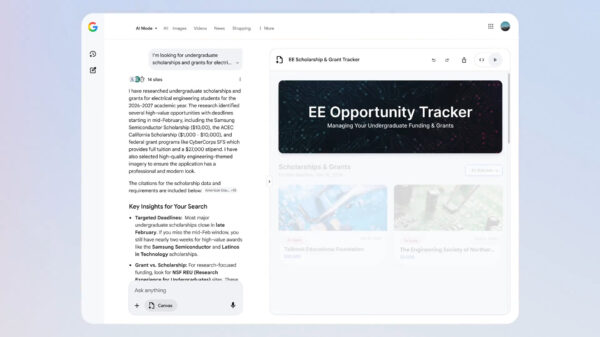















































Google has launched “Canvas,” an interactive workspace now available to all users of Search’s AI Mode in the United States. This new feature, which bears similarities to tools found in Google Labs and the Gemini app, is designed to enhance the search experience by transforming the conventional search bar into a dynamic project planner and coding station. By integrating Canvas into Google Search, the company aims to provide AI-powered research, planning, and development tools to users who have yet to engage with specialized chatbots like Gemini or Claude.
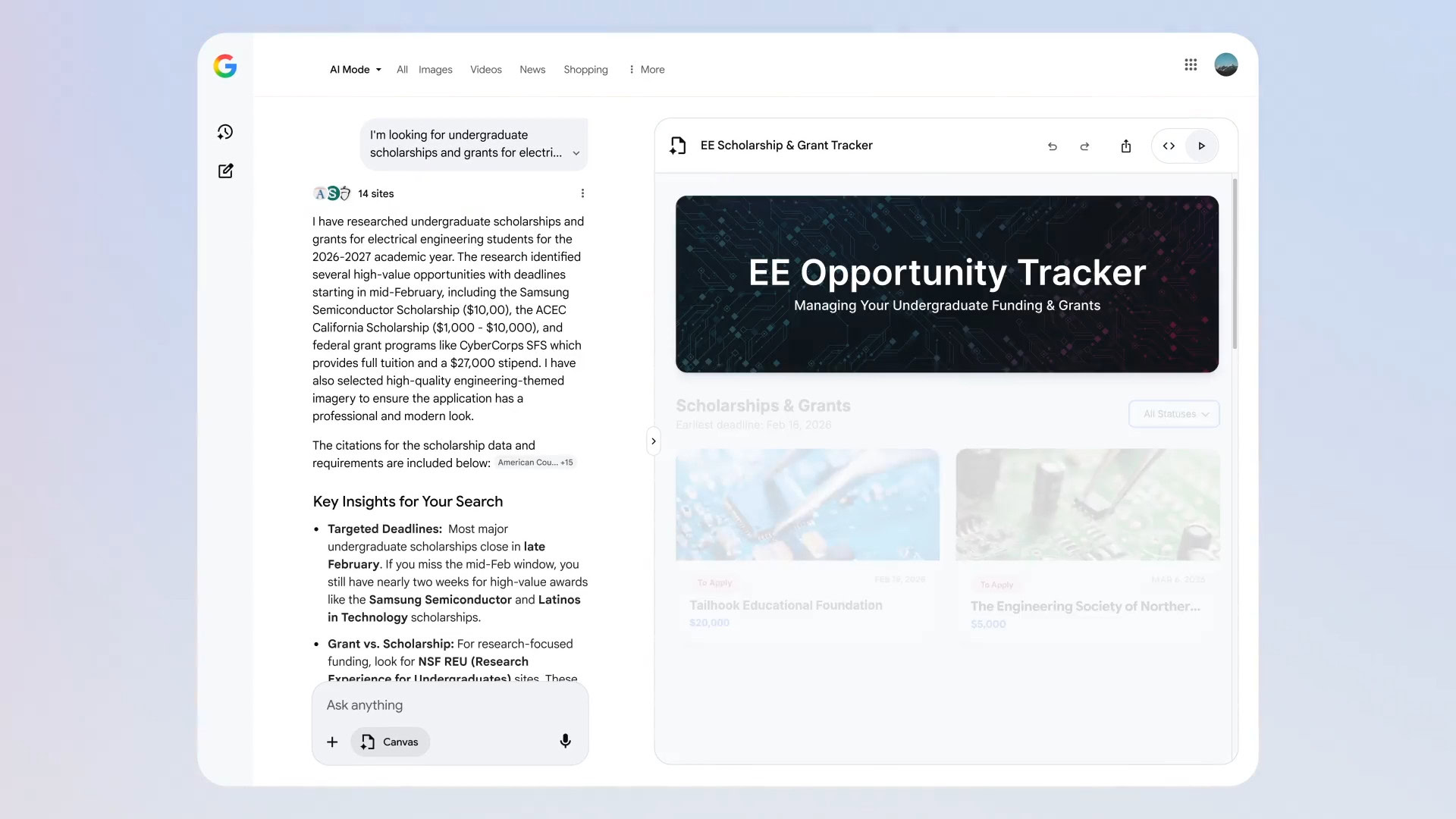
The Canvas tool offers a dedicated side panel that enables users to organize complex projects, draft documents, and even construct functional prototypes without leaving the search results page. Earlier iterations of Canvas focused primarily on visualizing travel itineraries, but this broader rollout now significantly enhances support for creative writing and coding projects. The interface allows users to interact with the AI on one side while simultaneously managing their projects—whether they be research reports, study guides, or interactive dashboards—on the other side.
A particularly noteworthy feature of Canvas is its coding capability, which allows users to describe ideas for apps or games, prompting the AI to generate the necessary code. Users can then test functionality in real time, view the raw code, and request adjustments from the AI. This feature effectively bridges the gap between a simple search query and the creation of a finished digital product, making it easier for users to bring their ideas to fruition.
Accessing Canvas is a straightforward process. While in AI Mode, users need only click the “plus” (+) icon in the menu and select the Canvas option. After describing a project—such as “create a dashboard to track academic scholarships with deadlines”—the AI utilizes fresh information from the web and Google’s Knowledge Graph to build a working prototype. Unlike ChatGPT’s version of similar features, which often activates automatically, Google’s Canvas requires users to take a deliberate step to enter the project workspace, providing more control over their interaction.
Currently, Canvas is available exclusively in English for users in the United States using Google Search’s AI Mode. This strategic rollout appears to position Google to engage a broader audience in the evolving landscape of AI-driven tools, marking a significant step in making advanced capabilities accessible to the general public. As businesses and individuals increasingly turn to AI for assistance in various tasks, Google’s Canvas could reshape how users approach both simple queries and more complex projects.
This introduction of Canvas comes at a time when competition in the AI space is heating up, with various tech companies racing to capture market share by offering innovative features. By embedding tools like Canvas into its widely used search platform, Google not only enhances its value proposition but also reinforces its position as a leader in the AI sector. As AI technology continues to evolve, users can expect further advancements and integrations that will likely influence how digital workspaces are utilized in the future.
See also Germany”s National Team Prepares for World Cup Qualifiers with Disco Atmosphere
 95% of AI Projects Fail in Companies According to MIT
 AI in Food & Beverages Market to Surge from $11.08B to $263.80B by 2032
 Satya Nadella Supports OpenAI’s $100B Revenue Goal, Highlights AI Funding Needs
 Wall Street Recovers from Early Loss as Nvidia Surges 1.8% Amid Market Volatility