






















































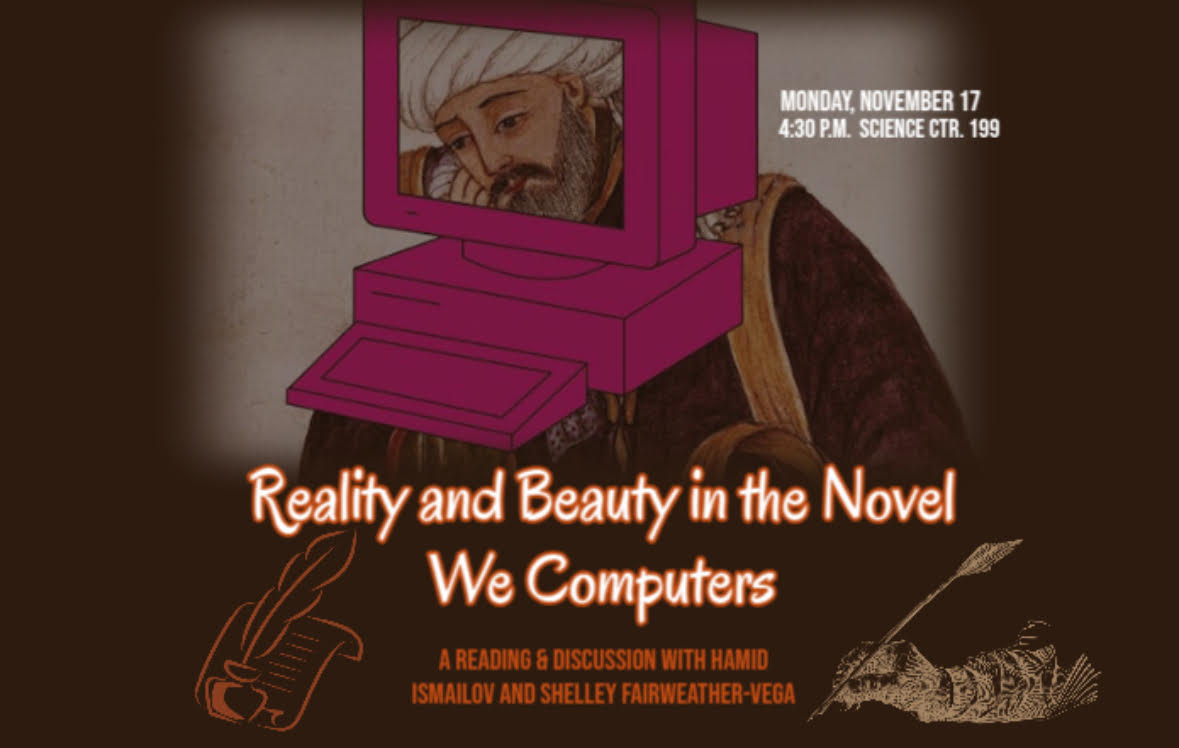
On Monday, November 17, novelist Hamid Ismailov and translator Shelley Fairweather-Vega visited Swarthmore College to discuss their recent collaborative work, “We Computers.” The novel, authored by Ismailov and translated by Fairweather-Vega, was recently announced as a finalist for the 2025 National Book Award for Translated Literature.
After an introduction from Susan W. Lippincott Professor of Modern and Classical Languages Sibelan Forrester, Ismailov read aloud from the novel’s original Uzbek text. Fairweather-Vega followed with an English translation.
The passage recounted a dream where Soviet poet Osip Mandelstam visits the protagonist, a fictionalized Ismailov named Abdulhamid Ismail or “A.I.,” suggesting he read a long-dead Turkish writer named Nedîm. The following day, A.I. discovers a historical figure who perfectly matches Mandelstam’s description. This poet’s exploration of the ‘ghazal’ form soon becomes a central source of inspiration for A.I.’s own work.
Ismailov explained that A.I.’s mystical experience with Nedîm accurately reflects his own discovery of the Turkish poet. Throughout the evening, Ismailov maintained an intentional ambiguity regarding questions of the supernatural. He expressed a desire to dissolve boundaries separating poetry from prose in his writing, often blurring lines between the literal and metaphorical, the mystical and mundane.
“For me,” he said in response to a question about the possibility of artificial intelligence replacing human authors, “AI is the ultimate representation of linear, rational thinking. Our faculties are much wider. Apart from linear thinking, we’ve got intuition. We’ve got a mystical side. I can’t explain this particular dream — where it came from, or why I was told the name of a man who became one of my beloved poets. Many of my pen names come from people I meet in dreams. So there is something more rich than rational thinking.”
Ismailov’s appreciation for human consciousness complements his belief in the creative potential of artificial intelligence. His interest in AI predates the recent surge in large language models. “We Computers” is based on his years of collaboration with French academic and writer Jean-Pierre Balpe, a pioneer of computer-generated literature. The novel’s other protagonist, Jon-Perse, engages with the fictionalized Ismailov in retellings of their longstanding debates about the nature of authorship.
“[Balpe’s] view is that poetry has nothing to do with human beings. It’s just a collection of words, and every reader brings his feelings into it by default. Nothing matters, not the biography of the poet or why he wrote this particular poem. Many poets agree with that. I disagree, and with this book I had the chance to go deeply into his mode of thinking. We’ve got a very playful, creative relationship. I fictionalized our lives, but I left the theoretical premises.”
Ismailov is also intensely interested in the biographies of writers and philosophers. A partially fabricated account of the life of Persian ghazal poet Hafez is woven into the narrative of A.I. and Jon-Perse. Fairweather-Vega noted that the Hafez sections presented particularly challenging translations due to their use of vulgar slang. Ismailov chuckled, explaining that this crudeness was intentional:
“The dirty jokes are not there for their own sake. They are there to show that Hafez and others were living normal lives, not restricted by ideologies or religious views. It was a flamboyant life — a joyful life. The jokes show the reality of the time, and the community of writers. They’re making fun of each other, which you might not expect from a lofty intellectual community.”
The importance of play—among people, languages, and genres—is a central theme of Ismailov’s work. “We Computers” is described as the first ghazal-novel, synthesizing the poetic and prosaic while integrating linguistic traces from various cultures that contributed to the development of the ghazal form.
“As a prose writer, I’m trying to blend the borders between different narrative styles. For me, human thought is not divided between, for example, academic thinking and fictional thinking. They can happen in your head simultaneously, and I’m trying to reflect that in my prose. The novel as a genre is always developing, becoming more complicated. Dostoevsky said that he wanted to write the polyphonic novel — a novel using many voices. I want to write a polytextual novel.”
Ismailov considers the ghazal a uniquely perfect model for this polytextuality. “The ghazal is a love song which was created in Arabic poetry of the seventh century, but then came to the Persian world and to the Turkic world and developed there. In both Persian and Turkic languages, there is no gender, so when you write the ghazal, you don’t know who the beloved is. It could be a him, a her, an absolute God, or anything else. There is a level of ambiguity.”
He highlighted that the ghazal’s popularity across literary traditions beyond its origins imbues the form with a sense of fundamental dislocation. Turkic and Persian ghazal poets grapple with their existence outside a common linguistic or cultural space with the original pioneers, striving to overcome this divide without sacrificing their native languages.
For Ismailov, the power of human language lies not in its clarity but in its ambiguity. Language, he asserts, does not need to be transparent or rational. Long before the rise of artificial intelligence, ghazal poets like Nedîm and Hafez used literature to engage with the incomprehensible facets of human experience. This approach has evolved through dialects, cultures, and centuries, suggesting that the age of AI presents not a threat to poetic tradition, but a thrilling opportunity. “Literature does not exist in time. It is language that takes us beyond specific time and place.”
See also Elon Musk Launches Grokipedia with 800,000 AI-Generated Entries to Challenge Wikipedia
 BRIDGE Summit 2025: AI, Cinema, and Geopolitics Transform Global Media Landscape in Abu Dhabi
 EU Launches Antitrust Probe against WhatsApp for AI Policy Limiting Third-Party Access
 Google’s 2025 Search Report Reveals Gemini Surpasses ChatGPT in India, AI Adoption Soars
 UAE’s Al Olama Joins Global AI Ethics Council, Advancing Middle Eastern Leadership in AI Standards