















































International Business Machines Corporation (IBM) and Intel Corporation (INTC) are two legacy technology firms that are increasingly pivoting towards emerging markets such as cloud computing and artificial intelligence (AI) while also emphasizing patent-driven innovations to appeal to investors. IBM has become a significant player by providing cloud and data solutions that facilitate digital transformation for enterprises. The company’s offerings range from hybrid cloud services to advanced IT solutions, including quantum computing, supercomputing solutions, enterprise software, storage systems, and microelectronics.
On the other hand, Intel, a leading semiconductor manufacturer and a key provider of microprocessors and chipsets, is gradually focusing on data-centric business areas like AI and autonomous driving. Its foundry operating model represents a strategic shift aimed at enhancing operational dynamics while driving transparency, accountability, and cost efficiency.
As both companies navigate their competitive landscapes, a closer examination reveals differing prospects that may influence their standing in an investor’s portfolio.
IBM’s Competitive Advantage
IBM stands to gain from a robust demand for hybrid cloud and AI solutions, particularly within its Software and Consulting segments. The company’s growth trajectory is anticipated to be supported by advancements in analytics, cloud computing, and security over the long term. The watsonx platform is set to underpin IBM’s AI capabilities, delivering foundational models to enterprises and enabling increased productivity.
The uptick in traditional cloud-native workloads, coupled with the rise in generative AI applications, has led enterprises to adopt complex cloud strategies that require a cloud-agnostic approach. This dynamic has propelled demand for IBM’s hybrid cloud solutions, further bolstered by its acquisition of HashiCorp, which enhances its ability to manage complex cloud environments effectively.
However, IBM faces stiff competition from the likes of Amazon.com, Inc. (AMZN) and Microsoft Corporation (MSFT), which have established strong footholds in cloud services. Intensifying pricing pressures are eroding IBM’s margins, and the company’s profitability has been on a downward trend, except for occasional spikes. The ongoing transition to cloud services has proven to be a significant hurdle, compounded by weaknesses in its traditional business segments and foreign exchange volatility.
Meanwhile, Intel is aggressively expanding its manufacturing capacity as part of its IDM 2.0 (Integrated Device Manufacturing) strategy. The company launched the Intel Core Ultra series 3 processor (codenamed Panther Lake) in January and plans to introduce the Xeon 6+ processor (codenamed Clearwater Forest) in the first half of 2026. Both products are manufactured at a cutting-edge facility in Chandler, AZ, and aim to serve a variety of applications, including consumer and commercial AI PCs and gaming devices.
Intel’s innovative AI solutions are designed to enhance the semiconductor ecosystem by reducing costs and improving performance. A significant partnership with NVIDIA Corporation (NVDA), which involves a $5 billion investment, aims to develop state-of-the-art solutions that will be critical to the evolution of the AI infrastructure landscape. The collaboration brings together NVIDIA’s expertise in AI and accelerated computing with Intel’s CPU technology and x86 ecosystem.
Despite these advancements, Intel’s reliance on the Chinese market poses risks, particularly as U.S. restrictions on high-tech exports tighten and China pushes for self-sufficiency in critical industries. This scenario presents dual challenges: potential market restrictions and increased competition from domestic chipmakers. Additionally, Intel continues to lag behind competitors like NVIDIA and AMD in the GPU and AI segments, as leading tech firms increasingly adopt NVIDIA’s GPUs for AI workloads, resulting in a significant revenue surge for NVIDIA.
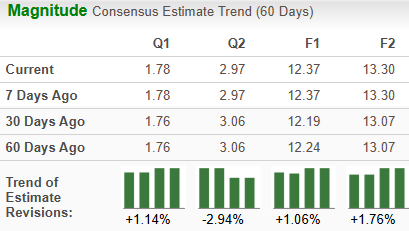
The Zacks Consensus Estimate for IBM’s sales in 2026 suggests a year-over-year increase of 5.5%, with earnings per share (EPS) projected to rise by 6.7%. In contrast, the estimate for Intel indicates a more modest sales growth of 1.8% but a more optimistic EPS rise of 16.7%, although EPS estimates have recently declined by 15.5% to $0.49.
Examining the price performance over the past year, IBM has gained 0.4%, compared to a remarkable 98.2% increase for Intel. From a valuation perspective, IBM appears more attractive, with shares trading at a price-to-sales ratio of 3.44, lower than Intel’s 4.31. Currently, IBM holds a Zacks Rank #3 (Hold), while Intel is rated #4 (Sell).
Although both companies project sales and earnings growth for 2026, IBM has exhibited more consistent revenue growth in recent years compared to Intel, which has been experiencing a decline. IBM also trades at a more appealing valuation. Nevertheless, Intel’s rapid price performance underscores its momentum in the market. Given its stable free cash flow and a solid portfolio geared towards enterprise SaaS and AI transformation, IBM appears better positioned than Intel for sustainable growth through advanced technology and consulting expertise.
As the convergence of AI and quantum computing represents a significant investment opportunity, investors are encouraged to consider the strategic positions of both companies in this evolving landscape. Those seeking to position their portfolios advantageously in the face of these technological advancements may find IBM’s comprehensive suite of solutions compelling.
For further insights, you can visit IBM’s official website and Intel’s website.
See also FTC Intensifies Probe into Microsoft’s Cloud and AI Practices Amid Monopoly Concerns
 Salesforce (CRM) Boosts Growth Outlook with $5.6B U.S. Army Deal Amid AI Adoption Surge
 Modi Launches India AI Impact Summit 2026, Anticipates 35,000 Global Delegates
 Runway Secures $315 Million in Series E Funding, Valuation Soars to $5.3 Billion
 India Leads AI Skills Globally, Fosters Innovation with Minimal Regulation: Jitin Prasada