

















































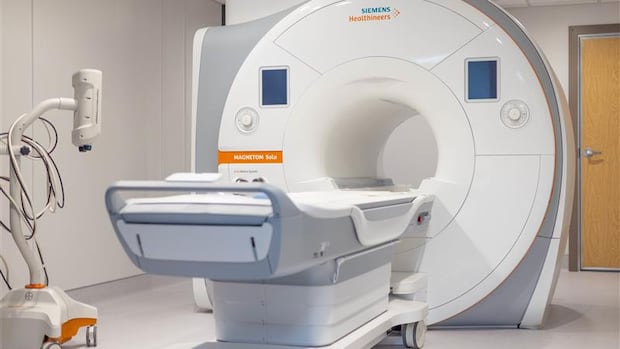
A growing number of Manitoba’s MRI machines are now incorporating artificial intelligence, with plans to have more than half utilizing the technology by spring 2026. This advancement aims to enhance diagnostic imaging by delivering clearer images and reducing scan times, according to Dr. AbdulRazaq Sokoro, chief operating officer of provincial diagnostic services for Shared Health.
“The patient will not notice any difference,” Sokoro stated. However, the duration of scans is significantly decreasing, from 20 minutes to just 10 minutes. New MRI machines, including a mobile unit initially stationed at Thompson General Hospital, are equipped with built-in AI technology. Several existing MRI units in the province are being retrofitted with AI software sourced from Siemens Healthineers.
While initial data is still being finalized, Sokoro emphasized the positive outcomes observed thus far. “This technology has been a center of our strategy to deal with the long wait list for MRI,” he said. He noted that AI represents one potential solution to the issue, and expressed gratitude for the government’s recognition and investment in this initiative. “I am confident that if we continue to leverage this technology across the province, we will make a significant dent in our wait times for MRI,” he remarked.
Currently, nine out of the province’s 14 scanners, located in facilities such as Boundary Trails Health Centre, the Pan Am Clinic, and various hospitals in Winnipeg, Brandon, and Selkirk, will have the AI software operational by spring 2026. Adjustments in scheduling, staff training for the new technology, and upgrades to protocols are essential for the successful implementation of this software, Sokoro indicated.
Despite the transformative potential of AI, Sokoro reassured that the technology is not intended to replace human staff. He has not received any concerns regarding the technology’s functionality but acknowledged that it is still early in the implementation process. “We tried to address every conceivable concern before we got into this business. The biggest one was data security and privacy,” Sokoro explained. “This is not a cloud-based system; it resides physically within the machine on which it runs.”
Health Minister Uzoma Asagwara noted that sites using the new AI-enhanced technology are already seeing significant improvements for patients. Preliminary data reveals that the Boundary Trails facility achieved an all-time high of 1,051 scans in October 2025, while the Pan Am Clinic experienced a 90 percent increase during the same timeframe. The initial month of AI implementation at Health Sciences Centre (HSC) resulted in a 24 percent boost in productivity.
The data from October 2025 was compared to the same month in 2022, marking the first period post-pandemic when MRI volumes began to stabilize. The upgrades have led to shorter scan times, fewer repeat exams, and quicker answers for patients, Asagwara’s office reported. The utilization of AI is also expanding into other areas of Manitoba’s health-care system, including weapons detection at HSC and a pilot program for note-taking during doctor appointments.
Asagwara emphasized that the province is collaborating with experts to explore how AI can enhance patient care and improve outcomes for Manitobans while alleviating the workload for health-care providers. At CancerCare Manitoba, a new AI tool is in development to facilitate the scheduling of chemotherapy appointments, aiming to optimize the process for over 5,500 treatments conducted monthly across 66 chemotherapy chairs in Winnipeg.
Ken Borce, former vice-president of clinical operations and chief nursing officer at CancerCare Manitoba, explained that the goal is to enable staff to focus more on patient interaction rather than administrative tasks. “It’s really in the context of the sustainability of the system and supporting our staff,” he stated, adding that the scheduling system from Gray Oncology Solutions will be aligned with existing procedures and protocols.
Borce reassured that patient safety and quality of care are top priorities during the implementation phase. “We’re not just buying a software off the shelf; our innovation does not come at the cost of safety and quality,” he stated. The new scheduling tool is expected to be operational next year, with no positions being eliminated as a result of this implementation.
As AI continues to evolve within the health-care sector, the potential for improving patient experiences and operational efficiencies remains promising. Manitoba’s strategic adoption of AI in MRI and chemotherapy scheduling reflects a broader trend toward leveraging technology to enhance healthcare delivery.
See also China’s EUV Lithography Breakthrough Threatens ASML’s Chip Dominance, Shifts AI Landscape
 Sam Altman Discusses OpenAI’s $1.4 Trillion Commitment and Path to Profitability
 Singapore AI Stocks Steady Amid Chip Demand Signals; Singtel, Data Centre REITs in Focus