
















































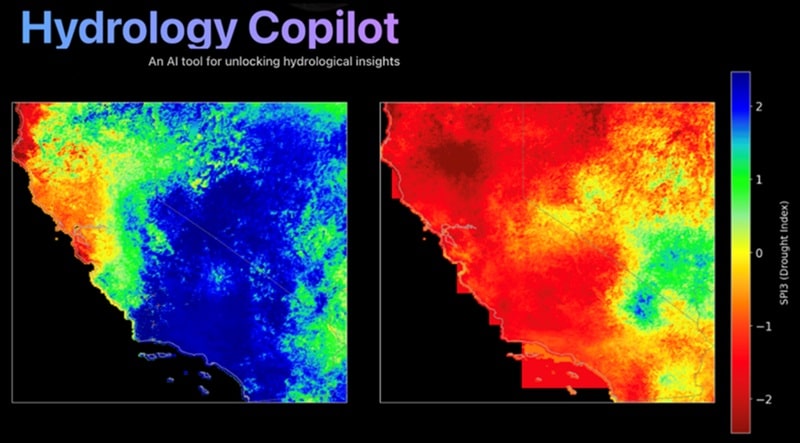
Microsoft and NASA are harnessing artificial intelligence to advance the field of hydrology, which focuses on understanding Earth’s water systems. Their joint initiative, known as Hydrology Copilot, features a suite of AI agents designed to streamline access, analysis, and interpretation of large-scale hydrological data. This collaboration aims to break down barriers that have historically hindered effective use of complex hydrology datasets.
Hydrology Copilot builds on the capabilities of NASA Earth Copilot, a cloud-based AI platform engineered to search and analyze vast amounts of Earth science data. By integrating these technologies, the initiative seeks to democratize access to complicated hydrological information, enabling a broader range of users to engage with critical data.
The study of hydrology encompasses the movement and distribution of water across the planet, including elements such as precipitation, runoff, evaporation, and the dynamics of rivers, lakes, and soil moisture. While this field underpins academic research, its practical applications extend to agriculture, forestry, urban development, and environmental planning.
Juan Carlos López, a senior solution specialist at Microsoft with a focus on space and AI, noted that NASA has historically produced advanced datasets related to hydrology and land surfaces. These datasets play a crucial role in drought early-warning systems and various environmental research initiatives. However, the specialized tools and expertise required to utilize this information effectively have often restricted its accessibility.
Hydrology Copilot addresses these challenges by allowing users to pose questions in plain language to query NASA’s data. For instance, an individual might inquire about regions at risk for flooding and receive interactive, visual results. This user-friendly approach is designed to make hydrological insights more approachable for a diverse audience.
The platform is powered by the Microsoft Azure OpenAI Service and Microsoft Foundry, providing simplified access to NASA’s North American Land Data Assimilation System Version 3. This advanced dataset uniquely combines satellite observations with computer modeling to offer a continuously updated, high-resolution perspective on the North American water cycle. The result is a comprehensive view of changing hydrological conditions across the continent.
Data obtained from Hydrology Copilot can inform a variety of planning functions, including drought monitoring, agricultural strategizing, water resource management, flood risk assessment, and emergency preparedness. Microsoft highlighted the recent flooding in Western Washington, intensified by successive atmospheric rivers, as an example of the importance of enhanced access to hydrological insights. This platform allows researchers and planners to better understand weather-driven water events by leveraging integrated datasets.
A Microsoft spokesperson emphasized that the initiative aims to empower local officials, city planners, and emergency responders with tools that facilitate a deeper understanding of weather patterns, thereby enhancing preparedness for hydrological events in the Pacific Northwest and beyond.
Currently, Hydrology Copilot remains under development and is primarily utilized by researchers. Microsoft’s Azure AI team is available to provide additional information about the platform. For those seeking publicly accessible hydrology data tools, Microsoft pointed to resources such as King County’s Hydrologic Information Center and the interactive map offered by the National Water Prediction Service.
As extreme weather events increasingly highlight water-related risks, Hydrology Copilot stands as a pivotal effort to enhance access to existing scientific data. Rather than forecasting or making predictions, the initiative focuses on improving the usability of available information to address pressing hydrological challenges.
See also Physics AI Revolutionizes Aerospace Engineering: Accelerates Design for Space’s Future
 Retail AI Surge: 2025 Sees 758% E-Commerce Growth Amid Industry Adoption Struggles
 Demis Hassabis and Yann LeCun Debate AGI’s Definition Amid AI’s Human-Level Capabilities
 Banking Transformation Ahead: AI and Stablecoins Set to Disrupt Industry by 2026
 India’s Job Market in 2026: Surge in High-Skill Roles Amid Salary Normalization and AI Integration