

















































Miranda Schwacke, a doctoral candidate at the Massachusetts Institute of Technology (MIT), is developing technology that emulates the functioning of the human brain to create more energy-efficient artificial intelligence (AI). Her research focuses on neuromorphic computing, which aims to process and store data at a single point, akin to the way neurons and synapses operate in the brain.
Schwacke’s journey into this innovative field began in her hometown of Charleston, South Carolina, where her mother, a marine biologist, studied the effects of pollutants on dolphin populations. This exposure to science as a tool for understanding and solving environmental issues influenced Schwacke’s academic aspirations. “That was an example of how science can be used to understand the world, and also to figure out how we can improve the world,” she remarked in an interview with MIT News.
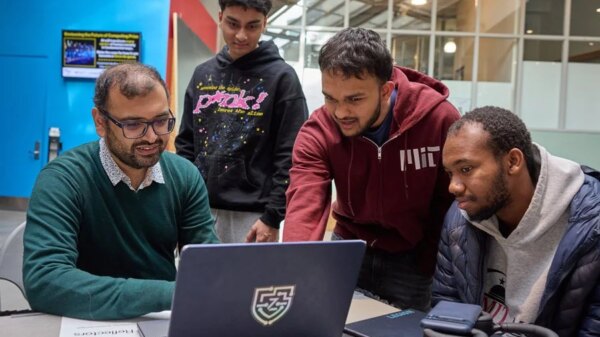
During high school, Schwacke developed a senior project focused on dye-sensitized solar cells, which piqued her interest in materials science. After enrolling at the California Institute of Technology (Caltech), she delved into nanoscale materials and energy storage technologies, including battery systems. Currently, she is part of Professor Bilge Yildiz‘s lab at MIT, where she investigates ionic synapses—devices that can alter their conductivity through chemical processes, mimicking the way brain cells strengthen or weaken their connections.
Schwacke is addressing a significant challenge in the AI realm: the substantial electricity consumption required for training large AI models. Traditional computers require separate storage and processing units, leading to inefficiencies and excessive power usage. In contrast, the human brain processes and retains information at a single site, offering a model of efficiency that could revolutionize AI technology.
Her devices utilize tungsten oxide, a material that can be precisely adjusted to influence electrical resistance. By studying how magnesium ions interact with this material, Schwacke explores how these alterations can emulate synaptic behavior in the brain. Her research has gained recognition, earning her a MathWorks Fellowship for the 2023-2024 academic year.
While AI holds the potential to optimize renewable energy grids, expedite climate solutions, and reduce pollution, it also presents considerable environmental challenges. Notably, training a single large language model can generate as much carbon pollution as five cars throughout their lifetimes. The technology’s energy demands, coupled with the need for substantial cooling resources in data centers, raise critical concerns.
As AI continues to proliferate across various industries, the awareness of its environmental footprint is becoming increasingly essential. Schwacke emphasizes the stark contrast between AI’s energy consumption and that of the human brain: “If you look at AI in particular, to train these really large models, that consumes a lot of energy. And if you compare that to the amount of energy that we consume as humans when we’re learning things, the brain consumes a lot less energy. That’s what led to this idea to find more brain-inspired, energy-efficient ways of doing AI.”
In light of these challenges, Schwacke’s work could pave the way for advancements in energy-efficient computing solutions that align with the growing demand for sustainable technology. As stakeholders in the tech industry are increasingly scrutinized for their environmental impact, research in areas like neuromorphic computing may offer a pathway to balance innovation with ecological responsibility. Individuals concerned about technology’s environmental implications are encouraged to support initiatives focused on energy-efficient computing, and to question tech companies about their energy sources and cooling methods.
For more information on research institutions, visit MIT or explore advancements in AI at OpenAI. The implications of Schwacke’s research may ultimately influence not only the AI landscape but also its broader environmental ramifications.
See also England’s AI-Driven Strategy Enhances Penalty Success Rate Ahead of 2026 World Cup
 Teachers Embrace AI: 41% in OECD Report Benefits, Risks, and Training Gaps in TALIS 2024
 Europe’s Local Clouds Elevate AI Compliance, Defining Digital Sovereignty for Startups
 Cohere CEO Aidan Gomez: U.S. and Canada Lead AI Race Against China, Emphasizes Partnerships
 Swiss Re Unveils Palantir-Driven AI Strategy to Transform Data into Actionable Insights