






















































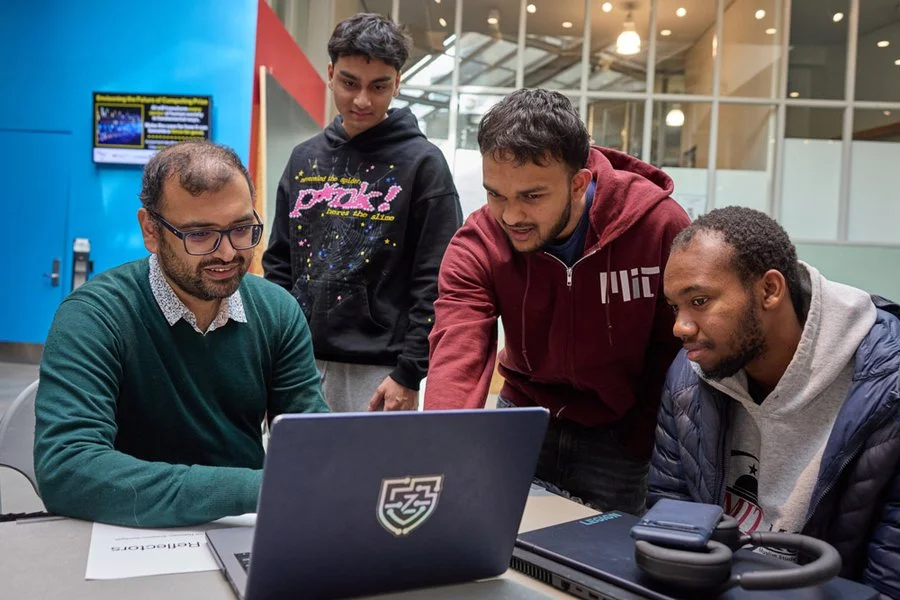
The Massachusetts Institute of Technology (MIT) has launched a novel undergraduate course that merges computer science and anthropology, focusing on the development of artificial intelligence chatbots designed to enhance human interaction rather than compete for attention. The course, titled Humane User Experience Design, aims to cultivate a new generation of digital tools that foster healthy social engagement in an era increasingly dominated by technology.
Developed by Professor Arvind Satyanarayan, an expert in human-computer interaction and data visualization, alongside Professor Graham Jones, an anthropologist interested in communication and social interaction, the initiative reflects a growing interest in the EdTech and AI sectors. It seeks to combine technical AI development with insights from linguistic anthropology, thus bridging the gap between how technology and social sciences can coalesce.
The students enrolled in the course collaborate to create AI chatbots that assist users in navigating real-world social contexts. Lessons focus on understanding conversational patterns, social cues, and interpersonal dynamics, with the objective of designing systems that help users develop social confidence and improve their communication skills. “There’s a way in which you don’t really fully externalize what you know or how you think until you’re teaching,” Jones remarked, highlighting the benefits of interdisciplinary collaboration.
Satyanarayan noted that the anthropological methods introduced in the course could enhance how technology researchers engage with users. He emphasized the importance of qualitative approaches such as interviews and user studies, which are often diluted in traditional technology-focused curricula. “For instance, it was very exciting for me to see how an anthropologist teaches students to interview people. It’s completely different than how I would do it,” he explained, pointing out the loss of rapport that can occur in data extraction methods.
Students in the class have embarked on various projects aimed at harnessing AI for practical social applications. One notable creation, named Pond, is aimed at assisting recent college graduates in their transition to adulthood. The chatbot offers guidance on social relationships, professional challenges, and everyday responsibilities. “Pond is built to be your companion from college life into post-college life, to help you in your transition from being a small fish in a small pond to being a small fish in a very big pond,” stated sophomore Mary Feliz.
Graduate student Emaan Khan elaborated on the rationale behind Pond, explaining that college environments often provide structured pathways for building relationships and discovering opportunities. “Post-grad life is low-context. You’re not always surrounded by your peers or your professors,” Khan said, highlighting the need for tools like Pond to aid in navigating this new phase of life.
Another project called News Nest targets younger users, helping them engage with credible news sources. This chatbot utilizes themed characters to represent different news categories, aiming to discourage compulsive scrolling while promoting media literacy. A third initiative, M³ (Multi-Agent Murder Mystery), facilitates social interaction through a multiplayer deduction game, allowing users to interact with AI agents as they solve a fictional crime scenario.
The course structure provides a unique opportunity for computer science students to satisfy humanities requirements while working on projects relevant to AI product development. Faculty members indicate that this interdisciplinary approach is increasingly essential in AI development, particularly as scrutiny grows over how conversational systems influence behavior and attention. Jones noted that large language models inherently contain patterns of human interaction, which can be shaped through design. “ChatGPT and other large language models are trained on naturally occurring human communication… waiting to be activated,” he stated.
As conversational AI systems become more integrated into digital platforms, MIT aims for this course to equip students with both technical and social design skills, preparing them for careers in the evolving landscape of AI technology. The initiative underscores the importance of blending technical expertise with human-centered design, thereby addressing the complexities of user interaction in an increasingly digital world.
See also Shoprite Foundation Launches Robotics Lab in Mpumalanga for 8,000 Learners’ Digital Skills
 University of Phoenix Scholars Reveal Insights on Generative AI’s Role in Higher Education
 Pippit AI Avatars Transform Digital Learning with Enhanced Engagement and Accessibility
 Zambia Launches AI Learning Platform in Secondary Schools to Enhance Education Access
 Huawei Launches AIEC Solution to Accelerate AI Education for 1 Million Students















