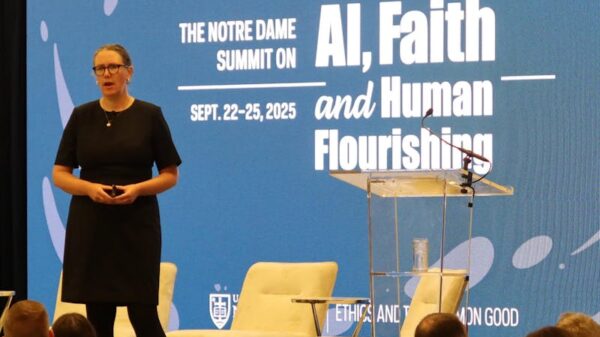



















































The University of Notre Dame has secured a significant $50.8 million grant from Lilly Endowment Inc. to advance a national initiative centered on ethics in artificial intelligence. This funding is set to bolster the DELTA Network, which aims to provide a faith-based ethical framework to guide educators, faith leaders, technologists, and the broader public in navigating the complexities of AI development and application.
This grant marks the largest amount Notre Dame has ever received from a private foundation, underscoring the foundation’s commitment to enhancing conversations about technology’s role in society. The DELTA initiative, which stands for Dignity, Embodiment, Love, Transcendence, and Agency, was introduced at Notre Dame’s inaugural Summit on AI, Faith and Human Flourishing earlier this fall. University officials emphasize that this framework seeks to enrich existing dialogues on AI safety by fostering a deeper contemplation of how AI impacts human existence and societal values.
In a September interview, Meghan Sullivan, director of Notre Dame’s Institute for Ethics and the Common Good, pointed out the limitations of current discussions surrounding AI ethics, which often concentrate on fundamental issues while neglecting broader ethical implications. “Much of the discussion around AI ethics right now hovers around what we call the ethical floor, just the rock-bottom basic principles about building AI that’s safe, explainable, and fair,” Sullivan remarked.
The newly acquired funding will facilitate the establishment of interdisciplinary communities focused on education, pastoral ministry, and public engagement. Additionally, the initiative is geared toward fostering programs that empower young adults to grapple with ethical inquiries related to AI. The DELTA Network will also enhance existing partnerships, notably the collaboration between Notre Dame and IBM through the Notre Dame–IBM Technology Ethics Lab.
Lilly Endowment, an Indianapolis-based private foundation, invests in various initiatives in community development, education, and religion, particularly aiming to strengthen religious life across the United States. This grant aligns with its broader mission of fostering ethical inquiries in significant contemporary issues.
The DELTA Network is poised to play a crucial role in shaping an ethical landscape for AI, a technology increasingly integrated into daily life across diverse sectors. As discussions around AI continue to evolve, the initiative emphasizes the need for a framework that transcends mere technical specifications, advocating for a more holistic understanding of AI’s ramifications on humanity.
Looking ahead, Notre Dame’s venture into AI ethics not only reflects a growing recognition of the importance of ethical considerations in technology but also positions the university as a key player in the discourse surrounding the future of AI. By encouraging a more profound exploration of AI’s impact, the DELTA initiative seeks to inform and guide the development of technology in ways that uphold human dignity and societal values.
See also IBM’s Practical AI Focus Fuels 9.1% Revenue Surge, Raises 2025 Cash Flow Outlook to $14B
 Malicious Extensions Steal Data from 900K Users of ChatGPT and DeepSeek, Researchers Warn
 AI Agents Fall Short in Federal Work: New Study Reveals Limits of Automation
 AI-Driven Cybercrime to Reach Trillions by 2026, Threatening Global Security and Economy
 S&P Global Partners with Google Cloud to Enhance AI Tools and Workflow Efficiency