














































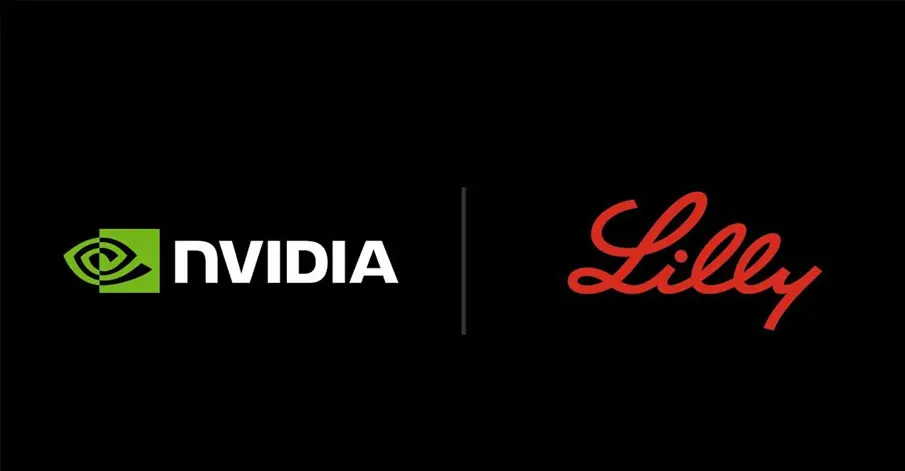
NVIDIA and Eli Lilly and Company have committed $1 billion over five years to establish a joint artificial intelligence research laboratory in the San Francisco Bay Area. This initiative aims to enhance drug discovery processes, reflecting a growing trend in the pharmaceutical sector to integrate advanced computing technologies.
The partnership was announced at the JPMorgan Healthcare Conference, coinciding with Eli Lilly’s plans to build a supercomputer utilizing over 1,000 NVIDIA Grace Blackwell AI chips. This move aligns with the company’s strategy to embed high-performance AI systems in its research and development operations, signifying a substantial investment in computational resources.
The new lab will facilitate close collaboration between researchers from both organizations, fostering the generation of high-quality, proprietary datasets essential for training AI models focused on biotechnology. The overarching objective is to enhance the identification, simulation, and optimization of potential drug candidates, thereby expediting the transition from initial discovery to laboratory and clinical testing phases.
According to NVIDIA Vice President of Healthcare Kimberly Powell, both companies are allocating “incremental resources” to the center, indicating a long-term commitment that extends beyond their existing investments. The specific location of the facility is set to be revealed in March. Additionally, the lab will serve as a testing ground for NVIDIA’s expanding array of healthcare-oriented AI tools, including newly launched open-source models aimed at simplifying the synthesis of AI-generated drug candidates in practical laboratory environments.
This collaboration underscores a broader transformation in the pharmaceutical industry, where AI is increasingly recognized not only for data analysis but as a fundamental driver of drug discovery. High-performance computing capabilities enable researchers to model intricate biological systems, anticipate molecular interactions, and create novel compounds at unprecedented scales.
For NVIDIA, this partnership solidifies its role as a key technology provider in the life sciences sector, broadening the application of its latest AI chips within one of the most data-intensive industries. For Eli Lilly, the joint lab signifies a strategic investment in next-generation research and development capabilities, reinforcing its commitment to deeply integrate AI into the future of pharmaceutical innovation.
The partnership between NVIDIA and Eli Lilly not only aims to streamline the drug discovery process but also sets a precedent for future collaborations in the life sciences field. As AI continues to evolve, its role in pharmaceutical research will likely expand, leading to faster, more effective drug development and ultimately improving patient outcomes.
As the implications of this partnership unfold, stakeholders within the industry will be closely monitoring advancements from the lab, which could potentially reshape the landscape of drug discovery and development.
See also Healthcare Investment Drops 12% to $46.8B in 2025; AI Drives 46% of Funding, SVB Reports
 Anthropic Launches Cowork to Enhance Claude’s Utility for Document-Centric Business Tasks
 Anthropic Blocks xAI from Accessing Claude Models Amid Rising AI Rivalry