


















































As the artificial intelligence (AI) boom continues, competitive pressures are emerging within the semiconductor industry, notably impacting key players like Nvidia and Taiwan Semiconductor Manufacturing (TSMC). Rapid advancements in AI technology depend on sophisticated semiconductor capabilities, with developers increasingly relying on advanced chips to train expansive large language models. This surge in AI adoption has heightened the demand for graphics processing units (GPUs) and other AI accelerator chips, further driving the computational needs for AI inference.
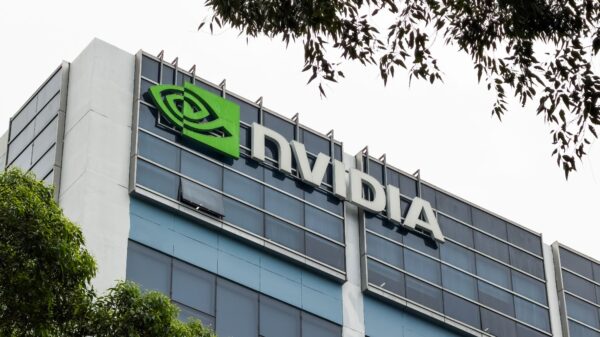
Nvidia, long regarded as a leader in this space, has reaped significant rewards from the growing need for processing power. The company partners with TSMC to manufacture its chips, effectively outsourcing the fabrication process. Both companies have seen remarkable stock growth in recent years, with Nvidia’s shares soaring over 900% and TSMC’s increasing roughly 250% over the last three years. However, with such substantial growth, investors are now scrutinizing future potential and risks.
In its latest earnings call, Nvidia CEO Jensen Huang reported that sales for the new Blackwell platform are “off the charts,” contributing to a 62% year-over-year revenue increase, which reached a total of $57 billion in the last quarter. Nvidia has built a formidable lead in hardware technology, bolstered by its CUDA software that facilitates developers in utilizing multiple Nvidia GPUs efficiently. This unique software creates significant switching costs for developers, often justifying the premium price of Nvidia’s chips over competitors.
However, this dominance is increasingly challenged as major customers such as Microsoft, Meta Platforms, Amazon, and Alphabet explore alternatives to Nvidia’s offerings. These companies are in various stages of developing custom AI accelerators, which poses a risk to Nvidia’s future growth as they seek to reduce reliance on the GPU market leader. In fact, the four largest customers accounted for a staggering 61% of Nvidia’s sales last quarter, raising concerns about the company’s vulnerability should any one of them pivot away from its products.
This uncertainty is reflected in Nvidia’s current valuation, which trades at 24 times analysts’ estimates for fiscal 2027. While this price may account for some risk, a slowdown in sales from any major client could lead to a downward revision in earnings projections, potentially compressing Nvidia’s earnings multiple. As long as major clients continue to invest in new data centers stocked with Nvidia GPUs, the company’s stock may maintain its upward trajectory.
Market Context
Conversely, TSMC has solidified its reputation as a pivotal player in the contract chip manufacturing sector amid the AI surge. With a commanding 70% market share, TSMC is often the go-to choice for companies needing advanced semiconductor manufacturing capabilities. Its recent financial results reflect this strong position, with a 40.8% year-over-year revenue increase and a gross margin expansion to 59.5%. However, management anticipates revenue growth will moderate, projecting a 20% increase for the upcoming quarter.
TSMC’s robust position in the advanced chip manufacturing landscape allows it to book significant customers years in advance, providing clarity on investment in new facilities to meet escalating demand. The company’s substantial revenue generation compared to its nearest competitor enables it to invest heavily in research and development, ensuring it retains a technological advantage.
Despite its strength, TSMC faces geopolitical challenges, particularly concerning U.S.-China relations which could disrupt its supply chain. In response, TSMC is diversifying its operations geographically, including establishing new foundries in Arizona. The stock is currently trading at around 23 times analysts’ 2026 expectations, suggesting that investors are factoring in these geopolitical risks.
In deciding between Nvidia and TSMC as investment opportunities, the choice hinges on the investor’s risk appetite. Nvidia may present greater upside potential; however, it carries heightened volatility due to external competitive pressures and dependence on a limited number of major customers. In contrast, TSMC, while lacking the same explosive growth potential, offers a more stable investment profile with less susceptibility to immediate market disruptions.
Given the current market dynamics, many analysts express greater confidence in TSMC’s capacity to sustain its earnings growth trajectory. Thus, TSMC appears to be the safer investment at this juncture, reflecting a more reliable pathway for maintaining profitability amidst a shifting semiconductor landscape.
See also AWS Advocates for Risk-Based Global AI Regulation to Balance Innovation and Responsibility
 Law Firms Boost Revenue Growth 2X with People-First AI Strategies, New Insights Reveal
 NVIDIA Fixer Enhances 3D Gaussian Reconstruction Quality, Reducing Artifacts by 15%
 AWS Unveils NVLink Fusion for Rapid Trainium4 AI Chip Deployment, Enhancing Performance and Scalability
 Qualcomm’s AI and Data Center Strategy Set to Drive 20% CAGR Growth by 2027