





Market Dynamics Shift in AI Chip Development
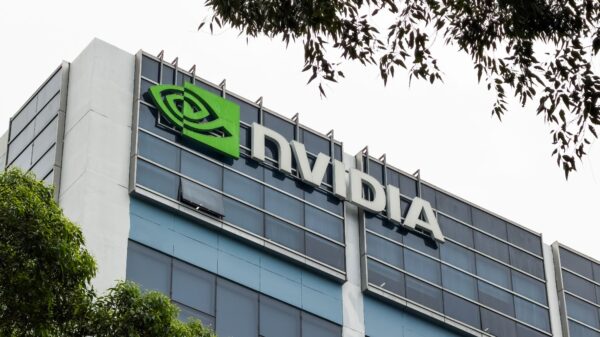
In a groundbreaking move within the artificial intelligence chip sector, Nvidia Corp. has entered into a licensing agreement with the startup Groq valued at approximately $20 billion. This deal, which emerged late last year, is not a traditional acquisition; instead, it allows Groq to retain a degree of independence while Nvidia gains access to its critical inference technology and top talent, including Groq’s CEO. This unusual structure has prompted investors to reevaluate their strategies in a rapidly consolidating market where early backers may be at risk of losing out on returns.
Reports indicate that Nvidia is licensing Groq’s inference technology, essential for optimizing AI model performance, while strategically hiring key executives. The complexity of this arrangement has left Groq’s investors, who had recently valued the company at $6.9 billion, grappling with the implications for their equity as payouts are now tied to the deal’s specifics rather than a straightforward exit. The move has sparked significant concern among venture capitalists about their control in hybrid deals that mix elements of acquisitions, licensing, and talent acquisition.
The deal spotlights a broader trend as Nvidia, with a market capitalization exceeding $3 trillion, utilizes its financial power to shape the AI landscape. By securing access to Groq’s innovative capabilities without undergoing extensive regulatory scrutiny typical of full acquisitions, Nvidia effectively neutralizes potential competition. This strategy has caused alarm among investors, particularly those from BlackRock, who had recently led a funding round that valued Groq at $2.8 billion.
As a response to these mounting concerns, venture capitalists are increasingly advocating for stronger contractual safeguards in future investments. New measures being introduced include clauses that guarantee minimum returns if a licensing agreement or asset sale occurs, alongside “change of control” provisions that would trigger payouts should a major player like Nvidia absorb critical assets without a complete acquisition. Such adjustments are becoming vital as investors aim to protect their stakes amid growing fears of strategic poaching by tech giants.
Nvidia’s approach with Groq serves as a defensive maneuver intended to maintain its dominance in the AI chip market, where it commands over 80% of the share. By focusing on a cash deal for asset acquisition rather than an outright merger, Nvidia sidesteps antitrust issues that have hindered other tech firms. This strategic decision has implications for the broader AI startup ecosystem, as it raises questions about how smaller players can compete when faced with such powerful incumbents.
The Groq transaction has also highlighted significant discussions regarding employee outcomes and retention, as Groq’s employees navigate equity vesting and potential retention bonuses amidst executive moves to Nvidia. Stock markets reacted favorably to the news, with Nvidia’s shares rising, reflecting investor confidence in the company’s ability to integrate Groq’s low-latency technology effectively.
Moreover, the deal emphasizes an evolving landscape of funding dynamics within the tech industry. Investors are prioritizing startups equipped with defensible moats against powerful corporations, focusing on niche applications and proprietary datasets. This shift in strategy reflects a cautionary approach as venture capitalists recognize the risks associated with backing challengers to dominant firms like Nvidia, which have shown a willingness to absorb or neutralize competition before it gains traction.
As funding trends adapt, experts predict a rise in “Nvidia clauses” in investment agreements, designed to mitigate the risks associated with dominant players cherry-picking assets. Such provisions may include mandatory auctions for intellectual property in distress scenarios or escalator clauses linked to the acquirer’s market cap. The Groq episode serves as a case study of the complex relationships forming between venture capitalists and tech giants, highlighting the need for enhanced protections in an increasingly competitive landscape.
Looking ahead, as AI innovation accelerates, investors will have to strike a balance between seizing opportunities and implementing safeguards that ensure equitable outcomes. The dynamics introduced by the Groq deal will likely influence how capital flows into emerging technology sectors, as stakeholders adapt to a reality where giants like Nvidia increasingly dictate market terms.
For more information on Nvidia, visit their official website at nvidia.com. Insights on Groq can be found at groq.com.
See also AI Productivity Gains Fall Short: 2025 Studies Reveal Hidden Costs and Industry Disruption
 OpenAI Partners with Jony Ive to Launch AI-Powered Pen Device by 2027
 Walmart’s AI Surge: 40% of New Software Code Fuels Retail Transformation and Efficiency
 Prepare for 2026: Key Compliance Trends Shaping AI Governance and Risk Management
 Progressives Risk Backfire by Advocating for Disempowered Federal Courts