















































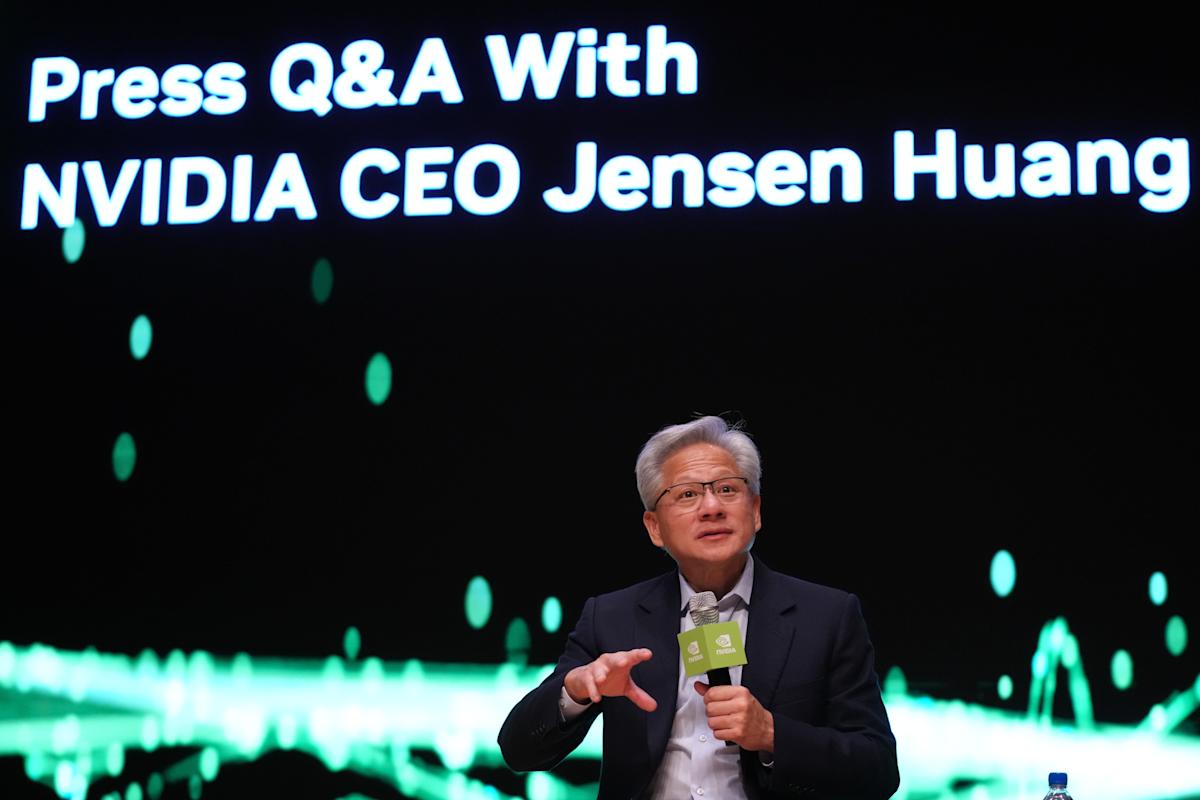
Nvidia has solidified its position in the artificial intelligence market by striking a significant licensing deal with chip startup Groq. Announced this week, the non-exclusive agreement allows Nvidia to license Groq’s technology and includes the hiring of key personnel, including Groq’s founder and CEO, Jonathan Ross. Reports suggest the deal could be valued at around $20 billion, marking Nvidia’s largest transaction to date, although the company has not confirmed this figure.
According to Bernstein analyst Stacy Rasgon, the Nvidia-Groq deal is a strategic maneuver that leverages Nvidia’s growing financial strength. In its latest quarter, the company reported a more than 30% increase in cash inflow, totaling $22 billion. Analysts from Hedgeye Risk Management remarked that this transaction functionally resembles an acquisition of Groq, cloaked as a licensing agreement to mitigate regulatory scrutiny.
This move is part of Nvidia’s broader strategy to reinforce its market dominance in artificial intelligence, following its recognition as the world’s first $5 trillion company. The chipmaker has made substantial investments across the AI landscape, partnering with major players such as OpenAI and xAI, and has also ventured into “neocloud” services through investments in companies like Lambda and CoreWeave.
Nvidia’s engagements have not been without controversy. The company’s investments in firms that are also its customers have drawn accusations of circular financing, reminiscent of the dot-com era. However, Nvidia has strongly denied these allegations. For its part, Groq, founded in 2016, had aimed to rival Nvidia by developing language processing units (LPUs) specifically designed for AI inferencing, marketed as alternatives to Nvidia’s graphics processing units (GPUs).
AI model training necessitates vast computing power for processing large datasets, while inferencing involves applying the trained model to generate outputs. Analysts suggest that although Nvidia leads the chip market for AI training, it may soon face intensified competition in the inference sector. Custom chips like Google’s TPUs and Groq’s LPUs are considered potentially more efficient for specific tasks, with Groq’s offerings being faster and more energy-efficient due to their use of SRAM memory technology.
Ross has outlined Groq’s ambition to satisfy half of the global AI inference computing requirements at a reduced cost. In a recent interview, he stated, “What we want to do is drive the cost of compute as close to zero as we can get it. Every year we want to make it cheaper.” Notably, Ross played a pivotal role in developing Google’s first-generation TPUs, a significant competitor to Nvidia’s offerings.
CJ Muse, an analyst at Cantor Fitzgerald, commented that Nvidia’s acquisition of Groq’s talent and technology signals a dual strategy of offense and defense in the AI arena. This deal is expected to enable Nvidia to capture an even larger share of the inference market.
Despite the potential benefits, some Wall Street analysts expressed skepticism about the $20 billion price tag, particularly given that Groq’s technologies remain largely unproven for larger AI models, attributed to their limited memory capacity. Alex Platt of DA Davidson noted that Groq’s current technology is restricted to a narrow range of inference workloads.
Nvidia’s stock saw an increase of over 1% immediately following the announcement of the deal, reflecting investor optimism despite the mixed reactions among analysts. The implications of this deal could reshape the competitive landscape of AI chip manufacturing, positioning Nvidia firmly in the crosshairs of emerging competitors intent on challenging its supremacy.
See also Vitalik Buterin Endorses Grok’s Role in Enhancing Truth Discovery on X Amid AI Bias Concerns
 Oracle Faces 30% Stock Plunge Amid Delays in $400B OpenAI Data Center Projects
 Cut Financial Risks: Avoid SoundHound, BigBear.ai, and Pony.ai for Retirement Savings
 Adobe Partners with Runway to Launch Gen-4.5 AI Video Tools for Creatives
 Nvidia Strengthens AI Inference with Groq Deal as Big Tech Faces 2026 Profitability Pressures