


















































Oracle has launched an ambitious infrastructure expansion strategy aimed at establishing itself as a pivotal player in the artificial intelligence revolution. This bold move, however, necessitates substantial capital investments, prompting some investors to reevaluate their financial commitments. The company’s fiscal second-quarter results for 2026 highlighted both the potential and the challenges of this high-stakes venture.
In a report detailing its fiscal second-quarter revenues, Oracle disclosed earnings of $16.1 billion, a 14% increase year-over-year. Cloud infrastructure revenues soared by 68%, reaching $4.1 billion. A notable highlight was the spike in remaining performance obligations, which surged to $523 billion after adding $68 billion in new commitments from major clients, including Meta and NVIDIA. This growing backlog underlines the strong demand among enterprises for Oracle’s cloud infrastructure capabilities, particularly for AI training and inference workloads.
Despite these promising indicators, the surge in bookings comes with significant upfront investment requirements. Oracle raised its capital expenditure guidance for fiscal 2026 to approximately $50 billion, up by $15 billion from earlier expectations and more than double the $21.2 billion spent in fiscal 2025. While the company anticipates generating an additional $4 billion in revenue for fiscal 2027 as this backlog converts, the immediate cash flow implications are considerable, with free cash flow registering a negative $10 billion in the fiscal second quarter due to the intensive data center expansion.
Oracle’s recent strategic initiatives further illustrate its commitment to becoming the backbone of future AI applications. In December 2025, the company announced the upcoming availability of its Oracle AI Database 26ai for on-premises Linux x86-64 platforms, set for release in January 2026. This development expands Oracle’s AI-native database capabilities beyond cloud-managed services, tapping into a broader market segment.
The firm also entered a partnership with the U.S. Department of Energy on December 18, 2025, aimed at advancing AI and high-performance computing initiatives, including the Genesis Mission. This collaboration seeks to merge supercomputers, experimental facilities, AI systems, and datasets to accelerate scientific discoveries and uphold American leadership in advanced computing.
At the AWS re:Invent conference in December 2025, Oracle revealed its native integration with AWS Key Management Service for Transparent Data Encryption key management within its Exadata Database Service. This enhancement bolsters the security of Oracle Database services operating on AWS infrastructure, a critical requirement for enterprises navigating multicloud strategies.
Oracle’s approach to embedding its infrastructure across multiple cloud providers seems to be gaining traction. The company currently operates 147 live customer-facing regions and plans to establish an additional 64 regions, including 72 multicloud datacenters within environments of Amazon, Alphabet, and Microsoft. Management noted that the multicloud database sector experienced an impressive growth of 817% in the fiscal second quarter, marking it as the fastest-growing segment in Oracle’s portfolio.
In addition, the company delivered nearly 400 megawatts of data center capacity during the quarter and boosted GPU capacity by 50% compared to the previous quarter. The ongoing SuperCluster deployment in Abilene, Texas, remains on course, with plans to install over 96,000 NVIDIA Grace Blackwell GB200 chips, positioning Oracle to handle demanding AI training workloads.
Looking ahead, Oracle forecasts total revenue growth of between 19% and 21% in U.S. dollars for the fiscal third quarter, with non-GAAP earnings per share expected to range from $1.70 to $1.74. The company has maintained its full-year revenue outlook for fiscal 2026 at $67 billion. The expanded capital expenditure program indicates management’s confidence in converting its sizeable backlog into realized revenue in the upcoming quarters.
Management has reiterated its commitment to preserving an investment-grade debt rating and highlighted alternative financing strategies, including customer-provided chips and supplier chip leasing arrangements, aimed at aligning capital outflows with revenue generation. Nevertheless, the execution risk remains significant given the scale of the infrastructure expansion.
The Zacks Consensus Estimate for Oracle’s fiscal 2026 earnings is projected at $7.38 per share, an 8.4% upward revision over the last month, indicating a growth of 22.39% compared to fiscal 2025.
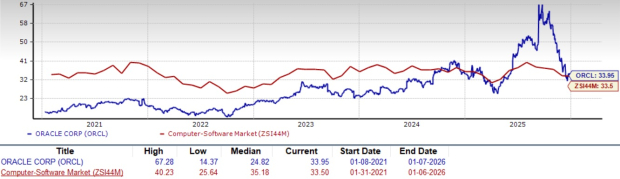
From a valuation standpoint, Oracle is trading at a trailing 12-month price-to-earnings ratio of 33.95 times, slightly above the industry average of 33.5 times, and carries a Value Score of D, suggesting relatively high valuation metrics. Over the past six months, Oracle shares have declined by 18.2%, underperforming the broader Computer and Technology sector, which appreciated by 18.4%, and the Computer-Software industry, which saw an 8.3% decline.
The competitive landscape remains fierce, with Oracle vying against established cloud infrastructure leaders. Microsoft is expanding Azure’s AI capabilities and solidifying enterprise relationships through its Office and Windows products. Google is pursuing aggressive pricing strategies in its Google Cloud Platform while leveraging proprietary AI models. Meanwhile, Amazon Web Services continues to lead the market through its expansive service portfolio and global infrastructure. While Microsoft emphasizes integrated software ecosystems, Google focuses on machine learning innovation, and Amazon prioritizes service breadth, Oracle differentiates itself through its expertise in database technology and multicloud deployment flexibility.
As Oracle navigates this transitional phase, investors face a complex dilemma. While the company possesses compelling competitive advantages in database technology and has secured significant commitments from prominent clients, its near-term financial profile reflects heavy investment rather than the typical cash generation associated with mature software enterprises. Given the anticipated capital expenditures that will heavily impact cash flow throughout fiscal 2026, patience appears prudent for those not currently invested in Oracle stock. Existing shareholders might consider holding their positions in light of the long-term potential of Oracle’s AI infrastructure strategy, whereas new investors may find it advantageous to wait for clearer visibility into capacity utilization rates and the conversion timeline for the substantial backlog. Currently, Oracle stock holds a Zacks Rank #3 (Hold).
See also Google Unveils AI-Powered Gmail Features to Transform Email into a Personal Assistant
 White House Executive Order Targets State AI Laws, Establishes National Policy Framework
 Meta’s Manus Acquisition Under Chinese Review for Compliance with Data Regulations
 DTCC Survey Reveals Geopolitical and Cyber Risks as Top Threats to Global Finance by 2026