





















































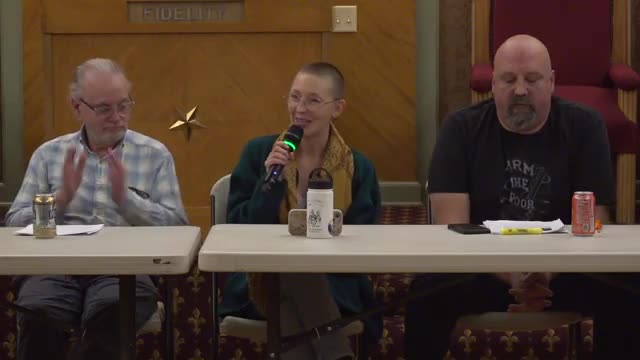
Justice York, a soil conservationist engaged with farmers and forest landowners in Missoula and Mineral counties, presented a forward-thinking eco-socialist agenda at a recent community event. York emphasized the importance of strengthening “imagination muscles” among attendees as a way to foster innovative solutions to pressing environmental challenges.
In her remarks, York recommended several land back mechanisms, including direct title transfers, conservation easements, and land sales to return decision-making authority to Indigenous communities. She highlighted the value of traditional ecological knowledge and advocated for prescribed burns to help restore western fire regimes. Citing a study, York pointed out that basic human needs could be met with approximately 15–30 gigajoules of energy per person per year, a significant reduction from the current average of 53 GJ.
On the topic of transportation, York argued for the implementation of high-speed rail, noting its potential to significantly reduce energy use and emissions per passenger mile when compared to traditional cars and planes. She identified local opportunities to replace short flights, such as those between Missoula and Seattle, with more sustainable alternatives. Additionally, she addressed the potential of desalination as a partial strategy for freshwater access, while acknowledging the environmental trade-offs associated with it.
York also underscored the importance of regenerative agriculture and local food systems as vital measures aimed at enhancing climate resilience. These strategies align with her broader vision of building sustainable and equitable communities. She urged audience members to engage in discussions and take action on these ideas within their own local contexts, illustrating the community-driven approach necessary for effective environmental stewardship.
As climate change continues to pose significant threats, York’s proposals strike at the heart of ongoing debates regarding land use, energy consumption, and sustainability. By advocating for a systemic shift in how resources are managed, she offers a pathway toward a more resilient future that incorporates the voices and traditions of Indigenous peoples.
The urgency of these discussions is underscored by a growing recognition of the need for collective action to address environmental issues. As communities strive to adapt to changing conditions, the principles of eco-socialism, as outlined by York, may serve as a crucial framework for fostering sustainable practices. The call to action she presented resonates with a community ready to explore these transformative ideas and apply them locally, bridging the gap between environmental need and social equity.
See also Bank of England Reports Rising Financial Risks from AI Bubble and Lending Practices
 Catholic Scholar Joseph Vukov Advocates Human Dignity Amid AI’s Rise in Ethics Lecture
 Cross-Border Counsel Krish Thakker Transforms Compliance Amid Global AI Regulatory Chaos
 AWS Launches Autonomous AI Agents and Nova Sonic for Enhanced Customer Interactions
 AI Trade Wars Intensify: Semiconductors and Data Sovereignty Redefine Global Power Dynamics






