
































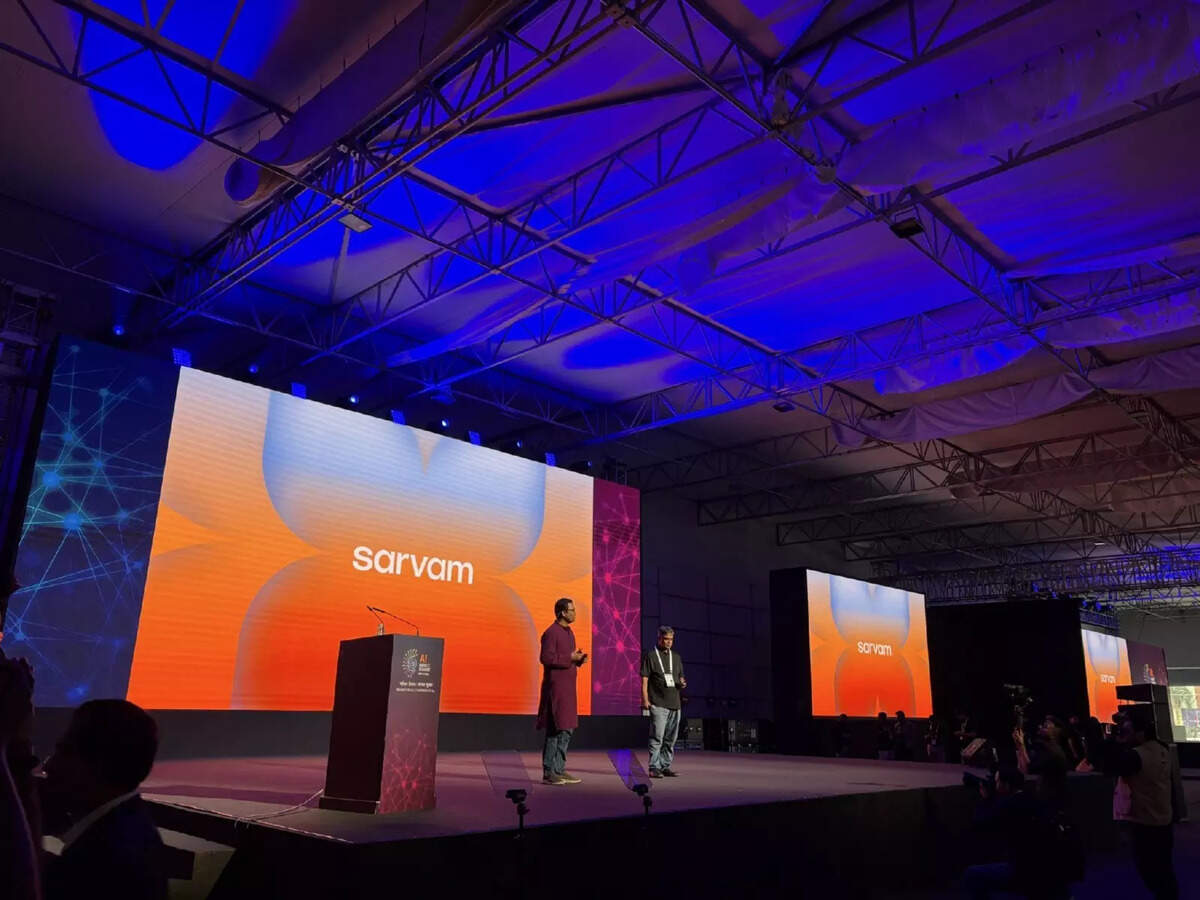
Sarvam AI, an emerging artificial intelligence lab based in India, has distinguished itself by developing foundational AI models with a minimal team and constrained resources. Co-founder Pratyush Kumar emphasized that the startup executed its model training internally, avoiding reliance on external technology stacks. “DeepSeek had around 5,000 researchers working on its models, whereas we did it with 40 researchers,” Kumar told Economic Times.
This stark contrast highlights Sarvam’s innovative operating strategy. While many global AI labs deploy extensive research teams and massive computational resources, Sarvam managed to train models using just 4,000 GPUs over a six-month period, creating models with parameter sizes of 3 billion, 30 billion, and 105 billion. “In global standards, this was extremely frugal,” Kumar stated, showcasing the lab’s efficiency.
Kumar characterized this initial phase as the company’s “first innings,” aimed at proving its capacity to build a complete technological stack independently. “Innings one was to show that we can build this entire stack end-to-end,” he said, adding that Sarvam operates without dependencies on external companies for data, algorithms, or engineering.
With its core models now established, Sarvam AI is pivoting towards product development. Kumar noted that the next phase involves building applications and generating revenue while continuing to invest in research. “Monetisation is important for survival and growth. But R&D is what gives us the muscle,” he explained, indicating a balanced approach to business sustainability.
The company is already applying its models in various enterprise and government contexts, including voice AI and language technologies. Although Sarvam has developed a consumer-facing interface named Indus AI, Kumar clarified that it is not intended to compete in the crowded market of free chatbots. “We don’t want to be in the race of putting free products out there,” he emphasized, pointing to the interface’s role in gathering user feedback to enhance model performance.
Instead, the primary focus remains squarely on enterprise applications and business-to-business (B2B) solutions. Kumar articulated that the broader ambition is to transform foundational research into deployable products originating from India, an aspiration that reflects a growing trend in the Indian technology landscape.
The startup has garnered support from notable venture capital firms such as Lightspeed Venture Partners, Peak XV Partners, and Khosla Ventures. Additionally, it is aligned with the Indian government’s India AI Mission, which aims to bolster sovereign AI capabilities in the country. As Sarvam AI prepares to raise further capital, the focus will be on scaling its infrastructure and augmenting its workforce.
“It’s not just about Sarvam. It’s India’s hunger to prove itself. This is the decade to do it,” Kumar concluded, underscoring the shared ambition within the Indian tech sector to establish itself as a leader in the global AI landscape.
See also Supreme Court Rejects Trump’s IEEPA Tariff Authority, Limits Presidential Power
 Hugging Face Unveils Comprehensive Guide for High-Quality Image Generation with Diffusers
 Dow Jones Futures Surge After Supreme Court Tariff Ruling; Nvidia’s AI Growth Drives Market
 Mistral AI’s Arthur Mensch Advocates for Decentralized AI Power at India Summit