






















































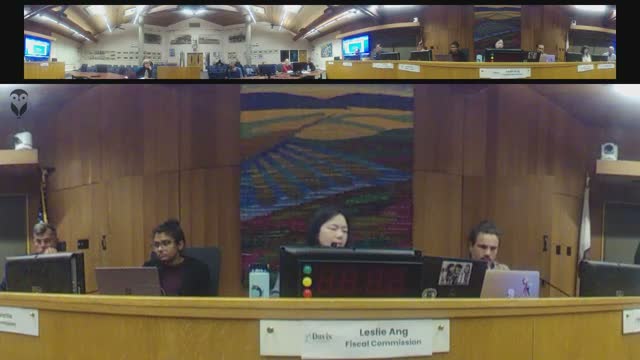
The Davis Finance Commission has voted to recommend a revised subcommittee memo on socially responsible investing (SRI) to the City Council, promoting a middle-path policy termed Option 2. This decision was reached during a recent meeting, where the subcommittee presented three distinct options aimed at aligning the city’s investment strategies with community values.
The subcommittee’s memo also included a separate, optional occupation-based exclusion derived from a list curated by the American Friends Service Committee (AFSC). During the discussions, the subcommittee lead emphasized that the majority of the city’s current investments are held in pooled or state-managed funds, which limits the commission’s ability to direct them. Notably, it was indicated that two of the proposed options could be adopted by the city’s investment manager without incurring additional costs.
The commission engaged in extensive deliberation regarding the scope and administration of the options. Concerns were raised about whether the AFSC’s occupation list was disproportionately focused on a specific geographic conflict and the potential administrative burden of an annual review of this list. Ultimately, the commission decided to recommend Option 2, as detailed in the memo, while explicitly excluding the occupation and human-rights amendment from their recommendation.
In a subsequent directive, the commission instructed staff to amend the memo by eliminating any references to the human-rights based investment exclusion, completing the company list, and correcting the date and page numbering. A separate amendment to modify Option 1 was also adopted, which involved striking three broad categories from the sample language presented in items 14–16, passing with a 4–3 vote.
This decision carries significant implications for the city’s investment policy, as the recommendation is advisory to the City Council. It reflects a preference for a targeted SRI approach that avoids the complexities and potential pitfalls associated with administratively burdensome or narrowly focused occupation-based screenings. Commissioners highlighted the importance of balancing symbolic actions with administrative feasibility, as well as the risk of future politicization within the decision-making process.
During the meeting, the subcommittee lead summarized the initiative by stating, “we were asked to review the city investment policy and to present some information to the city council about ways to better align the investment policy of the city with socially responsible principles.” Commissioners stressed the need for clarity regarding which subsectors would be influenced by the recommendations, raising concerns about the unintended exclusion of renewable energy firms.
Looking ahead, city staff will implement the requested changes and prepare the revised memo for transmission to the City Council. The commission has also scheduled the remaining agenda items for discussion at their next meeting, ensuring that the conversation around socially responsible investing continues to evolve. As cities increasingly grapple with aligning their financial strategies with ethical considerations, the outcome of this initiative may serve as a precedent for similar endeavors elsewhere.
See also AI Bubble Risks: Five Strategies to Safeguard Your Investments from Market Collapse
 Microsoft Launches Finance Launch AI to Automate Product Launch Processes and Enhance Efficiency
 KB and Shinhan Intensify Rivalry as AI-Driven Strategies Reshape Financial Landscape
 Financial Services Scale AI Adoption with 79% Prioritizing Governance for Success
 Meta Signs Multi-Gigawatt Nuclear Power Deals to Fuel AI Data Center Expansion






