






















































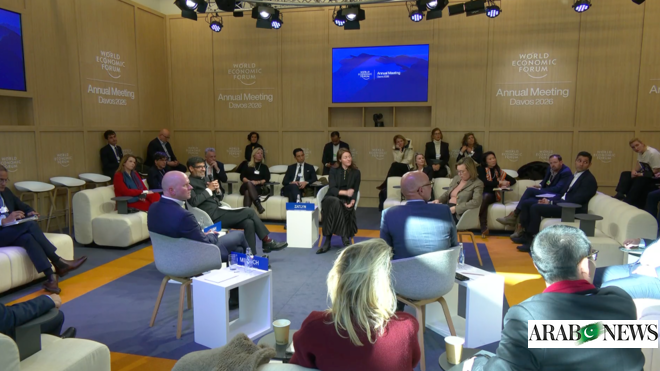
DUBAI: Artificial intelligence is increasingly not only enhancing the sophistication and prevalence of cyberattacks but also bolstering digital defenses, experts stated at the World Economic Forum on Wednesday. The urgency for implementing zero-trust systems and robust AI frameworks to mitigate vulnerabilities was underscored by the panelists.
Cyber threats surged in 2025, breaking records for Distributed Denial of Service attacks 25 times and witnessing a staggering 1,400 percent rise in incidents involving AI-powered bots detaining individuals. While AI has catalyzed new, sophisticated threats—particularly in phishing and impersonation—it has simultaneously led to the development of advanced security solutions.
Michelle Zatlyn, co-founder, president, and COO of Cloudflare, highlighted the modern cybersecurity solutions available to organizations. However, she cautioned against the widening digital divide, where larger financial institutions benefit from robust cybersecurity measures while smaller businesses grapple with outdated security technologies. This disparity, she stated, calls for heightened awareness and the adoption of contemporary security technologies to avert crises, especially during vulnerable periods like weekends.
The panelists emphasized the necessity of international cooperation and intelligence sharing among government agencies, law enforcement, and the private sector to effectively address cross-border threats and cultivate more resilient societies. Catherine de Bolle, executive director at Europol, noted that AI has revolutionized law enforcement, where traditional methods are proving inadequate. She stressed Europol’s ongoing efforts to foster collaboration with the private sector to enhance tools for protecting the digital ecosystem, improving cryptocurrency tracing, and strengthening financial security.
De Bolle remarked that AI has augmented the capabilities and outreach of organized crime syndicates, making it easier for them to operate. “AI facilitates the business model where you only need a computer and some people who are technically schooled,” she explained. She projected that digital fraud will become increasingly streamlined, enabling criminals to generate significant profits without substantial infrastructure. Collaborative efforts with the private sector are essential to maintain a secure ecosystem that fosters user trust in online platforms.
Michael Miebach, CEO of Mastercard, cautioned that while AI can offer defenses against cyberattacks, establishing trust among users remains paramount to maximizing the technology’s potential for driving growth and prosperity. “If we don’t build a trusted layer around these technologies, people will not use it,” he stated, highlighting the broader implications of cyber threats on geopolitical, societal, and corporate landscapes.
Hatem Dowidar, group CEO of e&, called for the deployment of more intelligent networks equipped with AI agents capable of early detection and isolation of malicious activities to safeguard digital ecosystems from disruptive cyberattacks. He warned that as organizations increasingly adopt agentic AI, potential loopholes could expose networks to new threats, necessitating the establishment of zero-trust systems to prevent security breaches.
Dowidar stressed the importance of implementing guardrails to monitor AI agents, noting that their programming can easily fall out of context. “We never could have relied 100 percent on a human agent to work if there is no supervision, and that will hold true for AI,” he emphasized.
Another significant challenge discussed was the blurred lines between state and non-state actors, with state-sponsored organized crime potentially being utilized to conduct cyber operations. De Bolle remarked that this development creates new challenges for traditional law enforcement and necessitates cohesive efforts across intelligence, defense, and law enforcement sectors. “State actors are using criminal groups for their own purposes to launch DDoS attacks,” she stated, warning that such tactics allow states and their affiliated criminals to operate with decreased accountability.
Dowidar highlighted the importance of information sharing at both national and international security levels. He suggested that a national entity should coordinate efforts among police, intelligence, network operators, and critical infrastructure companies. Internationally, he advocated for security centers to swiftly inform like-minded organizations of emerging threats, sharing solutions and requests for assistance.
De Bolle underscored the shared responsibility of the public and private sectors to enhance societal resilience, improve digital literacy, overhaul the education system, and nurture a critical mindset among the younger generation who will navigate these technologies in the future. Zatlyn urged business leaders to grasp the fundamentals of emerging technologies rather than rely solely on technical teams to safeguard their revenue and minimize risk. She concluded by stating that AI agents should be perceived as an “extension” of their teams. “Organizations are concerned that their data will leak with the use of new technologies, but this depends on how to train the agents. These are all stoppable issues,” Zatlyn remarked.
See also Executives Split on AI Trust: 82% Boost Cybersecurity Budgets Amid Job Cuts, U.S. vs. U.K.
 Delhi Police Deploys AI Smart Glasses with Facial Recognition for 2026 Republic Day Security
 Jeffs’ Brands’ KeepZone AI Signs Non-Exclusive Deal with STI for Threat Detection in Canada, Mexico















