The Thurston County Auditor’s Office plans to implement AI-enabled security cameras at its Voter Registration Center in Tumwater after the Board of County Commissioners approved a grant agreement on Tuesday. The vote, which passed with a 3-2 margin, allocates $35,104 for the procurement and installation of AI software on existing security cameras.
The software aims to flag potential threats such as weapons and explosives for election staff, as stated by Auditor Mary Hall. The funding originates from a program administered by the U.S. Department of Justice and will be distributed through the Washington State Department of Commerce.
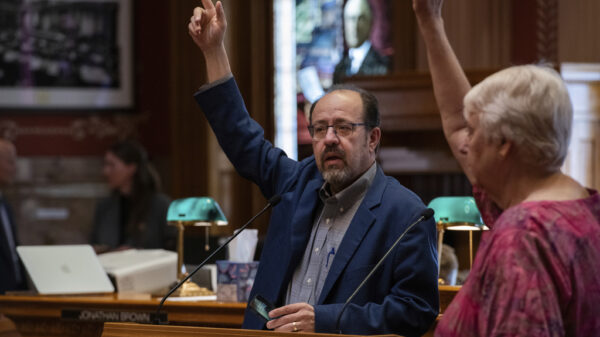
As local and state regulations regarding AI-enabled surveillance technology continue to evolve, the board directed staff to prepare an ordinance to regulate its acquisition and use. Some county commissioners, including Emily Clouse and Rachel Grant, expressed concerns about privacy and the need for additional information before approving the grant. Clouse specifically highlighted the importance of reviewing the vendor agreement associated with the AI software, stating, “I want to be able to answer those questions and with the full understanding of the scope of this technology.”
In contrast, Commissioners Carolina Mejia, Tye Menser, and Wayne Fournier supported the grant, emphasizing that the technology is aimed at strengthening security measures at the election facility without altering election processes. Mejia noted that protecting election facilities from threats is part of safeguarding democracy.
Clouse raised alarms regarding the grant’s federal origins, questioning potential implications given the oversight of the Trump administration. Mejia clarified that the contract does not authorize the Department of Justice or any federal agency to access live camera feeds or other sensitive data, stating, “The federal role here is limited to grant compliance, financial oversight, and standard audit requirements.”
The grant agreement specifies that AI-enabled software will be installed on 14 existing cameras—six positioned outside and eight inside the building. The Auditor’s Office aims to deploy the new technology within the month and conduct testing in the following months. Mejia emphasized that the technology is designed to detect potential threats of violence and clarified that it does not involve facial recognition or surveillance of lawful political activities.
Hall underscored the urgency of addressing bomb threats, which she described as the most significant risk in the election sector. Menser expressed confidence in the technology’s effectiveness, noting that the information collected would not infringe on privacy rights. “I’m very confident that the kind of information being collected here is not that kind,” he said.
In a related matter, the board unanimously approved a memorandum of understanding between the <Thurston County Sheriff’s Office> and the Washington State Patrol focusing on AI-surveillance concerns. While the Sheriff’s Office does not currently employ AI-enabled surveillance, they routinely collaborate with agencies that do.
“For the record, so that no one is misunderstood … we do not have AI-surveillance at the Sheriff’s Office,” said Sheriff Derek Sanders. He confirmed that any future approval for such technology would require board oversight.
Mejia acknowledged concerns over data sharing and federal overreach but reiterated that the grant agreement does not expand federal access to local data. “It governs how the Sheriff’s Office securely receives and safeguards information that already exists within the NCIC and the WACIC systems,” Mejia said, ensuring that stringent rules govern data usage and sharing.
This development marks a significant step in the integration of AI technology within local government operations, highlighting a growing trend as jurisdictions seek to enhance security measures. As discussions around AI surveillance continue, the implications for privacy and civil rights will likely remain at the forefront of public discourse.
See also Nvidia’s Jensen Huang: AI Boom to Create Six-Figure Jobs for Tradespeople
 CUNY SPH Unveils AI, Health, and Digital Spaces Section to Transform Health Communication
 Chris Pratt Stars in ‘Mercy,’ a Dystopian AI Thriller Critiquing Surveillance Justice
 Oracle’s Multicloud AI Strategy Fuels 817% Growth, Enhancing Sustainable Revenue Streams
 Corporate Prediction Markets Surge: $814M Daily Turnover on Meta AI, Amazon Layoffs, and Starbucks Strategies